




\[x-4\] is a equation of a line parallel to:
Answer
 Verified
544.2k+ views
Hint: In this question we have to check that \[x-4\] is a equation of a line parallel to which axis, to find this put \[x-4=0\] and then you can find to which axis given line is parallel and you can also estimate the correct answer by making a graph hence you can obtain the given result.
Complete step-by-step solution:
A line is the locus of two points if every point on the path connecting the two points lies on it. A straight line, often known as a line, is an infinite figure with no breadth and no curve. It can be horizontal, vertical, or slanted. Parallel lines can help us identify missing angles, solve for unknown values, and even learn what they represent in coordinate geometry if we know what they are.
Parallel lines, as we know, are ones that, no matter how far they are extended, never collide. Parallel lines are always drawn on the same plane and are always the same distance apart.
Intersecting lines are lines that meet or appear to meet when stretched, and the place where they meet is known as the point of intersection.
Transversal lines are formed when two parallel lines cross one other. Parallelism does not necessitate that lines be always straight. They must be equidistant along their length to be called parallel. Curved lines can also be parallel if they never cross and stay at the same distance. The wavy lines seen below are equidistant and so parallel.
A horizontal axis is typically referred to as the \[x-axis\] , while a vertical axis is referred to as the \[y-axis\] in a two-dimensional coordinate system.
Now according to the question we have given that \[x-4\] is a equation hence:
\[\Rightarrow x-4=0\]
\[\Rightarrow x=4\]
The line \[x=4\] is having \[x\] coordinate, therefore the point lying on the line will be perpendicular to \[x-axis\]
Therefore the line \[x=4\] is parallel to \[y-axis\] and you can prove this statement with the help of the graph.
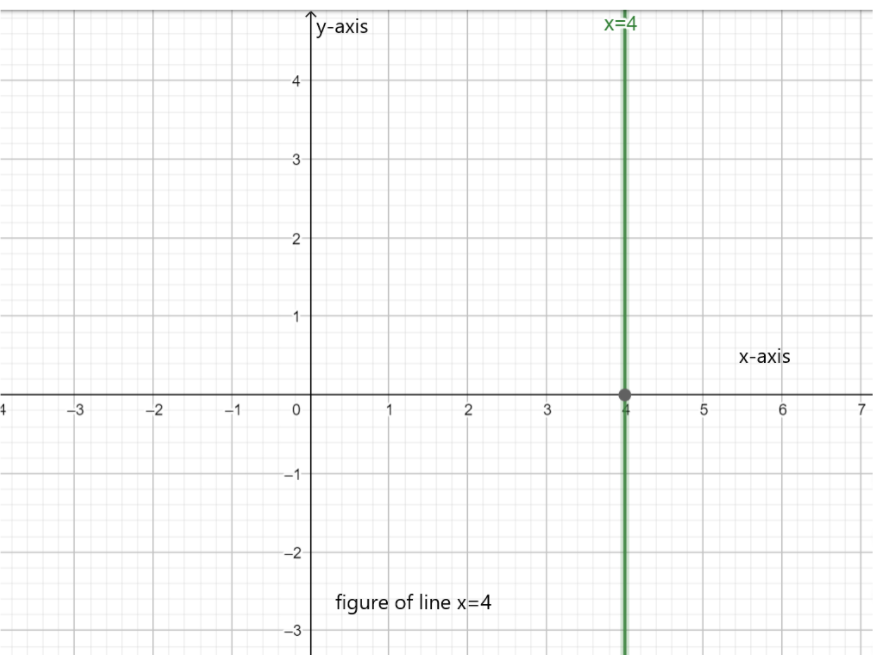
Note: Students note that each line can have an infinite number of parallel lines, and parallel lines can be extended indefinitely. Consider an equals sign or a railway track, opposing walls and doors in a room, or opposite sides of a chalkboard if you wish to recall the symbol of parallel lines.
Complete step-by-step solution:
A line is the locus of two points if every point on the path connecting the two points lies on it. A straight line, often known as a line, is an infinite figure with no breadth and no curve. It can be horizontal, vertical, or slanted. Parallel lines can help us identify missing angles, solve for unknown values, and even learn what they represent in coordinate geometry if we know what they are.
Parallel lines, as we know, are ones that, no matter how far they are extended, never collide. Parallel lines are always drawn on the same plane and are always the same distance apart.
Intersecting lines are lines that meet or appear to meet when stretched, and the place where they meet is known as the point of intersection.
Transversal lines are formed when two parallel lines cross one other. Parallelism does not necessitate that lines be always straight. They must be equidistant along their length to be called parallel. Curved lines can also be parallel if they never cross and stay at the same distance. The wavy lines seen below are equidistant and so parallel.
A horizontal axis is typically referred to as the \[x-axis\] , while a vertical axis is referred to as the \[y-axis\] in a two-dimensional coordinate system.
Now according to the question we have given that \[x-4\] is a equation hence:
\[\Rightarrow x-4=0\]
\[\Rightarrow x=4\]
The line \[x=4\] is having \[x\] coordinate, therefore the point lying on the line will be perpendicular to \[x-axis\]
Therefore the line \[x=4\] is parallel to \[y-axis\] and you can prove this statement with the help of the graph.
Note: Students note that each line can have an infinite number of parallel lines, and parallel lines can be extended indefinitely. Consider an equals sign or a railway track, opposing walls and doors in a room, or opposite sides of a chalkboard if you wish to recall the symbol of parallel lines.
Recently Updated Pages
Master Class 11 English: Engaging Questions & Answers for Success

Master Class 11 Social Science: Engaging Questions & Answers for Success
Master Class 11 Maths: Engaging Questions & Answers for Success
Master Class 11 Biology: Engaging Questions & Answers for Success
Master Class 11 Physics: Engaging Questions & Answers for Success
Master Class 11 Chemistry: Engaging Questions & Answers for Success
Trending doubts
One Metric ton is equal to kg A 10000 B 1000 C 100 class 11 physics CBSE
Difference Between Prokaryotic Cells and Eukaryotic Cells
Find the value of the expression given below sin 30circ class 11 maths CBSE
Difference between physical and chemical change class 11 chemistry CBSE
Two of the body parts which do not appear in MRI are class 11 biology CBSE
Draw a diagram of a plant cell and label at least eight class 11 biology CBSE