




How do you write $y=\left| 6+2x \right|+1$ as a piecewise function?
Answer
 Verified
567.6k+ views
Hint: A piecewise is a function which is defined differently in different intervals within its domain. So we have to write the different definitions of the given function in the different intervals of x, which can be determined by using the definition of the modulus function. The modulus function returns the absolute value of the argument. So we have to consider two cases, one for $6+2x\ge 0$ and the other for $6+2x<0$.
Complete step-by-step solution:
The function given in the above question is
$\Rightarrow y=\left| 6+2x \right|+1......\left( i \right)$
We know that the modulus function returns the absolute value of the argument. Therefore, we can consider the two cases as below.
Case I: When $6+2x\ge 0$
$\Rightarrow 6+2x\ge 0$
Subtracting $6$ from both sides
$\begin{align}
& \Rightarrow 6+2x-6\ge 0-6 \\
& \Rightarrow 2x\ge -6 \\
\end{align}$
Dividing both sides by $2$
$\begin{align}
& \Rightarrow \dfrac{2x}{2}\ge \dfrac{-6}{2} \\
& \Rightarrow x\ge -3 \\
\end{align}$
Since in this case, the argument of the modulus function is non-negative, its absolute value will be equal to the argument. Therefore for $x\ge -3$ we can write
$\Rightarrow \left| 6+2x \right|=6+2x$
Substituting this in the equation (i) we get
$\begin{align}
& \Rightarrow y=6+2x+1 \\
& \Rightarrow y=2x+7 \\
\end{align}$
Case II: When $6+2x\ge 0$
$\Rightarrow 6+2x<0$
Subtracting $6$ from both sides
$\begin{align}
& \Rightarrow 6+2x-6<0-6 \\
& \Rightarrow 2x<-6 \\
\end{align}$
Dividing both sides by $2$
$\begin{align}
& \Rightarrow \dfrac{2x}{2}<\dfrac{-6}{2} \\
& \Rightarrow x<-3 \\
\end{align}$
Since in this case, the argument of the modulus function is non-negative, its absolute value will be equal to the argument. Therefore for $x<-3$ we can write
\[\Rightarrow \left| 6+2x \right|=-\left( 6+2x \right)\]
Substituting this in the equation (i) we get
\[\begin{align}
& \Rightarrow y=-\left( 6+2x \right)+1 \\
& \Rightarrow y=-6-2x+1 \\
& \Rightarrow y=-2x-5 \\
\end{align}\]
From the above two cases, we can write the given function in the piecewise form as
\[\Rightarrow y=\left\{ \begin{align}
& 2x+7;x\ge -3 \\
& -2x-5;x<-3 \\
\end{align} \right\}\]
We can see these two pieces of the given function in the below graph.
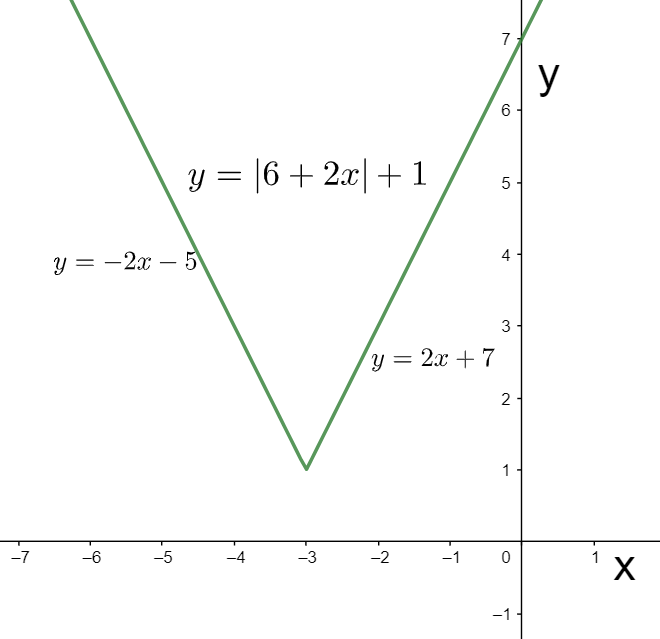
Hence, we have written the given function in the piecewise form.
Note: Whenever a function is defined in terms of modulus, greatest integer, fractional part etc. it is written in the piecewise form, since these have different definitions for the different intervals. We can put the equality sign on both of the inequalities for two intervals also.
Complete step-by-step solution:
The function given in the above question is
$\Rightarrow y=\left| 6+2x \right|+1......\left( i \right)$
We know that the modulus function returns the absolute value of the argument. Therefore, we can consider the two cases as below.
Case I: When $6+2x\ge 0$
$\Rightarrow 6+2x\ge 0$
Subtracting $6$ from both sides
$\begin{align}
& \Rightarrow 6+2x-6\ge 0-6 \\
& \Rightarrow 2x\ge -6 \\
\end{align}$
Dividing both sides by $2$
$\begin{align}
& \Rightarrow \dfrac{2x}{2}\ge \dfrac{-6}{2} \\
& \Rightarrow x\ge -3 \\
\end{align}$
Since in this case, the argument of the modulus function is non-negative, its absolute value will be equal to the argument. Therefore for $x\ge -3$ we can write
$\Rightarrow \left| 6+2x \right|=6+2x$
Substituting this in the equation (i) we get
$\begin{align}
& \Rightarrow y=6+2x+1 \\
& \Rightarrow y=2x+7 \\
\end{align}$
Case II: When $6+2x\ge 0$
$\Rightarrow 6+2x<0$
Subtracting $6$ from both sides
$\begin{align}
& \Rightarrow 6+2x-6<0-6 \\
& \Rightarrow 2x<-6 \\
\end{align}$
Dividing both sides by $2$
$\begin{align}
& \Rightarrow \dfrac{2x}{2}<\dfrac{-6}{2} \\
& \Rightarrow x<-3 \\
\end{align}$
Since in this case, the argument of the modulus function is non-negative, its absolute value will be equal to the argument. Therefore for $x<-3$ we can write
\[\Rightarrow \left| 6+2x \right|=-\left( 6+2x \right)\]
Substituting this in the equation (i) we get
\[\begin{align}
& \Rightarrow y=-\left( 6+2x \right)+1 \\
& \Rightarrow y=-6-2x+1 \\
& \Rightarrow y=-2x-5 \\
\end{align}\]
From the above two cases, we can write the given function in the piecewise form as
\[\Rightarrow y=\left\{ \begin{align}
& 2x+7;x\ge -3 \\
& -2x-5;x<-3 \\
\end{align} \right\}\]
We can see these two pieces of the given function in the below graph.
Hence, we have written the given function in the piecewise form.
Note: Whenever a function is defined in terms of modulus, greatest integer, fractional part etc. it is written in the piecewise form, since these have different definitions for the different intervals. We can put the equality sign on both of the inequalities for two intervals also.
Recently Updated Pages
Master Class 12 Economics: Engaging Questions & Answers for Success

Master Class 12 English: Engaging Questions & Answers for Success
Master Class 12 Social Science: Engaging Questions & Answers for Success
Master Class 12 Maths: Engaging Questions & Answers for Success
Master Class 12 Physics: Engaging Questions & Answers for Success
Master Class 9 General Knowledge: Engaging Questions & Answers for Success
Trending doubts
One Metric ton is equal to kg A 10000 B 1000 C 100 class 11 physics CBSE
Difference Between Prokaryotic Cells and Eukaryotic Cells
Two of the body parts which do not appear in MRI are class 11 biology CBSE
1 ton equals to A 100 kg B 1000 kg C 10 kg D 10000 class 11 physics CBSE
Draw a diagram of nephron and explain its structur class 11 biology CBSE
10 examples of friction in our daily life