




Write two-two points of your choice which lie on X-axis and Y-axis.
Answer
 Verified
565.8k+ views
Hint: For any point on X-axis, ordinate must be 0, and so the coordinates should be of the form (a,0). For any point on Y-axis, abscissa must be 0, and so the coordinates should be of the form (0,b). Hence, we can take any value for a and b to get the required points. Next, we can plot these points on the Cartesian coordinate.
Complete step by step solution:
We know that in a Cartesian coordinate system, two fixed lines are perpendicular to each other. This system can uniquely identify each point on the plane by a set of two coordinates, which are the distances of the point from the two fixed lines. We define the horizontal fixed line as the X-axis, and the vertical fixed line as the Y-axis.
We are well aware the any point P, on this Cartesian plane, will be of the form P (a,b). Here, we call a as the abscissa of point P, that represents the distance of point P from Y-axis. And, we call b as the ordinate of point P, that represents the distance of point P from X-axis.
We can very easily say that for any point on X-axis, the ordinate must be 0. Thus, we can say that any point of the form (a,0) will lie on the X-axis.
So, (1,0) and (-1,0) are two points on the X-axis. We can plot these points on the X-axis, as shown in red colour on the graph.
Similarly, we can say that for any point on Y-axis, the abscissa must be 0. Thus, we can say that any point of the form (0,b) will lie on the Y-axis.
So, (0,1) and (0,-1) are two points on the Y-axis. We can plot these points on the Y-axis, as shown in blue colour on the graph.
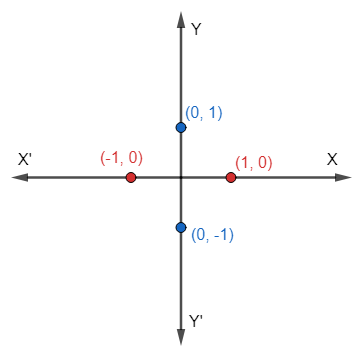
Hence, we can clearly see that, (1,0) and (-1,0) are two points on the X-axis, and (0,1) and (0,-1) are two points on the Y-axis as shown in the figure.
Note: We must take care that in a system of coordinates, the first term is abscissa and the second term is ordinary. Points with the coordinates of the form (a,0) lie on the X-axis, and the points with coordinates of the form (0,b) lie on the Y-axis. We must understand that is just a possible solution, and that this problem can have infinitely different solutions.
Complete step by step solution:
We know that in a Cartesian coordinate system, two fixed lines are perpendicular to each other. This system can uniquely identify each point on the plane by a set of two coordinates, which are the distances of the point from the two fixed lines. We define the horizontal fixed line as the X-axis, and the vertical fixed line as the Y-axis.
We are well aware the any point P, on this Cartesian plane, will be of the form P (a,b). Here, we call a as the abscissa of point P, that represents the distance of point P from Y-axis. And, we call b as the ordinate of point P, that represents the distance of point P from X-axis.
We can very easily say that for any point on X-axis, the ordinate must be 0. Thus, we can say that any point of the form (a,0) will lie on the X-axis.
So, (1,0) and (-1,0) are two points on the X-axis. We can plot these points on the X-axis, as shown in red colour on the graph.
Similarly, we can say that for any point on Y-axis, the abscissa must be 0. Thus, we can say that any point of the form (0,b) will lie on the Y-axis.
So, (0,1) and (0,-1) are two points on the Y-axis. We can plot these points on the Y-axis, as shown in blue colour on the graph.
Hence, we can clearly see that, (1,0) and (-1,0) are two points on the X-axis, and (0,1) and (0,-1) are two points on the Y-axis as shown in the figure.
Note: We must take care that in a system of coordinates, the first term is abscissa and the second term is ordinary. Points with the coordinates of the form (a,0) lie on the X-axis, and the points with coordinates of the form (0,b) lie on the Y-axis. We must understand that is just a possible solution, and that this problem can have infinitely different solutions.
Recently Updated Pages
Master Class 12 Economics: Engaging Questions & Answers for Success

Master Class 12 English: Engaging Questions & Answers for Success
Master Class 12 Social Science: Engaging Questions & Answers for Success
Master Class 12 Maths: Engaging Questions & Answers for Success
Master Class 12 Physics: Engaging Questions & Answers for Success
Master Class 9 General Knowledge: Engaging Questions & Answers for Success
Trending doubts
Explain the Treaty of Vienna of 1815 class 10 social science CBSE
Who Won 36 Oscar Awards? Record Holder Revealed
Why is it 530 pm in india when it is 1200 afternoon class 10 social science CBSE
Make a sketch of the human nerve cell What function class 10 biology CBSE
What is the full form of POSCO class 10 social science CBSE
Define Potential, Developed, Stock and Reserved resources