



Write the full form of SONAR. How do you determine the depth of the sea using echo ranging?
Answer
 Verified
602.7k+ views
Hint: We need to understand what SONAR stands for and the usage of certain technology in finding distances between two hindrances or the depth of the deep seas as demanded in the problem to find the solution for this question easily.
Complete step-by-step solution:
SONAR is a technology which uses the high frequency and high energy sound waves in detection of distances in the ocean or to find the sunk ships or other lost objects. The full form of SONAR is SOund Navigation and Ranging. It is analogous to the RADAR technology which we use on land to detect objects by calculating the time taken for a radio wave to strike an object and return back.
The SONARs also use the same technique. A sound wave of a fixed frequency is sent to the deep seas. We know the speed of the sound waves in salty water. So, using this information and the time taken for the sound wave to return to the source can be used to calculate the distance of the source to the bottom where the sound waves reflected from. The SONAR technique is used instead of RADAR (radio navigation and ranging) as sound travels faster in water than in air, so we can easily identify any change in the medium of travelling which is difficult to distinguish using the radio waves.
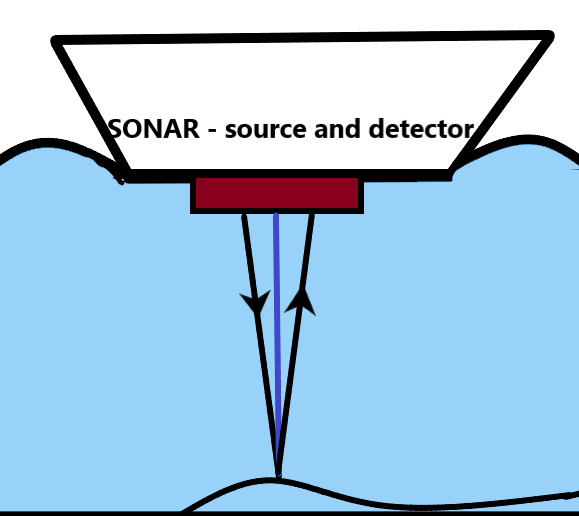
The SONAR has sound amplitudes of 140dB, so that it doesn’t vanish too soon without returning.
This process is called echo-ranging.
This is the required solution.
Note: The echo ranging is named so because echoing is the process in which the sound waves on hitting a surface or a hindrance is reflected back to reach the source, which is exactly happening in the echo ranging process using the SONAR technology.
Complete step-by-step solution:
SONAR is a technology which uses the high frequency and high energy sound waves in detection of distances in the ocean or to find the sunk ships or other lost objects. The full form of SONAR is SOund Navigation and Ranging. It is analogous to the RADAR technology which we use on land to detect objects by calculating the time taken for a radio wave to strike an object and return back.
The SONARs also use the same technique. A sound wave of a fixed frequency is sent to the deep seas. We know the speed of the sound waves in salty water. So, using this information and the time taken for the sound wave to return to the source can be used to calculate the distance of the source to the bottom where the sound waves reflected from. The SONAR technique is used instead of RADAR (radio navigation and ranging) as sound travels faster in water than in air, so we can easily identify any change in the medium of travelling which is difficult to distinguish using the radio waves.
The SONAR has sound amplitudes of 140dB, so that it doesn’t vanish too soon without returning.
This process is called echo-ranging.
This is the required solution.
Note: The echo ranging is named so because echoing is the process in which the sound waves on hitting a surface or a hindrance is reflected back to reach the source, which is exactly happening in the echo ranging process using the SONAR technology.
Recently Updated Pages
Master Class 11 English: Engaging Questions & Answers for Success

Master Class 11 Social Science: Engaging Questions & Answers for Success
Master Class 11 Maths: Engaging Questions & Answers for Success
Master Class 11 Biology: Engaging Questions & Answers for Success
Master Class 11 Physics: Engaging Questions & Answers for Success
Master Class 11 Chemistry: Engaging Questions & Answers for Success
Trending doubts