




Write the formula for calculating wattless current.
Answer
 Verified
563.7k+ views
Hint: In order to answer the above question, we will refresh our knowledge about a simple LCR circuit which is the most basic circuit. We will be deriving the equation to find out the power consumed by such a circuit. Then we will derive the equation for wattless current.
Complete step by step solution:
First of all we will have a look at an LCR circuit:
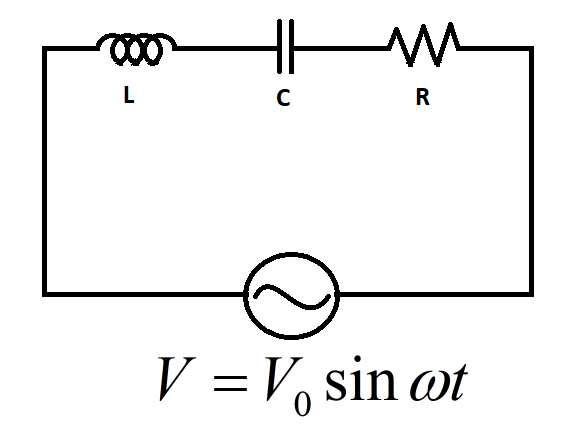
As we can see from the above figure, we have an LCR circuit which comprises an inductor $(L)$, a capacitor $(C)$and a resistor $(R)$. The voltage applied to it is an AC voltage $V={{V}_{0}}\sin \omega t$. The current flowing through this circuit can be given by $I={{I}_{0}}\sin (\omega t+\Phi )$, where $\sin \omega t$is the sinusoidal term and $\Phi $ is the phase difference between current and voltage.
To understand the phase difference properly, we will draw a phase diagram
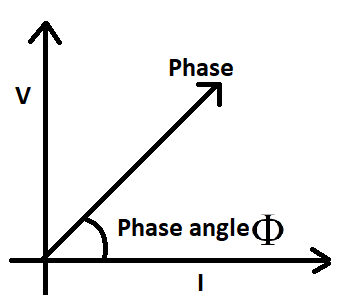
Now, the work done by the AC source during time interval of $t$ and $t+dt$ is given by
$\begin{align}
& dW=VIdt \\
& \Rightarrow dW={{V}_{0}}\sin \omega t\cdot {{I}_{0}}\sin (\omega t+\Phi )\cdot dt \\
& \Rightarrow dW={{V}_{0}}{{I}_{0}}[\sin \omega t(\sin \omega t\cos \Phi +\cos \omega t\sin \Phi )]dt \\
& \Rightarrow dW={{V}_{0}}{{I}_{0}}({{\sin }^{2}}\omega t\cos \Phi +\sin \omega t\cos \omega t\sin \Phi )dt \\
\end{align}$
The total work done in one complete cycle is given by taking integral of the above equation over $[0,T]$
$\Rightarrow W={{V}_{0}}{{I}_{0}}\cos \Phi \int\limits_{0}^{T}{{{\sin }^{2}}\omega t\cdot dt+}{{V}_{0}}{{I}_{0}}\sin \Phi \int\limits_{0}^{T}{\sin \omega t\cos \omega t\cdot dt}$
$\Rightarrow W=\dfrac{1}{2}{{V}_{0}}{{I}_{0}}\cos \Phi \int\limits_{0}^{T}{(1-\cos 2\omega t)\cdot dt+\dfrac{1}{2}}{{V}_{0}}{{I}_{0}}\sin \Phi \int\limits_{0}^{T}{\sin 2\omega t\cdot dt}$
$\Rightarrow W=\dfrac{1}{2}{{V}_{0}}{{I}_{0}}T\cos \Phi $
Now, to calculate the average power delivered by the source, we divide the above equation by time period $T$
$\begin{align}
& P=\dfrac{W}{T} \\
& \Rightarrow P=\dfrac{1}{2}\dfrac{{{V}_{0}}{{I}_{0}}T\cos \Phi }{T} \\
& \Rightarrow P=\dfrac{1}{2}{{V}_{0}}{{I}_{0}}\cos \Phi \\
\end{align}$
Simplifying a little
\[\Rightarrow P=\dfrac{{{V}_{0}}}{\sqrt{2}}\dfrac{{{I}_{0}}}{\sqrt{2}}\cos \Phi \]
Now, we know that $\dfrac{{{V}_{0}}}{\sqrt{2}}={{V}_{rms}}$ and $\dfrac{{{I}_{0}}}{\sqrt{2}}={{I}_{rms}}$ represent the $rms$ values for voltage and current. Therefore,
\[\Rightarrow P={{V}_{rms}}{{I}_{rms}}\cos \Phi \]
The above formula is the formula for power dissipated in an AC circuit.
Now, we want to find the formula for wattless current. When the power dissipated or consumed is zero, the current is said to be wattless current or an idle current.
From the above derived formula of power, we can say that the power can only be zero if the value of $\cos \Phi $ is zero or $\Phi =\pm \dfrac{\pi }{2}$. This implies that the phase difference between the current and voltage should be $\dfrac{\pi }{2}$.
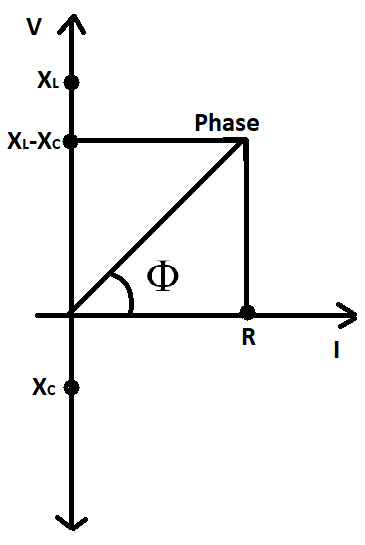
Now as we know that the current in the circuit is given by $I={{I}_{0}}\sin (\omega t+\Phi )$, but for wattless current, the current will be given by
$I={{I}_{0}}\sin \left( \omega t\pm \dfrac{\pi }{2} \right)$
Note:
It is very important to note that the power consumed can be made zero only when a resistance is connected with either a capacitor or an inductor and not with both of them together. The phase angle will become $+\dfrac{\pi }{2}$when only an inductor is connected with a resistor. Whereas, the angle becomes $-\dfrac{\pi }{2}$when only a capacitor is connected with a resistor in a circuit.
Complete step by step solution:
First of all we will have a look at an LCR circuit:
As we can see from the above figure, we have an LCR circuit which comprises an inductor $(L)$, a capacitor $(C)$and a resistor $(R)$. The voltage applied to it is an AC voltage $V={{V}_{0}}\sin \omega t$. The current flowing through this circuit can be given by $I={{I}_{0}}\sin (\omega t+\Phi )$, where $\sin \omega t$is the sinusoidal term and $\Phi $ is the phase difference between current and voltage.
To understand the phase difference properly, we will draw a phase diagram
Now, the work done by the AC source during time interval of $t$ and $t+dt$ is given by
$\begin{align}
& dW=VIdt \\
& \Rightarrow dW={{V}_{0}}\sin \omega t\cdot {{I}_{0}}\sin (\omega t+\Phi )\cdot dt \\
& \Rightarrow dW={{V}_{0}}{{I}_{0}}[\sin \omega t(\sin \omega t\cos \Phi +\cos \omega t\sin \Phi )]dt \\
& \Rightarrow dW={{V}_{0}}{{I}_{0}}({{\sin }^{2}}\omega t\cos \Phi +\sin \omega t\cos \omega t\sin \Phi )dt \\
\end{align}$
The total work done in one complete cycle is given by taking integral of the above equation over $[0,T]$
$\Rightarrow W={{V}_{0}}{{I}_{0}}\cos \Phi \int\limits_{0}^{T}{{{\sin }^{2}}\omega t\cdot dt+}{{V}_{0}}{{I}_{0}}\sin \Phi \int\limits_{0}^{T}{\sin \omega t\cos \omega t\cdot dt}$
$\Rightarrow W=\dfrac{1}{2}{{V}_{0}}{{I}_{0}}\cos \Phi \int\limits_{0}^{T}{(1-\cos 2\omega t)\cdot dt+\dfrac{1}{2}}{{V}_{0}}{{I}_{0}}\sin \Phi \int\limits_{0}^{T}{\sin 2\omega t\cdot dt}$
$\Rightarrow W=\dfrac{1}{2}{{V}_{0}}{{I}_{0}}T\cos \Phi $
Now, to calculate the average power delivered by the source, we divide the above equation by time period $T$
$\begin{align}
& P=\dfrac{W}{T} \\
& \Rightarrow P=\dfrac{1}{2}\dfrac{{{V}_{0}}{{I}_{0}}T\cos \Phi }{T} \\
& \Rightarrow P=\dfrac{1}{2}{{V}_{0}}{{I}_{0}}\cos \Phi \\
\end{align}$
Simplifying a little
\[\Rightarrow P=\dfrac{{{V}_{0}}}{\sqrt{2}}\dfrac{{{I}_{0}}}{\sqrt{2}}\cos \Phi \]
Now, we know that $\dfrac{{{V}_{0}}}{\sqrt{2}}={{V}_{rms}}$ and $\dfrac{{{I}_{0}}}{\sqrt{2}}={{I}_{rms}}$ represent the $rms$ values for voltage and current. Therefore,
\[\Rightarrow P={{V}_{rms}}{{I}_{rms}}\cos \Phi \]
The above formula is the formula for power dissipated in an AC circuit.
Now, we want to find the formula for wattless current. When the power dissipated or consumed is zero, the current is said to be wattless current or an idle current.
From the above derived formula of power, we can say that the power can only be zero if the value of $\cos \Phi $ is zero or $\Phi =\pm \dfrac{\pi }{2}$. This implies that the phase difference between the current and voltage should be $\dfrac{\pi }{2}$.
Now as we know that the current in the circuit is given by $I={{I}_{0}}\sin (\omega t+\Phi )$, but for wattless current, the current will be given by
$I={{I}_{0}}\sin \left( \omega t\pm \dfrac{\pi }{2} \right)$
Note:
It is very important to note that the power consumed can be made zero only when a resistance is connected with either a capacitor or an inductor and not with both of them together. The phase angle will become $+\dfrac{\pi }{2}$when only an inductor is connected with a resistor. Whereas, the angle becomes $-\dfrac{\pi }{2}$when only a capacitor is connected with a resistor in a circuit.
Recently Updated Pages
Master Class 12 Business Studies: Engaging Questions & Answers for Success

Master Class 12 Chemistry: Engaging Questions & Answers for Success
Master Class 12 Biology: Engaging Questions & Answers for Success
Class 12 Question and Answer - Your Ultimate Solutions Guide
Master Class 11 English: Engaging Questions & Answers for Success
Master Class 11 Social Science: Engaging Questions & Answers for Success
Trending doubts
Which are the Top 10 Largest Countries of the World?
Draw a labelled sketch of the human eye class 12 physics CBSE
The end of compass needle which points towards north class 12 physics CBSE
Differentiate between homogeneous and heterogeneous class 12 chemistry CBSE
Why is the cell called the structural and functional class 12 biology CBSE
When was the first election held in India a 194748 class 12 sst CBSE