




Write the formula and draw the electron dot structure of Carbon tetrachloride.
Answer
 Verified
549k+ views
Hint: Electron Dot structures also known as the Lewis electron Dot structures, are diagrams that depict the bonding between different atoms and also show their valence electrons and lone pairs, if any exists. It mostly has two types of dots $ \times \& \circ $ that represent electrons from two different atoms.
Complete Step By Step Answer:
The chemical formula of Carbon Tetrachloride is $ CC{l_4} $ . In this the central atom is carbon, which is attached to four chlorine atoms. Carbon belongs to the group 14 of the periodic table and has four valence electrons in the outermost shell. Chlorine belongs to the Halides Family of the Group 17 of the periodic table, and has seven valence electrons in the outermost shell. Chlorine gains one of the four electrons of carbon and attains the eight electron stability. Carbon shares it’s four electrons with four chlorine atoms as it is difficult to lose/gain 4 electrons energy wise. Hence Group 14 elements attain stability by sharing electrons.
The Lewis dot structure deals with only the valence electrons of an element, and shows the bonding precisely. The outermost electron count can be easily figured out.
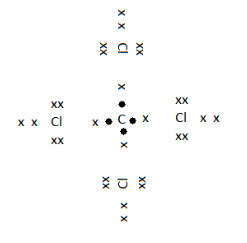
In the given image the electrons represented by $ \bullet $ are the valence electrons of Carbon and that represented by $ \times $ are the valence electrons of Chlorine. As we can see that by sharing its four valence electrons with 4 chlorines, carbon has gained an overall electron count of 8 electrons, making it stable. And that of Chlorine, it has gained one electron, making its count 8.
Note:
The main disadvantage of this structure is that it doesn’t explain the geometry of the molecule. It violates the octet rule in which the central atom has more than eight electrons. It doesn’t give information about the energy of the covalent bond formed.
Complete Step By Step Answer:
The chemical formula of Carbon Tetrachloride is $ CC{l_4} $ . In this the central atom is carbon, which is attached to four chlorine atoms. Carbon belongs to the group 14 of the periodic table and has four valence electrons in the outermost shell. Chlorine belongs to the Halides Family of the Group 17 of the periodic table, and has seven valence electrons in the outermost shell. Chlorine gains one of the four electrons of carbon and attains the eight electron stability. Carbon shares it’s four electrons with four chlorine atoms as it is difficult to lose/gain 4 electrons energy wise. Hence Group 14 elements attain stability by sharing electrons.
The Lewis dot structure deals with only the valence electrons of an element, and shows the bonding precisely. The outermost electron count can be easily figured out.
In the given image the electrons represented by $ \bullet $ are the valence electrons of Carbon and that represented by $ \times $ are the valence electrons of Chlorine. As we can see that by sharing its four valence electrons with 4 chlorines, carbon has gained an overall electron count of 8 electrons, making it stable. And that of Chlorine, it has gained one electron, making its count 8.
Note:
The main disadvantage of this structure is that it doesn’t explain the geometry of the molecule. It violates the octet rule in which the central atom has more than eight electrons. It doesn’t give information about the energy of the covalent bond formed.
Recently Updated Pages
If x a + bt + ct2 where x is in meters and t is in class 11 physics CBSE

A car covers the first half distance between two places class 11 physics CBSE
The resultant of two vectors overrightarrow P and overrightarrow class 11 physics CBSE
Find the value of cos 135 class 11 maths CBSE
A mass M is held in place by an applied force F and class 11 physics CBSE
A solution of glucose in water is labelled as 10 dfracwv class 11 chemistry CBSE
Trending doubts
Find the value of the expression given below sin 30circ class 11 maths CBSE
One Metric ton is equal to kg A 10000 B 1000 C 100 class 11 physics CBSE
Draw a diagram of nephron and explain its structur class 11 biology CBSE
10 examples of friction in our daily life
Proton was discovered by A Thomson B Rutherford C Chadwick class 11 chemistry CBSE
Bond order ofO2 O2+ O2 and O22 is in order A O2 langle class 11 chemistry CBSE