




How do you write the electron dot diagram of the hydronium ion ${{H}_{3}}{{O}^{+}}$ ?
Answer
 Verified
573k+ views
Hint: Electron dot diagrams are called Lewis dot structures. In this representation, electrons are represented using dots. Bonding in a molecule is presented using the atoms along with their bond pairs and lone pairs.
Complete step by step solution:
Hydronium ion is the common aqueous ion. It is produced by protonation of water molecules. Formation of hydronium ions can be explained using the following electron dot diagram.
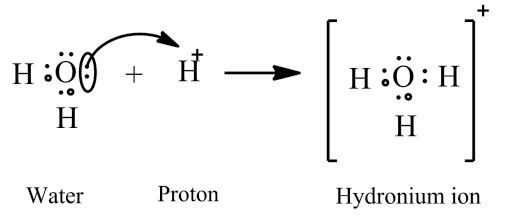
The central atom in water is oxygen. It contains a total six valence electrons. Two of these electrons form bonds with two hydrogen atoms. There are two lone pairs left on the oxygen atom. A proton is a hydrogen cation which does not have any electrons. When a proton approaches the water molecule, the oxygen donates one lone pair towards this proton and forms hydronium ion as shown below, since both electrons in the formation of hydronium ions are from the oxygen, the bond formed is a coordination bond. The structure of hydronium ion is shown below;
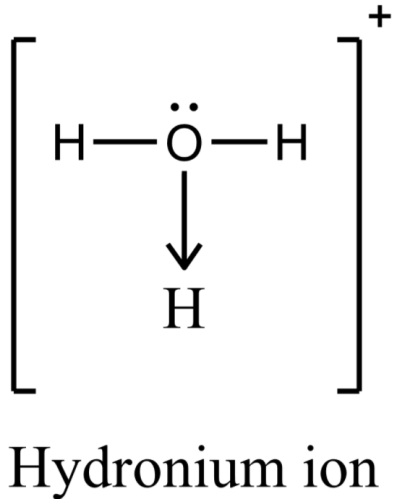
Hence the type of bonding present in hydronium ion is coordination bond. Structure of hydronium ion is trigonal pyramidal with oxygen in $s{{p}^{3}}$ hybridization. The\[~H-O-H\] bond angle is $s{{p}^{3}}$. The one lone pair occupy above the oxygen atom.
Note: Formula for hydronium ions is ${{H}_{3}}{{O}^{+}}$ According to IUPAC nomenclature hydronium ion is called oxonium ion. Hydronium ions are highly reactive and exist as solvated in water. It exists as a tri-hydrated hydronium ion. Structure of hydronium ion is trigonal pyramidal with oxygen. It exists as a tri-hydrated hydronium ion with chemical formula is \[{{H}_{3}}{{O}^{+}}\cdot 3{{H}_{2}}O\]
Complete step by step solution:
Hydronium ion is the common aqueous ion. It is produced by protonation of water molecules. Formation of hydronium ions can be explained using the following electron dot diagram.
The central atom in water is oxygen. It contains a total six valence electrons. Two of these electrons form bonds with two hydrogen atoms. There are two lone pairs left on the oxygen atom. A proton is a hydrogen cation which does not have any electrons. When a proton approaches the water molecule, the oxygen donates one lone pair towards this proton and forms hydronium ion as shown below, since both electrons in the formation of hydronium ions are from the oxygen, the bond formed is a coordination bond. The structure of hydronium ion is shown below;
Hence the type of bonding present in hydronium ion is coordination bond. Structure of hydronium ion is trigonal pyramidal with oxygen in $s{{p}^{3}}$ hybridization. The\[~H-O-H\] bond angle is $s{{p}^{3}}$. The one lone pair occupy above the oxygen atom.
Note: Formula for hydronium ions is ${{H}_{3}}{{O}^{+}}$ According to IUPAC nomenclature hydronium ion is called oxonium ion. Hydronium ions are highly reactive and exist as solvated in water. It exists as a tri-hydrated hydronium ion. Structure of hydronium ion is trigonal pyramidal with oxygen. It exists as a tri-hydrated hydronium ion with chemical formula is \[{{H}_{3}}{{O}^{+}}\cdot 3{{H}_{2}}O\]
Recently Updated Pages
Master Class 11 English: Engaging Questions & Answers for Success

Master Class 11 Social Science: Engaging Questions & Answers for Success
Master Class 11 Maths: Engaging Questions & Answers for Success
Master Class 11 Biology: Engaging Questions & Answers for Success
Master Class 11 Physics: Engaging Questions & Answers for Success
Master Class 11 Chemistry: Engaging Questions & Answers for Success
Trending doubts
One Metric ton is equal to kg A 10000 B 1000 C 100 class 11 physics CBSE
Difference Between Prokaryotic Cells and Eukaryotic Cells
1 ton equals to A 100 kg B 1000 kg C 10 kg D 10000 class 11 physics CBSE
Find the value of the expression given below sin 30circ class 11 maths CBSE
Two of the body parts which do not appear in MRI are class 11 biology CBSE
Draw a diagram of a plant cell and label at least eight class 11 biology CBSE