



Write the distance of the point P (3, 4, 5) from z-axis______
Answer
 Verified
593.1k+ views
Hint: We know that distance between points \[P({x_1},{y_1},{z_1})\] and \[Q({x_2},{y_2},{z_2})\] is given by \[PQ = \sqrt {{{({x_1} - {x_2})}^2} + {{({y_1} - {y_2})}^2} + {{({z_1} - {z_2})}^2}} \] . We also know that any point on the Z-axis has a coordinate \[(0,0,z)\] . That is X and Y coordinates are zero. We find the value of \[z\] and then we can find the distance between P and point on a Z-axis.
Complete step-by-step answer:
Let Q be any point on the Z-axis then its coordinates are \[Q(0,0,z)\] and \[P(3,4,5)\] .
Look at the below diagram, so that we can understand better.
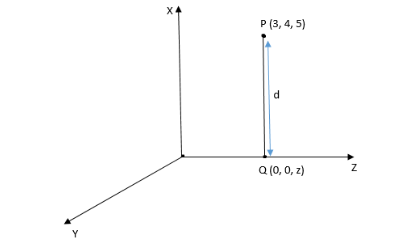
We need to find the distance between PQ, before that we need the value of the coordinate of Q. That is \[z\] .
Now the direction ratio of PQ is proportional to \[ \Rightarrow (3 - 0,{\text{ 4 - 0, 5 - z) = (3,4,5 - z)}}\] .
We can see from the figure that PQ is perpendicular to the Z-axis then,
(We know that, if two lines are perpendicular then their product of sum of direction ratios are equal to zero.)
\[ \Rightarrow (3 \times 0) + (4 \times 0) + (1 \times {\text{5 - z}}) = 0\]
\[ \Rightarrow 0 + 0 + 5 - z = 0\]
\[ \Rightarrow 5 - z = 0\]
\[ \Rightarrow z = 5\]
Hence the coordinates of the point \[Q(0,0,5)\] .
Now to find the distance between PQ, \[P(3,4,5)\] and \[Q(0,0,5)\]
Using the distance formula, that is \[PQ = \sqrt {{{({x_1} - {x_2})}^2} + {{({y_1} - {y_2})}^2} + {{({z_1} - {z_2})}^2}} \]
\[ \Rightarrow PQ = \sqrt {{{(3 - 0)}^2} + {{(4 - 0)}^2} + {{(5 - 5)}^2}} \]
\[ \Rightarrow PQ = \sqrt {9 + 16 + 0} \]
\[ \Rightarrow PQ = \sqrt {25} \]
\[ \Rightarrow PQ = 5\]
Hence, the distance of the point P (3, 4, 5) from the z-axis is $5$ units.
So, the correct answer is “5 units”.
Note: If the problem is based on the Conic section or three dimensional geometry always express the given problem into the diagram so that we will have a better understanding of the problem. In the above problem we notice that the line PQ is perpendicular to the Z-axis by looking into the diagram. After that all we did is a simple calculation.
Complete step-by-step answer:
Let Q be any point on the Z-axis then its coordinates are \[Q(0,0,z)\] and \[P(3,4,5)\] .
Look at the below diagram, so that we can understand better.
We need to find the distance between PQ, before that we need the value of the coordinate of Q. That is \[z\] .
Now the direction ratio of PQ is proportional to \[ \Rightarrow (3 - 0,{\text{ 4 - 0, 5 - z) = (3,4,5 - z)}}\] .
We can see from the figure that PQ is perpendicular to the Z-axis then,
(We know that, if two lines are perpendicular then their product of sum of direction ratios are equal to zero.)
\[ \Rightarrow (3 \times 0) + (4 \times 0) + (1 \times {\text{5 - z}}) = 0\]
\[ \Rightarrow 0 + 0 + 5 - z = 0\]
\[ \Rightarrow 5 - z = 0\]
\[ \Rightarrow z = 5\]
Hence the coordinates of the point \[Q(0,0,5)\] .
Now to find the distance between PQ, \[P(3,4,5)\] and \[Q(0,0,5)\]
Using the distance formula, that is \[PQ = \sqrt {{{({x_1} - {x_2})}^2} + {{({y_1} - {y_2})}^2} + {{({z_1} - {z_2})}^2}} \]
\[ \Rightarrow PQ = \sqrt {{{(3 - 0)}^2} + {{(4 - 0)}^2} + {{(5 - 5)}^2}} \]
\[ \Rightarrow PQ = \sqrt {9 + 16 + 0} \]
\[ \Rightarrow PQ = \sqrt {25} \]
\[ \Rightarrow PQ = 5\]
Hence, the distance of the point P (3, 4, 5) from the z-axis is $5$ units.
So, the correct answer is “5 units”.
Note: If the problem is based on the Conic section or three dimensional geometry always express the given problem into the diagram so that we will have a better understanding of the problem. In the above problem we notice that the line PQ is perpendicular to the Z-axis by looking into the diagram. After that all we did is a simple calculation.
Recently Updated Pages
Master Class 11 Social Science: Engaging Questions & Answers for Success

Master Class 11 English: Engaging Questions & Answers for Success
Master Class 11 Maths: Engaging Questions & Answers for Success
Master Class 11 Chemistry: Engaging Questions & Answers for Success
Master Class 11 Biology: Engaging Questions & Answers for Success
Master Class 11 Physics: Engaging Questions & Answers for Success
Trending doubts
Differentiate between an exothermic and an endothermic class 11 chemistry CBSE
One Metric ton is equal to kg A 10000 B 1000 C 100 class 11 physics CBSE
Difference Between Prokaryotic Cells and Eukaryotic Cells
There are 720 permutations of the digits 1 2 3 4 5 class 11 maths CBSE
Two of the body parts which do not appear in MRI are class 11 biology CBSE
Which gas is abundant in air class 11 chemistry CBSE