




Write the different reactions taking place in the blast furnace during the extraction of iron from its ore.
Answer
 Verified
593.7k+ views
Hint:A blast furnace is a huge steel container lined with refractory bricks on the inner side. A blast of hot air at very high temperature is blown from the bottom and the materials to be heated are added from the top.
Complete step by step answer:1) The temperature in the blast furnace varies from $1500{\text{K}}$ at the bottom to $500{\text{K}}$ in the upper part. We get iron oxide in the form of iron ore from mining. It has impurities and needs to be converted to iron metal for useful purposes. This is done in a blast furnace and the reactions taking place can be written as shown below.
2) The reactions taking place in the upper part of the blast furnace $500 - 800{\text{K}}$ :
${\text{1]3Fe2O3 + CO}} \to {\text{2Fe3O4}}$
$2]F{e_3}{O_4} + 4CO \to 3Fe + 4C{O_2}$
$3]F{e_3}{O_4} + CO \to 3Fe + 4C{O_2}$
3) The reactions taking place in the lower part of the blast furnace $900 - 1500{\text{K}}$ :
${\text{1]C + CO2}} \to {\text{2CO}}$
$2]FeO + CO \to Fe + C{O_2}{\text{ (Iron metal in molten state)}}$
$3]CaC{O_3} \to CaO + C{O_2}$
$4]CaO + Si{O_2} \to CaSi{O_3}{\text{ (Molten slag)}}$
4) We get pure iron metal in the molten from at the bottom and the impurities are removed as slag. Additional information: In the blast furnace iron ore, limestone and coke (carbon) is added from the upper side and a blast of hot air is added from the bottom. The exhaust gases are pushed outside from an opening at the top.
5) The figure is shown as below:
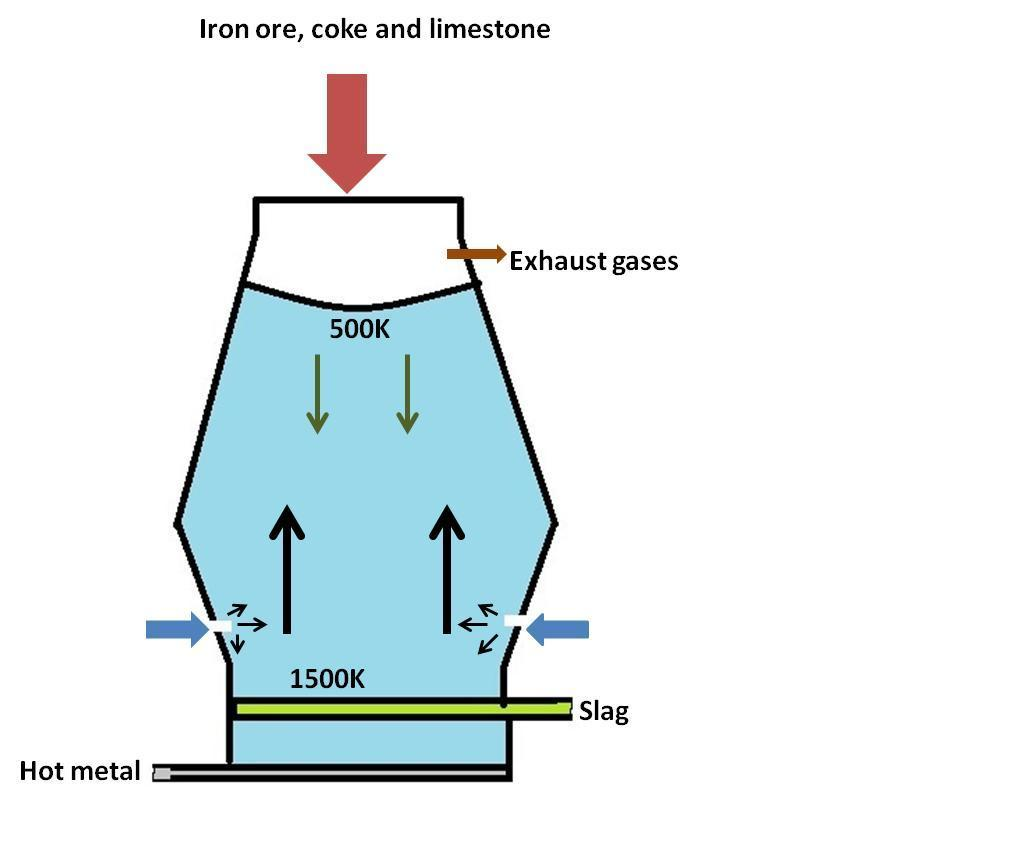
Note: Different reactions take place at different temperatures in the same blast furnace which are dependent upon the height at which reaction occurs. But at the end the product molten iron is obtained at the bottom. Oxygen is to be removed from the iron oxide to get pure iron metal and this process of removal of oxygen is called reduction. In this process iron oxide is reduced to iron and carbon is oxidized to carbon dioxide.
Complete step by step answer:1) The temperature in the blast furnace varies from $1500{\text{K}}$ at the bottom to $500{\text{K}}$ in the upper part. We get iron oxide in the form of iron ore from mining. It has impurities and needs to be converted to iron metal for useful purposes. This is done in a blast furnace and the reactions taking place can be written as shown below.
2) The reactions taking place in the upper part of the blast furnace $500 - 800{\text{K}}$ :
${\text{1]3Fe2O3 + CO}} \to {\text{2Fe3O4}}$
$2]F{e_3}{O_4} + 4CO \to 3Fe + 4C{O_2}$
$3]F{e_3}{O_4} + CO \to 3Fe + 4C{O_2}$
3) The reactions taking place in the lower part of the blast furnace $900 - 1500{\text{K}}$ :
${\text{1]C + CO2}} \to {\text{2CO}}$
$2]FeO + CO \to Fe + C{O_2}{\text{ (Iron metal in molten state)}}$
$3]CaC{O_3} \to CaO + C{O_2}$
$4]CaO + Si{O_2} \to CaSi{O_3}{\text{ (Molten slag)}}$
4) We get pure iron metal in the molten from at the bottom and the impurities are removed as slag. Additional information: In the blast furnace iron ore, limestone and coke (carbon) is added from the upper side and a blast of hot air is added from the bottom. The exhaust gases are pushed outside from an opening at the top.
5) The figure is shown as below:
Note: Different reactions take place at different temperatures in the same blast furnace which are dependent upon the height at which reaction occurs. But at the end the product molten iron is obtained at the bottom. Oxygen is to be removed from the iron oxide to get pure iron metal and this process of removal of oxygen is called reduction. In this process iron oxide is reduced to iron and carbon is oxidized to carbon dioxide.
Recently Updated Pages
Basicity of sulphurous acid and sulphuric acid are

Master Class 11 Business Studies: Engaging Questions & Answers for Success
Master Class 11 Computer Science: Engaging Questions & Answers for Success
Master Class 11 Economics: Engaging Questions & Answers for Success
Master Class 11 Social Science: Engaging Questions & Answers for Success
Master Class 11 English: Engaging Questions & Answers for Success
Trending doubts
One Metric ton is equal to kg A 10000 B 1000 C 100 class 11 physics CBSE
The largest wind power cluster is located in the state class 11 social science CBSE
Explain zero factorial class 11 maths CBSE
State and prove Bernoullis theorem class 11 physics CBSE
Which among the following are examples of coming together class 11 social science CBSE
Can anyone list 10 advantages and disadvantages of friction