




Write the differences between convex and concave lens.
Answer
 Verified
626.4k+ views
Hint A lens is a piece of refracting medium that is bounded by two surfaces, at least one of which is a curved surface. The most common lenses are the spherical lenses, i.e., Convex and Concave lenses. We can use them separately or a combination of them as per our convenience.
Complete step-by-step answer:
Lenses can be broadly classified into two categories:
Convex Lens Some important characteristics of convex lenses are as follows:
- This lens is thick at the centre and thin at the edges.
- It is a converging type of lens.
- A convex has a real focus.
- It converges a parallel beam of light onto its focus on refraction through it.
- A ray of light passing through its focus becomes parallel to the principal axis after refraction.
- It always forms a real image except when the object is placed within its focus.
- If an object is placed within the focal length, a virtual image is formed.
Concave Lens Some important characteristics of concave lenses are as follows:
- This lens is thick at the edges and thin at the centre.
- It is a diverging type of lens.
- A concave lens has a virtual focus.
- It diverges a parallel beam of light so that it appears to be emerging from its focus.
- A ray of light appearing to meet its focus becomes parallel to the principal axis after refraction.
- It always forms virtual images.
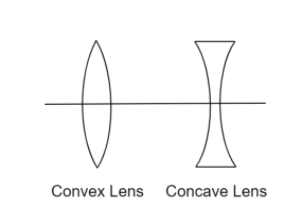
Note The lenses can be differentiated easily by touching them with hands. If the centre is bulging outwards, it is a convex lens and if the centre is curved inwards, it is a concave lens.
Moreover, if the image is real, it must be a convex lens. And if the image is virtual then it is generally a concave lens but can be a convex lens in case the object distance is less than the focal length.
From magnifying glasses to other optical instruments like microscope, telescope, camera, etc., all work by the use of these lenses.
Complete step-by-step answer:
Lenses can be broadly classified into two categories:
Convex Lens Some important characteristics of convex lenses are as follows:
- This lens is thick at the centre and thin at the edges.
- It is a converging type of lens.
- A convex has a real focus.
- It converges a parallel beam of light onto its focus on refraction through it.
- A ray of light passing through its focus becomes parallel to the principal axis after refraction.
- It always forms a real image except when the object is placed within its focus.
- If an object is placed within the focal length, a virtual image is formed.
Concave Lens Some important characteristics of concave lenses are as follows:
- This lens is thick at the edges and thin at the centre.
- It is a diverging type of lens.
- A concave lens has a virtual focus.
- It diverges a parallel beam of light so that it appears to be emerging from its focus.
- A ray of light appearing to meet its focus becomes parallel to the principal axis after refraction.
- It always forms virtual images.
Note The lenses can be differentiated easily by touching them with hands. If the centre is bulging outwards, it is a convex lens and if the centre is curved inwards, it is a concave lens.
Moreover, if the image is real, it must be a convex lens. And if the image is virtual then it is generally a concave lens but can be a convex lens in case the object distance is less than the focal length.
From magnifying glasses to other optical instruments like microscope, telescope, camera, etc., all work by the use of these lenses.
Recently Updated Pages
Master Class 12 Business Studies: Engaging Questions & Answers for Success

Master Class 12 Chemistry: Engaging Questions & Answers for Success
Master Class 12 Biology: Engaging Questions & Answers for Success
Class 12 Question and Answer - Your Ultimate Solutions Guide
Master Class 11 English: Engaging Questions & Answers for Success
Master Class 11 Social Science: Engaging Questions & Answers for Success
Trending doubts
Which are the Top 10 Largest Countries of the World?
Draw a labelled sketch of the human eye class 12 physics CBSE
Differentiate between homogeneous and heterogeneous class 12 chemistry CBSE
Differentiate between Pyramid of energy and pyramid class 12 biology CBSE
Why is the cell called the structural and functional class 12 biology CBSE
Draw the diagram of the pyramid of energy Explain In class 12 biology CBSE