




Write the chemical formula for the zinc acetate and antimony trioxide.
Answer
 Verified
598.5k+ views
Hint: Chemical formula: A set of chemical symbols representing the elements and their respective proportions in a chemical compound. Chemical formula of a compound can be written by using the respective valencies of an atom or formal charge of molecules comprising the compound.
Complete answer:
The chemical formula can be written according to the steps which are as follows:
1.Zinc Acetate
Step-1: Write down the symbols of element, ion or molecules used in the compound:
Symbol for Zinc atom \[ = Zn\]
Symbol for acetate ion \[ = C{H_3}CO{O^ - }\]
Step-2: Write down the valency of elements or formal charge of molecules used.
Valency of zinc atom: The valence shell of zinc i.e., \[4s\] subshell consists of two electrons i.e., it has a tendency to lose two electrons which are located in its \[4s\] subshell. Therefore, the valency of the zinc atom is \[ + 2\].
Acetate ion already exists in its ionic form, so there is no need to calculate any formal charge for it.
Step-3: The chemical formula is written according to the cross-multiplication rule.
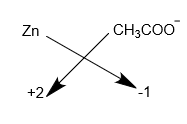
Hence, the chemical formula of the zinc acetate is \[Zn{(C{H_3}COO)_2}\]
1.Antimony trioxide
Step-1: Write down the symbols of element, ion or molecules used in the compound:
Symbol for antimony atom \[ = Sb\]
Symbol for oxygen ion \[ = O\]
Step-2: Write down the valency of elements or formal charge of molecules used.
Valency of antimony atom: The valence shell of antimony i.e., \[5p\] subshell consist of three electrons i.e., it has a tendency to lose three electrons which are located in its \[5p\] subshell. Therefore, the valency of antimony is \[ + 3\].
Valency of oxygen atom: The valence shell of oxygen i.e., \[2p\] subshell consists of four electrons i.e., it has a tendency to accept four electrons. Therefore, the valency of oxygen is \[ - 2\].
Step-3: The chemical formula is written according to the cross-multiplication rule.
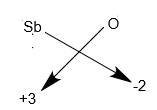
Hence, the chemical formula of the antimony trioxide is \[S{b_2}{O_3}\].
Note:
The electropositive element i.e., element having positive valency is always symbolized before the electronegative element i.e., element with negative charge. In the suffix of the symbols, charge is never mentioned, only magnitude of the valency is written.
Complete answer:
The chemical formula can be written according to the steps which are as follows:
1.Zinc Acetate
Step-1: Write down the symbols of element, ion or molecules used in the compound:
Symbol for Zinc atom \[ = Zn\]
Symbol for acetate ion \[ = C{H_3}CO{O^ - }\]
Step-2: Write down the valency of elements or formal charge of molecules used.
Valency of zinc atom: The valence shell of zinc i.e., \[4s\] subshell consists of two electrons i.e., it has a tendency to lose two electrons which are located in its \[4s\] subshell. Therefore, the valency of the zinc atom is \[ + 2\].
Acetate ion already exists in its ionic form, so there is no need to calculate any formal charge for it.
Step-3: The chemical formula is written according to the cross-multiplication rule.
Hence, the chemical formula of the zinc acetate is \[Zn{(C{H_3}COO)_2}\]
1.Antimony trioxide
Step-1: Write down the symbols of element, ion or molecules used in the compound:
Symbol for antimony atom \[ = Sb\]
Symbol for oxygen ion \[ = O\]
Step-2: Write down the valency of elements or formal charge of molecules used.
Valency of antimony atom: The valence shell of antimony i.e., \[5p\] subshell consist of three electrons i.e., it has a tendency to lose three electrons which are located in its \[5p\] subshell. Therefore, the valency of antimony is \[ + 3\].
Valency of oxygen atom: The valence shell of oxygen i.e., \[2p\] subshell consists of four electrons i.e., it has a tendency to accept four electrons. Therefore, the valency of oxygen is \[ - 2\].
Step-3: The chemical formula is written according to the cross-multiplication rule.
Hence, the chemical formula of the antimony trioxide is \[S{b_2}{O_3}\].
Note:
The electropositive element i.e., element having positive valency is always symbolized before the electronegative element i.e., element with negative charge. In the suffix of the symbols, charge is never mentioned, only magnitude of the valency is written.
Recently Updated Pages
Which will be the least stable resonating structure class 11 chemistry CBSE

How many 5 digit telephone numbers can be construc-class-11-maths-CBSE
How do you find the angle of the resultant vector class 11 physics CBSE
Draw labelled diagram of the following i Gram seed class 11 biology CBSE
1 Quintal is equal to a 110 kg b 10 kg c 100kg d 1000 class 11 physics CBSE
What is the need and importance of classification class 11 biology CBSE
Trending doubts
Find the value of the expression given below sin 30circ class 11 maths CBSE
One Metric ton is equal to kg A 10000 B 1000 C 100 class 11 physics CBSE
10 examples of friction in our daily life
Draw a diagram of a plant cell and label at least eight class 11 biology CBSE
Difference between physical and chemical change class 11 chemistry CBSE
Proton was discovered by A Thomson B Rutherford C Chadwick class 11 chemistry CBSE