




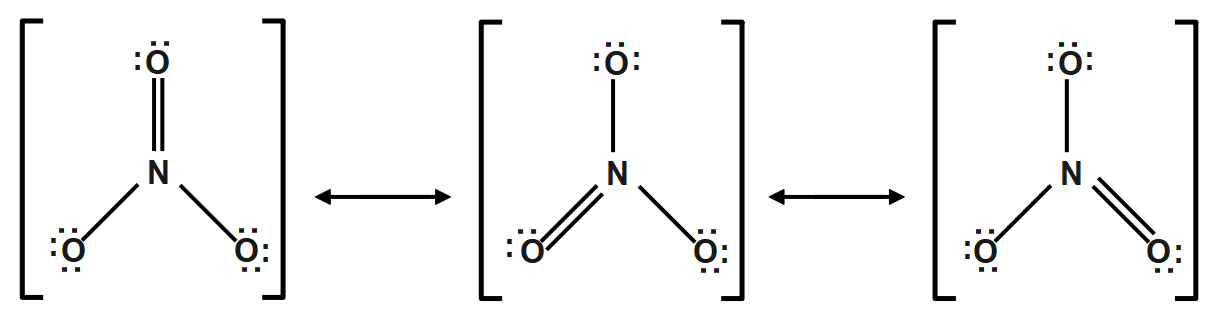
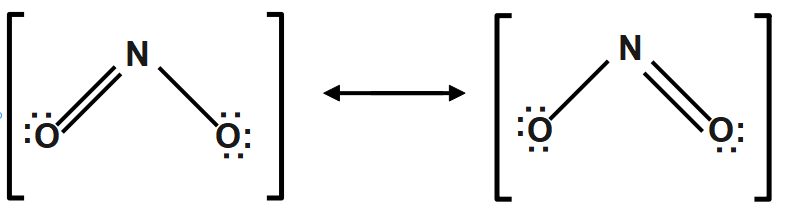
Write resonance structure of $NO_{3}^{-}$ and $N{{O}_{2}}$
Answer
 Verified
572.4k+ views
Hint: All non-metals form metal oxides with oxygen, which reacts with water that will form acids or with bases forms salts. Most nonmetals form oxyacid’s from their acidic oxides. A set of two or Lewis structures collectively describes the electronic bonding of a single polyatomic species including fractional charges are resonance structures.
Complete step by step answer:
Based on resonance structures of single polyatomic species are capable of describing delocalized electrons that cannot be expressed by a single Lewis formula with an integer number of covalent bonds.
The nitrate ($NO_{3}^{-}$ ) ion:
Count the valence electrons $=$ no of nitrogen atoms $\times 5$electrons $+$ no of oxygen atoms $\times 6$ electrons $+$ one electron.
\[=1\times 5+3\times 6+1=24electrons\]
The below diagram shows the bond connectivity and octet electrons to the atoms bonded to the central atom which is the trigonal planar and the possible resonance structures are:
Nitrogen dioxide ($N{{O}_{2}}$ ): Nitrogen dioxide contains an odd number of $17$ valence electrons and it behaves as a typical odd molecule. It exhibits a resonance structure on dimerization, Nitrogen dioxide converted to stable dinitrogen tetraoxide molecule with an even number of molecules.
Note: Sometimes Lewis structure is not enough for explaining bonding in some molecules or ions and a single Lewis formula is not sufficient to describe the delocalized electrons within certain molecules or polyatomic ions. A molecule or ion with such delocalized electrons is represented by several structures. For example, ozone is an allotrope of oxygen with a V-shaped structure with an $O-O-O$ bond angle of $117.5{}^\circ $
Complete step by step answer:
Based on resonance structures of single polyatomic species are capable of describing delocalized electrons that cannot be expressed by a single Lewis formula with an integer number of covalent bonds.
The nitrate ($NO_{3}^{-}$ ) ion:
Count the valence electrons $=$ no of nitrogen atoms $\times 5$electrons $+$ no of oxygen atoms $\times 6$ electrons $+$ one electron.
\[=1\times 5+3\times 6+1=24electrons\]
The below diagram shows the bond connectivity and octet electrons to the atoms bonded to the central atom which is the trigonal planar and the possible resonance structures are:
Nitrogen dioxide ($N{{O}_{2}}$ ): Nitrogen dioxide contains an odd number of $17$ valence electrons and it behaves as a typical odd molecule. It exhibits a resonance structure on dimerization, Nitrogen dioxide converted to stable dinitrogen tetraoxide molecule with an even number of molecules.
Note: Sometimes Lewis structure is not enough for explaining bonding in some molecules or ions and a single Lewis formula is not sufficient to describe the delocalized electrons within certain molecules or polyatomic ions. A molecule or ion with such delocalized electrons is represented by several structures. For example, ozone is an allotrope of oxygen with a V-shaped structure with an $O-O-O$ bond angle of $117.5{}^\circ $
Recently Updated Pages
Master Class 11 English: Engaging Questions & Answers for Success

Master Class 11 Social Science: Engaging Questions & Answers for Success
Master Class 11 Maths: Engaging Questions & Answers for Success
Master Class 11 Biology: Engaging Questions & Answers for Success
Master Class 11 Physics: Engaging Questions & Answers for Success
Master Class 11 Chemistry: Engaging Questions & Answers for Success
Trending doubts
One Metric ton is equal to kg A 10000 B 1000 C 100 class 11 physics CBSE
Difference Between Prokaryotic Cells and Eukaryotic Cells
1 ton equals to A 100 kg B 1000 kg C 10 kg D 10000 class 11 physics CBSE
Find the value of the expression given below sin 30circ class 11 maths CBSE
Two of the body parts which do not appear in MRI are class 11 biology CBSE
What are hard magnetic materials class 11 physics CBSE