




Write general characters of Balanoglossus.
Answer
 Verified
604.2k+ views
Hint: Balanoglossus, commonly called acorn worm is an ocean-dwelling Hemichordate. It is an exclusively marine organism found in shallow waters in coastal regions of warm oceans. Their body is divided into proboscis, collar, and trunk. It is a burrowing animal. They are basically ciliary feeders. Development can be direct or indirect.
Complete answer:
- Balanoglossus has a worm-like, brittle and soft body.
- Their body cavity is enterocoelous.
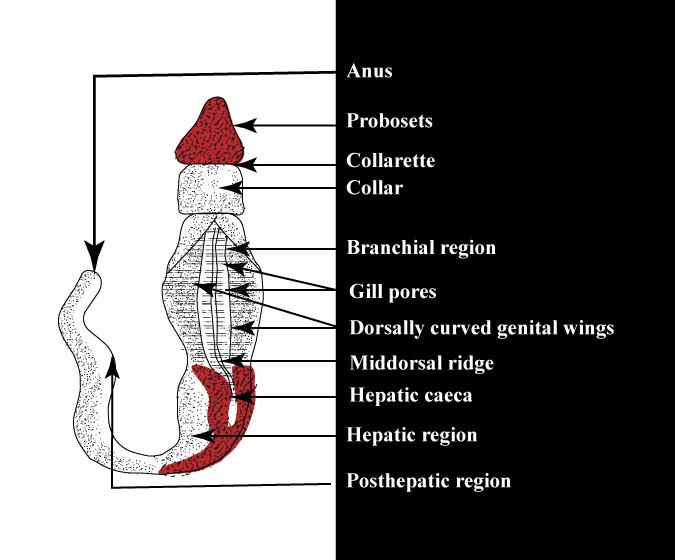
- They have a complete alimentary canal present in the digestive system.
- They respire by gill or body surface. Their respiratory pigment is vanadium in their blood.
- They have open circulation with colorless blood and amoeboid corpuscles.
- They possess true notochord. They do not have post- anal tail.
- Excretion is done by a single glomerulus commonly called the proboscis gland.
Additional information:
- Central nervous system is just like non chordates. The brain is present in the form of a nerve ring. Primitive nervous consists of the subepidermal nerve plexus.
- Cleavage is holoblastic in balanoglossus.
- Its food comprises minute organic substances, microscopic organisms, mud, and sand.
- It uses its muscular proboscis and collar to burrow sand and mud.
- In balanoglossus development can be both direct as well as indirect.
- If development is indirect, the larva is called Tornaria.
- Hemichordata is divided into two classes- Enteropneusta and Pterobranchia. Balanoglossus comes under Enteropneusta.
- They lack two major characteristics of chordates- notochord and a post- anal tail.
- in hemichordates, a notochord like structure is found known as stomochord.it is a hollow outgrowth arising from a buccal cavity called a buccal diverticulum in the proboscis.
Note: Modern taxonomists do not include hemichordates in the chordate phylum. Hyman kept in separate phylum hemichordata in invertebrates. Hemichordata is the connecting link between non-chordates and chordates.
Complete answer:
- Balanoglossus has a worm-like, brittle and soft body.
- Their body cavity is enterocoelous.
- They have a complete alimentary canal present in the digestive system.
- They respire by gill or body surface. Their respiratory pigment is vanadium in their blood.
- They have open circulation with colorless blood and amoeboid corpuscles.
- They possess true notochord. They do not have post- anal tail.
- Excretion is done by a single glomerulus commonly called the proboscis gland.
Additional information:
- Central nervous system is just like non chordates. The brain is present in the form of a nerve ring. Primitive nervous consists of the subepidermal nerve plexus.
- Cleavage is holoblastic in balanoglossus.
- Its food comprises minute organic substances, microscopic organisms, mud, and sand.
- It uses its muscular proboscis and collar to burrow sand and mud.
- In balanoglossus development can be both direct as well as indirect.
- If development is indirect, the larva is called Tornaria.
- Hemichordata is divided into two classes- Enteropneusta and Pterobranchia. Balanoglossus comes under Enteropneusta.
- They lack two major characteristics of chordates- notochord and a post- anal tail.
- in hemichordates, a notochord like structure is found known as stomochord.it is a hollow outgrowth arising from a buccal cavity called a buccal diverticulum in the proboscis.
Note: Modern taxonomists do not include hemichordates in the chordate phylum. Hyman kept in separate phylum hemichordata in invertebrates. Hemichordata is the connecting link between non-chordates and chordates.
Recently Updated Pages
Master Class 11 English: Engaging Questions & Answers for Success

Master Class 11 Social Science: Engaging Questions & Answers for Success
Master Class 11 Maths: Engaging Questions & Answers for Success
Master Class 11 Biology: Engaging Questions & Answers for Success
Master Class 11 Physics: Engaging Questions & Answers for Success
Master Class 11 Chemistry: Engaging Questions & Answers for Success
Trending doubts
One Metric ton is equal to kg A 10000 B 1000 C 100 class 11 physics CBSE
Difference Between Prokaryotic Cells and Eukaryotic Cells
Two of the body parts which do not appear in MRI are class 11 biology CBSE
Find the value of the expression given below sin 30circ class 11 maths CBSE
Draw a diagram of a plant cell and label at least eight class 11 biology CBSE
10 examples of friction in our daily life