



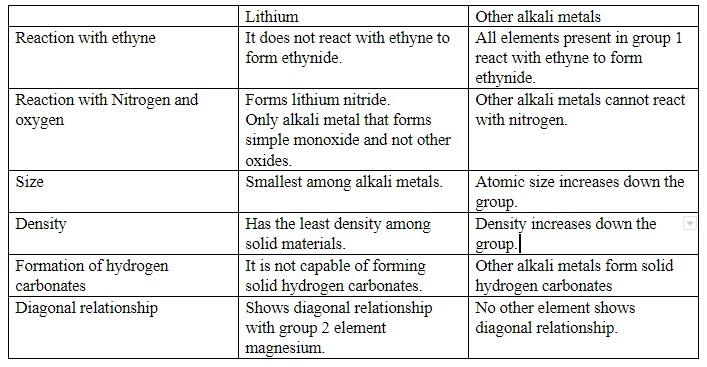
Write any four differences between lithium and other alkali metals.
Answer
 Verified
655.2k+ views
Hint: Alkali metals are the chemical elements in group 1 of the periodic table of elements except for hydrogen. Thus, the members of this group that fall into this category are Lithium, Sodium, Potassium, Rubidium, Caesium and Francium. The reason why we name them as alkali metals is that they form alkali compounds.
Complete step by step answer:
The key difference between Lithium and other alkali metals that we can tell is that the lithium is the only alkali metal that can react with nitrogen whereas the other alkali metals cannot undergo any reaction with nitrogen. Moreover, lithium cannot form an anion while other alkali metals can form anions. Melting and boiling point is higher than other alkali metals .
Rest of the differences are explained in below table
Note:
Lithium has very low affinities for electrons, moreover requires relatively little energy to lose an electron. Also due to their small size, they are unable to accommodate more electrons as adding an electron can increase the electron-electron repulsions within the atom .
Complete step by step answer:
The key difference between Lithium and other alkali metals that we can tell is that the lithium is the only alkali metal that can react with nitrogen whereas the other alkali metals cannot undergo any reaction with nitrogen. Moreover, lithium cannot form an anion while other alkali metals can form anions. Melting and boiling point is higher than other alkali metals .
Rest of the differences are explained in below table
Note:
Lithium has very low affinities for electrons, moreover requires relatively little energy to lose an electron. Also due to their small size, they are unable to accommodate more electrons as adding an electron can increase the electron-electron repulsions within the atom .
Recently Updated Pages
The given figure shows two endocrine glands marked class 11 biology NEET_UG

Match columnI with columnII and select the correct class 11 biology NEET
Match column I with column II and select the correct class 11 biology NEET_UG
Which floral family has left 9 right + 1 arrangement class 11 biology NEET_UG
Which is not a variety of sheep A Lohi B Beetal C Nellore class 11 biology NEET_UG
Match column I with column II and select the correct class 11 biology NEET_UG
Trending doubts
One Metric ton is equal to kg A 10000 B 1000 C 100 class 11 physics CBSE
Draw a diagram of a plant cell and label at least eight class 11 biology CBSE
Difference Between Prokaryotic Cells and Eukaryotic Cells
Draw a well labelled diagram of reflex arc and explain class 11 biology CBSE
Two of the body parts which do not appear in MRI are class 11 biology CBSE
1 ton equals to A 100 kg B 1000 kg C 10 kg D 10000 class 11 physics CBSE