




How do you write an equation of an ellipse with centre \[\left( 0,4 \right)\] and a=2c, vertices \[\left( -4,4 \right)\left( 4,4 \right)\].
Answer
 Verified
540k+ views
Hint: In this problem, we have to find the equation of an ellipse with the given centre and the vertices. We know that the standard form of the ellipse is \[\dfrac{{{\left( x-h \right)}^{2}}}{{{a}^{2}}}+\dfrac{{{\left( y-k \right)}^{2}}}{{{b}^{2}}}=1\] , a and b are the semi major and the minor axis. We know that the relation to determine the value of a and b is \[{{c}^{2}}={{a}^{2}}-{{b}^{2}}\] . we can now find the value of a and b and we have a centre, by substituting those values, we can find the equation of the given ellipse.
Complete step by step answer:
We know that the standard form of the ellipse is,
\[\dfrac{{{\left( x-h \right)}^{2}}}{{{a}^{2}}}+\dfrac{{{\left( y-k \right)}^{2}}}{{{b}^{2}}}=1,a>b\]…… (1)
Where, \[\left( h,k \right)\] is the centre and a, b are the semi major and the semi minor axis respectively.
We are given that the centre is,
\[\left( h,k \right)=\left( 0,4 \right)\]……. (2)
Now we can find the value of a and b.
We know that for the equation of ellipse, a is strictly greater than b, for this semi major and semi minor axis, we have a relation through which we can determine them, it sis
\[{{c}^{2}}={{a}^{2}}-{{b}^{2}}\]
We are given that, a = 2c. we can now substitute this in the above relation, we get
\[\begin{align}
& \Rightarrow {{c}^{2}}={{\left( 2c \right)}^{2}}+{{b}^{2}} \\
& \Rightarrow {{c}^{2}}=4{{c}^{2}}+{{b}^{2}} \\
& \Rightarrow {{b}^{2}}=3{{c}^{2}}.....(3) \\
\end{align}\]
We know that the given vertices are \[\left( -4,4 \right)\left( 4,4 \right)\]. Now from looking at the vertices and the centre, we can see that the major semi axis length, a is 4.
We can now substitute a = 4 in a = 2c, we get
\[\Rightarrow c=2\]
Now we can substitute the above c value in (3), we get
\[\begin{align}
& \Rightarrow {{b}^{2}}=3{{\left( 2 \right)}^{2}} \\
& \Rightarrow b=\sqrt{12}=2\sqrt{3} \\
\end{align}\]
We can now substitute the centre, \[\left( h,k \right)=\left( 0,4 \right)\] , a= 4 and b = \[2\sqrt{3}\] in (1), we get
\[\Rightarrow \dfrac{{{\left( x-0 \right)}^{2}}}{{{4}^{2}}}+\dfrac{{{\left( y-4 \right)}^{2}}}{{{\left( 2\sqrt{3} \right)}^{2}}}=1\]
We can now simplify the above step, we get
\[\Rightarrow \dfrac{{{x}^{2}}}{16}+\dfrac{{{\left( y-4 \right)}^{2}}}{4}=1\]
Therefore, the required equation of ellipse is \[\dfrac{{{x}^{2}}}{16}+\dfrac{{{\left( y-4 \right)}^{2}}}{4}=1\].
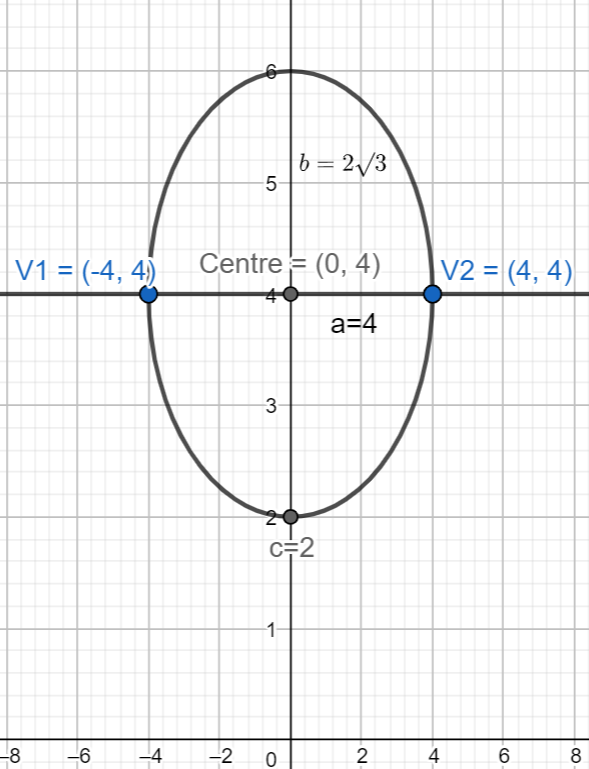
Note: We should know that the relation to determine the value of a and b is \[{{c}^{2}}={{a}^{2}}-{{b}^{2}}\] . We know that the standard form of the ellipse is, \[\dfrac{{{\left( x-h \right)}^{2}}}{{{a}^{2}}}+\dfrac{{{\left( y-k \right)}^{2}}}{{{b}^{2}}}=1,a>b\] Where, \[\left( h,k \right)\] is the centre and a, b are the semi major and the semi minor axis respectively.
Complete step by step answer:
We know that the standard form of the ellipse is,
\[\dfrac{{{\left( x-h \right)}^{2}}}{{{a}^{2}}}+\dfrac{{{\left( y-k \right)}^{2}}}{{{b}^{2}}}=1,a>b\]…… (1)
Where, \[\left( h,k \right)\] is the centre and a, b are the semi major and the semi minor axis respectively.
We are given that the centre is,
\[\left( h,k \right)=\left( 0,4 \right)\]……. (2)
Now we can find the value of a and b.
We know that for the equation of ellipse, a is strictly greater than b, for this semi major and semi minor axis, we have a relation through which we can determine them, it sis
\[{{c}^{2}}={{a}^{2}}-{{b}^{2}}\]
We are given that, a = 2c. we can now substitute this in the above relation, we get
\[\begin{align}
& \Rightarrow {{c}^{2}}={{\left( 2c \right)}^{2}}+{{b}^{2}} \\
& \Rightarrow {{c}^{2}}=4{{c}^{2}}+{{b}^{2}} \\
& \Rightarrow {{b}^{2}}=3{{c}^{2}}.....(3) \\
\end{align}\]
We know that the given vertices are \[\left( -4,4 \right)\left( 4,4 \right)\]. Now from looking at the vertices and the centre, we can see that the major semi axis length, a is 4.
We can now substitute a = 4 in a = 2c, we get
\[\Rightarrow c=2\]
Now we can substitute the above c value in (3), we get
\[\begin{align}
& \Rightarrow {{b}^{2}}=3{{\left( 2 \right)}^{2}} \\
& \Rightarrow b=\sqrt{12}=2\sqrt{3} \\
\end{align}\]
We can now substitute the centre, \[\left( h,k \right)=\left( 0,4 \right)\] , a= 4 and b = \[2\sqrt{3}\] in (1), we get
\[\Rightarrow \dfrac{{{\left( x-0 \right)}^{2}}}{{{4}^{2}}}+\dfrac{{{\left( y-4 \right)}^{2}}}{{{\left( 2\sqrt{3} \right)}^{2}}}=1\]
We can now simplify the above step, we get
\[\Rightarrow \dfrac{{{x}^{2}}}{16}+\dfrac{{{\left( y-4 \right)}^{2}}}{4}=1\]
Therefore, the required equation of ellipse is \[\dfrac{{{x}^{2}}}{16}+\dfrac{{{\left( y-4 \right)}^{2}}}{4}=1\].
Note: We should know that the relation to determine the value of a and b is \[{{c}^{2}}={{a}^{2}}-{{b}^{2}}\] . We know that the standard form of the ellipse is, \[\dfrac{{{\left( x-h \right)}^{2}}}{{{a}^{2}}}+\dfrac{{{\left( y-k \right)}^{2}}}{{{b}^{2}}}=1,a>b\] Where, \[\left( h,k \right)\] is the centre and a, b are the semi major and the semi minor axis respectively.
Recently Updated Pages
Master Class 11 Computer Science: Engaging Questions & Answers for Success

Master Class 11 Business Studies: Engaging Questions & Answers for Success
Master Class 11 Economics: Engaging Questions & Answers for Success
Master Class 11 English: Engaging Questions & Answers for Success
Master Class 11 Maths: Engaging Questions & Answers for Success
Master Class 11 Biology: Engaging Questions & Answers for Success
Trending doubts
One Metric ton is equal to kg A 10000 B 1000 C 100 class 11 physics CBSE
There are 720 permutations of the digits 1 2 3 4 5 class 11 maths CBSE
Discuss the various forms of bacteria class 11 biology CBSE
Draw a diagram of a plant cell and label at least eight class 11 biology CBSE
State the laws of reflection of light
Explain zero factorial class 11 maths CBSE