




How do you write an equation of an ellipse given endpoints of major axis at $\left( -11,5 \right)$ and $\left( 7,5 \right)$ and endpoints of the minor axis at $\left( -2,9 \right)$ and $\left( -2,1 \right)$?
Answer
 Verified
573.3k+ views
Hint: In this question we have been given with the endpoints of the major axis and the minor axis of an ellipse. We will use the general form of the endpoints of the major axis which is in the form $\left( h-a,k \right)$ and $\left( h+a,k \right)$, and the general form of the endpoint of the major axis which is the form $\left( h,k-b \right)$ and $\left( h,k+b \right)$. We will get equations and then solve for the value of $a$ and $b$, and write the equation of the ellipse in the standard form as $\dfrac{{{\left( x-h \right)}^{2}}}{{{a}^{2}}}+\dfrac{{{\left( y-k \right)}^{2}}}{{{b}^{2}}}=1$.
Complete step-by-step solution:
We have the endpoints of the major axis as:
$\left( -11,5 \right)$ and $\left( 7,5 \right)$
The general form of the endpoints is:
$\left( h-a,k \right)$ and $\left( h+a,k \right)$
Therefore, we can write:
$k=5\to \left( 1 \right)$
$h-a=-11\to \left( 2 \right)$
$h+a=7\to \left( 3 \right)$
We have the endpoints of the minor axis as:
$\left( -2,9 \right)$ and $\left( -2,1 \right)$
The general form of the endpoints is:
$\left( h,k-b \right)$ and $\left( h,k+b \right)$
Therefore, we can write:
$h=-2\to \left( 4 \right)$
$k-b=1\to \left( 5 \right)$
$k+b=9\to \left( 6 \right)$
Subtracting $\left( 2 \right)$ from $\left( 3 \right)$, we get:
$\Rightarrow 2a=18$
On dividing both the sides of the expression by $2$, we get:
$\Rightarrow a=9$
Subtracting $\left( 5 \right)$ from $\left( 6 \right)$, we get:
$\Rightarrow 2b=8$
On dividing both the sides of the expression by $2$, we get:
$\Rightarrow b=4$
Now we know the general form of the equation of an ellipse is $\dfrac{{{\left( x-h \right)}^{2}}}{{{a}^{2}}}+\dfrac{{{\left( y-k \right)}^{2}}}{{{b}^{2}}}=1$.
On substituting the values of $h,k,a$ and $b$, we get:
$\dfrac{{{\left( x-\left( -2 \right) \right)}^{2}}}{{{9}^{2}}}+\dfrac{{{\left( y-5 \right)}^{2}}}{{{4}^{2}}}=1$, which is the required solution.
Drawing the ellipse on the graph, we get:
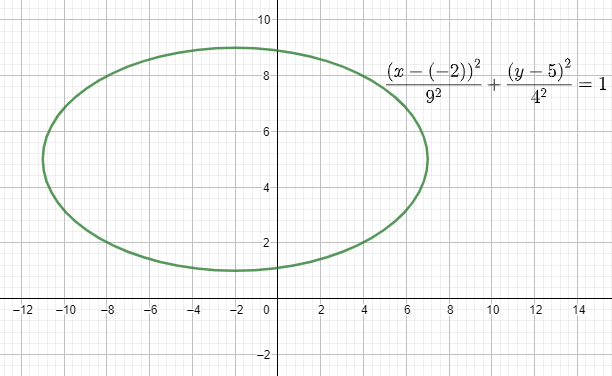
Note: The major axis of the ellipse represents the axis which is longer, in this case the $x$ axis and the minor axis represents the axis which is smaller, in this case the $y$ axis. $a$ represents the major axis and $b$ represents the minor axis. It is to be noted that in this case we have with us a horizontal ellipse since $a>b$. If $b>a$ then the ellipse formed is called a vertical ellipse.
Complete step-by-step solution:
We have the endpoints of the major axis as:
$\left( -11,5 \right)$ and $\left( 7,5 \right)$
The general form of the endpoints is:
$\left( h-a,k \right)$ and $\left( h+a,k \right)$
Therefore, we can write:
$k=5\to \left( 1 \right)$
$h-a=-11\to \left( 2 \right)$
$h+a=7\to \left( 3 \right)$
We have the endpoints of the minor axis as:
$\left( -2,9 \right)$ and $\left( -2,1 \right)$
The general form of the endpoints is:
$\left( h,k-b \right)$ and $\left( h,k+b \right)$
Therefore, we can write:
$h=-2\to \left( 4 \right)$
$k-b=1\to \left( 5 \right)$
$k+b=9\to \left( 6 \right)$
Subtracting $\left( 2 \right)$ from $\left( 3 \right)$, we get:
$\Rightarrow 2a=18$
On dividing both the sides of the expression by $2$, we get:
$\Rightarrow a=9$
Subtracting $\left( 5 \right)$ from $\left( 6 \right)$, we get:
$\Rightarrow 2b=8$
On dividing both the sides of the expression by $2$, we get:
$\Rightarrow b=4$
Now we know the general form of the equation of an ellipse is $\dfrac{{{\left( x-h \right)}^{2}}}{{{a}^{2}}}+\dfrac{{{\left( y-k \right)}^{2}}}{{{b}^{2}}}=1$.
On substituting the values of $h,k,a$ and $b$, we get:
$\dfrac{{{\left( x-\left( -2 \right) \right)}^{2}}}{{{9}^{2}}}+\dfrac{{{\left( y-5 \right)}^{2}}}{{{4}^{2}}}=1$, which is the required solution.
Drawing the ellipse on the graph, we get:
Note: The major axis of the ellipse represents the axis which is longer, in this case the $x$ axis and the minor axis represents the axis which is smaller, in this case the $y$ axis. $a$ represents the major axis and $b$ represents the minor axis. It is to be noted that in this case we have with us a horizontal ellipse since $a>b$. If $b>a$ then the ellipse formed is called a vertical ellipse.
Recently Updated Pages
Master Class 12 Economics: Engaging Questions & Answers for Success

Master Class 12 English: Engaging Questions & Answers for Success
Master Class 12 Social Science: Engaging Questions & Answers for Success
Master Class 12 Maths: Engaging Questions & Answers for Success
Master Class 12 Physics: Engaging Questions & Answers for Success
Master Class 9 General Knowledge: Engaging Questions & Answers for Success
Trending doubts
Find the value of the expression given below sin 30circ class 11 maths CBSE
Name the Largest and the Smallest Cell in the Human Body ?
What organs are located on the left side of your body class 11 biology CBSE
What is the weight in lbs of a 75 Kg person class 11 physics CBSE
What is the percentage of photosynthetically active class 11 biology CBSE
How do I convert ms to kmh Give an example class 11 physics CBSE