




How do you write an equation for a circle whose diameter has endpoints of \[\left( -2,4 \right)\] and \[\left( 4,12 \right)\]?
Answer
 Verified
581.1k+ views
Hint: We should know the standard form equations to solve this question. First we have to know the formula for the circle whose diameter has endpoints. Then we have to substitute given endpoints in the formula and simplify it to get the equation of the circle.
Complete step by step answer:
The standard equation of the circle with center \[\left( h,k \right)\] and radius \[r\] is
\[{{\left( x-h \right)}^{2}}+{{\left( y-k \right)}^{2}}={{r}^{2}}\].
The equation of the circle diameter with endpoints \[\left( {{x}_{1}},{{x}_{2}} \right)\]and \[\left( {{y}_{1}},{{y}_{2}} \right)\] is
\[\left( x-{{x}_{1}} \right)\left( x-{{x}_{2}} \right)+\left( y-{{y}_{1}} \right)\left( y-{{y}_{2}} \right)=0\].
We will use the above formula to solve our problem.
Given endpoints are \[\left( -2,4 \right)\] and \[\left( 4,12 \right)\]
We already discussed the equation of circle whose diameter with endpoints \[\left( {{x}_{1}},{{x}_{2}} \right)\]and \[\left( {{y}_{1}},{{y}_{2}} \right)\] is
given by
\[\left( x-{{x}_{1}} \right)\left( x-{{x}_{2}} \right)+\left( y-{{y}_{1}} \right)\left( y-{{y}_{2}} \right)=0\]
Now we have the circle whose diameter has endpoints \[\left( -2,4 \right)\] and \[\left( 4,12 \right)\].
So we substitute these formulas in the equation we have.
After substitution we will get the equation as
\[\Rightarrow \left( x-\left( -2 \right) \right)\left( x-4 \right)+\left( y-4 \right)\left( y-12 \right)=0\]
By simplifying we will get
\[\Rightarrow \left( x+2 \right)\left( x-4 \right)+\left( y-4 \right)\left( y-12 \right)=0\]
Now we have to multiply the terms with each other.
By multiplying first two terms we will get
\[\Rightarrow {{x}^{2}}+2x-4x-8+\left( y-4 \right)\left( y-12 \right)=0\]
Now we have to multiply the next two terms.
\[\Rightarrow {{x}^{2}}+2x-4x-8+{{y}^{2}}-12y-4y+48=0\]
Now we have to simplify the equation accordingly to arrive at the solution.
Now we have to add or subtract the like terms. We will get
\[\Rightarrow {{x}^{2}}-2x-8+{{y}^{2}}-16y+48=0\]
By further simplifying we will get
\[\Rightarrow {{x}^{2}}-2x+{{y}^{2}}-16y+40=0\]
Now we have to rearrange the terms accordingly. We will get
\[\Rightarrow {{x}^{2}}+{{y}^{2}}-2x-16y+40=0\]
So the equation of the circle whose diameter has endpoints \[\left( -2,4 \right)\] and \[\left( 4,12 \right)\] is
\[{{x}^{2}}+{{y}^{2}}-2x-16y+40=0\].
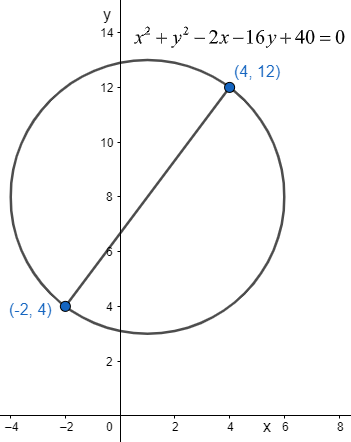
Note:
We can also do this in another way. First we have to find the center of the diameter and then we have to find the radius of the circle. After that we have to substitute in the standard equation of circle. We can do it in either way. But the above said method is the simplest one.
Complete step by step answer:
The standard equation of the circle with center \[\left( h,k \right)\] and radius \[r\] is
\[{{\left( x-h \right)}^{2}}+{{\left( y-k \right)}^{2}}={{r}^{2}}\].
The equation of the circle diameter with endpoints \[\left( {{x}_{1}},{{x}_{2}} \right)\]and \[\left( {{y}_{1}},{{y}_{2}} \right)\] is
\[\left( x-{{x}_{1}} \right)\left( x-{{x}_{2}} \right)+\left( y-{{y}_{1}} \right)\left( y-{{y}_{2}} \right)=0\].
We will use the above formula to solve our problem.
Given endpoints are \[\left( -2,4 \right)\] and \[\left( 4,12 \right)\]
We already discussed the equation of circle whose diameter with endpoints \[\left( {{x}_{1}},{{x}_{2}} \right)\]and \[\left( {{y}_{1}},{{y}_{2}} \right)\] is
given by
\[\left( x-{{x}_{1}} \right)\left( x-{{x}_{2}} \right)+\left( y-{{y}_{1}} \right)\left( y-{{y}_{2}} \right)=0\]
Now we have the circle whose diameter has endpoints \[\left( -2,4 \right)\] and \[\left( 4,12 \right)\].
So we substitute these formulas in the equation we have.
After substitution we will get the equation as
\[\Rightarrow \left( x-\left( -2 \right) \right)\left( x-4 \right)+\left( y-4 \right)\left( y-12 \right)=0\]
By simplifying we will get
\[\Rightarrow \left( x+2 \right)\left( x-4 \right)+\left( y-4 \right)\left( y-12 \right)=0\]
Now we have to multiply the terms with each other.
By multiplying first two terms we will get
\[\Rightarrow {{x}^{2}}+2x-4x-8+\left( y-4 \right)\left( y-12 \right)=0\]
Now we have to multiply the next two terms.
\[\Rightarrow {{x}^{2}}+2x-4x-8+{{y}^{2}}-12y-4y+48=0\]
Now we have to simplify the equation accordingly to arrive at the solution.
Now we have to add or subtract the like terms. We will get
\[\Rightarrow {{x}^{2}}-2x-8+{{y}^{2}}-16y+48=0\]
By further simplifying we will get
\[\Rightarrow {{x}^{2}}-2x+{{y}^{2}}-16y+40=0\]
Now we have to rearrange the terms accordingly. We will get
\[\Rightarrow {{x}^{2}}+{{y}^{2}}-2x-16y+40=0\]
So the equation of the circle whose diameter has endpoints \[\left( -2,4 \right)\] and \[\left( 4,12 \right)\] is
\[{{x}^{2}}+{{y}^{2}}-2x-16y+40=0\].
Note:
We can also do this in another way. First we have to find the center of the diameter and then we have to find the radius of the circle. After that we have to substitute in the standard equation of circle. We can do it in either way. But the above said method is the simplest one.
Recently Updated Pages
Master Class 11 Social Science: Engaging Questions & Answers for Success

Master Class 11 English: Engaging Questions & Answers for Success
Master Class 11 Maths: Engaging Questions & Answers for Success
Master Class 11 Chemistry: Engaging Questions & Answers for Success
Master Class 11 Biology: Engaging Questions & Answers for Success
Master Class 11 Physics: Engaging Questions & Answers for Success
Trending doubts
One Metric ton is equal to kg A 10000 B 1000 C 100 class 11 physics CBSE
Difference Between Prokaryotic Cells and Eukaryotic Cells
How many of the following diseases can be studied with class 11 biology CBSE
Which of the following enzymes is used for carboxylation class 11 biology CBSE
Two of the body parts which do not appear in MRI are class 11 biology CBSE
Draw a diagram of a plant cell and label at least eight class 11 biology CBSE