




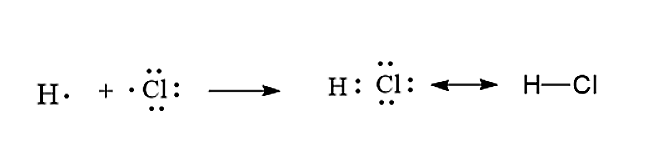
How would you write an Electron dot diagram of a hydrogen chloride molecule?
Answer
 Verified
596.1k+ views
Hint: In order to draw an electron dot structure for hydrogen chloride molecule, we must first know what an electron dot structure is. Electron dot structure can also be called the Lewis structure. This will describe the chemical bonding present between the atoms in a molecule.
Complete step by step answer:
- Let us understand deeply about the Electron dot structure. Electron dot structure is also called the Lewis structure. This will describe the nature of the bond present and the position of the atoms present in the molecule which are connected in the molecule. It will be easier to draw the electron dot structure, if we know the molecular or chemical formula of the compound. The Electron dot structure will give the chemical bonding between the atoms. Each dot in the Electron dot structure will represent an electron. When electron dots are present in the pairs it will represent the chemical bond.
- Hydrogen chloride molecules will contain one hydrogen atom and one chlorine atom. Hydrogen is having one valence electron and chlorine is having seven valence electrons. In order to attain stable electronic configuration, the hydrogen and the chlorine atom will combine with each other to form hydrogen chloride molecules.
-The electron dot structure of hydrogen chloride molecule is given below:
Note: We have to remember that the Lewis structure is very important because
- It will help to predict the geometry of the compound.
- polarity
- Reactivity of organic and inorganic compounds.
Complete step by step answer:
- Let us understand deeply about the Electron dot structure. Electron dot structure is also called the Lewis structure. This will describe the nature of the bond present and the position of the atoms present in the molecule which are connected in the molecule. It will be easier to draw the electron dot structure, if we know the molecular or chemical formula of the compound. The Electron dot structure will give the chemical bonding between the atoms. Each dot in the Electron dot structure will represent an electron. When electron dots are present in the pairs it will represent the chemical bond.
- Hydrogen chloride molecules will contain one hydrogen atom and one chlorine atom. Hydrogen is having one valence electron and chlorine is having seven valence electrons. In order to attain stable electronic configuration, the hydrogen and the chlorine atom will combine with each other to form hydrogen chloride molecules.
-The electron dot structure of hydrogen chloride molecule is given below:
Note: We have to remember that the Lewis structure is very important because
- It will help to predict the geometry of the compound.
- polarity
- Reactivity of organic and inorganic compounds.
Recently Updated Pages
Master Class 12 Economics: Engaging Questions & Answers for Success

Master Class 12 English: Engaging Questions & Answers for Success
Master Class 12 Social Science: Engaging Questions & Answers for Success
Master Class 12 Maths: Engaging Questions & Answers for Success
Master Class 12 Physics: Engaging Questions & Answers for Success
Master Class 11 Social Science: Engaging Questions & Answers for Success
Trending doubts
One Metric ton is equal to kg A 10000 B 1000 C 100 class 11 physics CBSE
Difference Between Prokaryotic Cells and Eukaryotic Cells
Two of the body parts which do not appear in MRI are class 11 biology CBSE
1 ton equals to A 100 kg B 1000 kg C 10 kg D 10000 class 11 physics CBSE
Draw a diagram of nephron and explain its structur class 11 biology CBSE
10 examples of friction in our daily life