




Would CAM plants have a lot of stomata? Why or why not?
Answer
 Verified
503.4k+ views
Hint: A plant that utilizes Crassulacean acid metabolism (CAM) as an adaptation for survival in arid conditions is called a CAM plant. It is named after the Crassulaceae family of plants. It follows a different method of carbon fixation to minimize photorespiration, which is needed for dry environments. Examples of CAM plants are jade plant, orchids, pineapple, and cactus.
Complete answer:
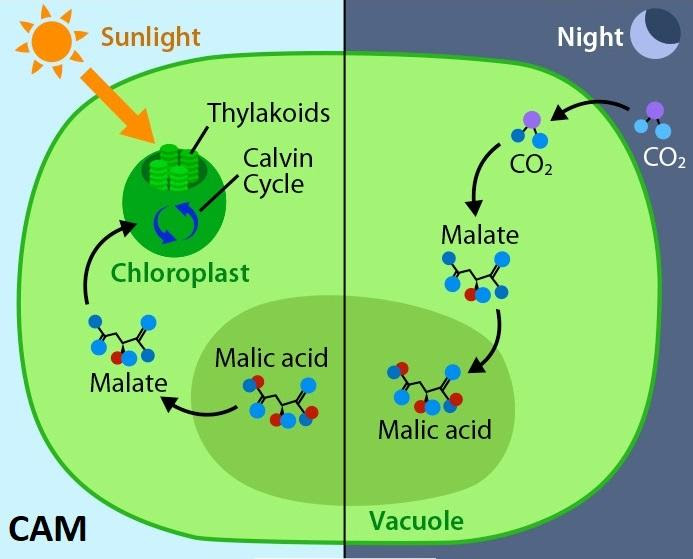
Fig: CAM pathway
When a plant opens the stomata for the collection of carbon dioxide, it loses a lot of water through a process called transpiration. In dry places like deserts, CAM plants are found as they help in conserving water as much as possible.
CAM plants possess a lesser number of stomata than plants. In addition, they open their stomata only during the night. Since the stomata are closed during the day, the amount of water loss during the day is considerably reduced. As the stomata are closed during daytime, carbon dioxide can’t enter the leaves and so photosynthesis does not take place as light reactions are required to offer the needed ATP and NADH to the leaves.
When night comes, stomata open, leading to the entry of carbon dioxide into the leaves and the leaves store carbon dioxide in organic acids. Hence, during the daytime, carbon dioxide is released from the acids, making the sugar required in the photosynthesis process.
This is the strategy of plants for storing water and preventing its loss. Also, they minimize photorespiration. Lower air temperature and higher humidity at night reduce the water loss from leaves.
Note:
CAM plants have lower photosynthetic capacity, slower growth, and lower competitive abilities as their photosynthetic abilities are limited by vacuole storage capacity and greater ATP costs. The separation of carbon dioxide fixation and the Calvin cycle in time (between day and night) takes place. So, CAM plants possess a lesser number of stomata.
Complete answer:
Fig: CAM pathway
When a plant opens the stomata for the collection of carbon dioxide, it loses a lot of water through a process called transpiration. In dry places like deserts, CAM plants are found as they help in conserving water as much as possible.
CAM plants possess a lesser number of stomata than plants. In addition, they open their stomata only during the night. Since the stomata are closed during the day, the amount of water loss during the day is considerably reduced. As the stomata are closed during daytime, carbon dioxide can’t enter the leaves and so photosynthesis does not take place as light reactions are required to offer the needed ATP and NADH to the leaves.
When night comes, stomata open, leading to the entry of carbon dioxide into the leaves and the leaves store carbon dioxide in organic acids. Hence, during the daytime, carbon dioxide is released from the acids, making the sugar required in the photosynthesis process.
This is the strategy of plants for storing water and preventing its loss. Also, they minimize photorespiration. Lower air temperature and higher humidity at night reduce the water loss from leaves.
Note:
CAM plants have lower photosynthetic capacity, slower growth, and lower competitive abilities as their photosynthetic abilities are limited by vacuole storage capacity and greater ATP costs. The separation of carbon dioxide fixation and the Calvin cycle in time (between day and night) takes place. So, CAM plants possess a lesser number of stomata.
Recently Updated Pages
Master Class 11 Social Science: Engaging Questions & Answers for Success

Master Class 11 English: Engaging Questions & Answers for Success
Master Class 11 Maths: Engaging Questions & Answers for Success
Master Class 11 Chemistry: Engaging Questions & Answers for Success
Master Class 11 Biology: Engaging Questions & Answers for Success
Master Class 11 Physics: Engaging Questions & Answers for Success
Trending doubts
Differentiate between an exothermic and an endothermic class 11 chemistry CBSE
One Metric ton is equal to kg A 10000 B 1000 C 100 class 11 physics CBSE
Difference Between Prokaryotic Cells and Eukaryotic Cells
There are 720 permutations of the digits 1 2 3 4 5 class 11 maths CBSE
Two of the body parts which do not appear in MRI are class 11 biology CBSE
Which gas is abundant in air class 11 chemistry CBSE