




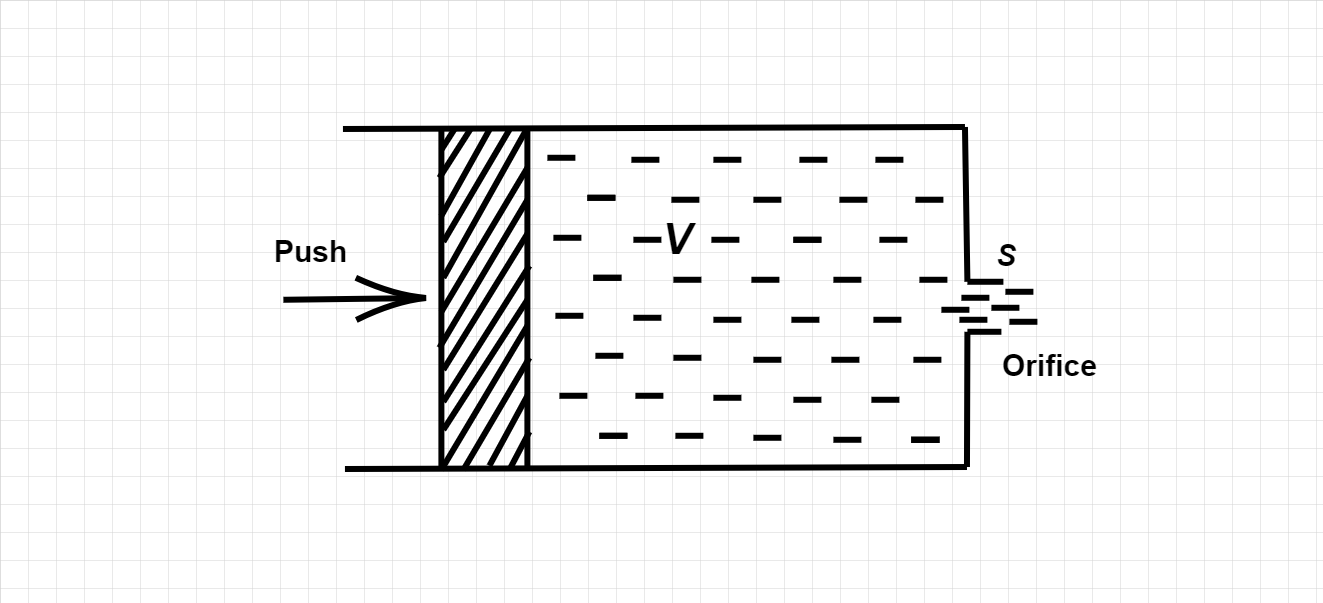
What work should be done in order to squeeze all the water from a horizontally located cylinder (figure shown above) during the time t by means of a constant force acting on the piston? The volume of a water in the cylinder is equal to V, the cross-sectional area of the orifice to s, with s being considerably less than the piston area. The friction and the viscosity are negligibly small.
A. $A = \dfrac{1}{2}\rho \dfrac{{{V^3}}}{{{{(St)}^2}}}$
B. $A = \dfrac{3}{2}\rho \dfrac{{{V^3}}}{{{{(St)}^2}}}$
C. $A = \dfrac{5}{2}\rho \dfrac{{{V^3}}}{{{{(St)}^2}}}$
D. None of these
Answer
 Verified
657.9k+ views
Hint: Velocity at which water ejects out of the orifice is called discharge velocity or volume discharge rate. It is given by $v = \dfrac{{Volume}}{{Area \times time}}$
Formula Used:
1. Volume discharge rate velocity, $v = \dfrac{{Volume}}{{Area \times time}}$ …… (a)
2. Kinetic energy of mass moving with velocity $v$ given by, $K.E = \dfrac{1}{2}m{v^2}$ ……. (b)
Complete step by step answer:
Given,
density of liquid in container $\rho $
Total volume of liquid to expel out $V$
Cross-sectional area of orifice $S$
Step 1 of 5:
From equation (a), Discharge rate $v$ of liquid out of orifice equals
$v = \dfrac{{Volume}}{{Area \times time}}$
$ \Rightarrow v = \dfrac{V}{{St}}$ …… (1)
Step 2 of 5:
From work energy theorem, we know change in Kinetic energy is total work done by piston-
$ \Rightarrow \Delta K.E = \dfrac{1}{2}m{v^2} - \dfrac{1}{2}m{u^2}$
Step 3 of 5:
But, let’s say initial velocity is 0 (no water coming out before time t=0)
$ \Rightarrow K.E = \dfrac{1}{2}m{v^2}$ …… (2)
Step 4 of 5:
Total mass of water coming out through orifice $M = \rho V$…… (3)
Step 5 of 5:
Putting values from equation (1) and (3) in equation (2), we get,
Kinetic Energy, $A = \dfrac{1}{2}\rho \dfrac{{{V^3}}}{{{{(St)}^2}}}$
Correct Answer: A. $A = \dfrac{1}{2}\rho \dfrac{{{V^3}}}{{{{(St)}^2}}}$
Additional Information:
Another approach of solving the problem is by using Bernoulli principle of fluid flow. Here, Force is acting perpendicular to the cross section area. So, pressure can be calculated as $P = \dfrac{F}{A}$where F is a constant force on the piston. Using Bernoulli’s equation force given by,
$F = \dfrac{1}{2}\rho {v^2}A$ where, $v$ is velocity of flow out of orifice. Then, by deducting the value of $v$ from equation (1) and putting in the equation of total work done. We will get the same answer.
Note: In order to use Bernoulli equation mark two points A and B. Bernoulli equation ensures continuity of flow.
Formula Used:
1. Volume discharge rate velocity, $v = \dfrac{{Volume}}{{Area \times time}}$ …… (a)
2. Kinetic energy of mass moving with velocity $v$ given by, $K.E = \dfrac{1}{2}m{v^2}$ ……. (b)
Complete step by step answer:
Given,
density of liquid in container $\rho $
Total volume of liquid to expel out $V$
Cross-sectional area of orifice $S$
Step 1 of 5:
From equation (a), Discharge rate $v$ of liquid out of orifice equals
$v = \dfrac{{Volume}}{{Area \times time}}$
$ \Rightarrow v = \dfrac{V}{{St}}$ …… (1)
Step 2 of 5:
From work energy theorem, we know change in Kinetic energy is total work done by piston-
$ \Rightarrow \Delta K.E = \dfrac{1}{2}m{v^2} - \dfrac{1}{2}m{u^2}$
Step 3 of 5:
But, let’s say initial velocity is 0 (no water coming out before time t=0)
$ \Rightarrow K.E = \dfrac{1}{2}m{v^2}$ …… (2)
Step 4 of 5:
Total mass of water coming out through orifice $M = \rho V$…… (3)
Step 5 of 5:
Putting values from equation (1) and (3) in equation (2), we get,
Kinetic Energy, $A = \dfrac{1}{2}\rho \dfrac{{{V^3}}}{{{{(St)}^2}}}$
Correct Answer: A. $A = \dfrac{1}{2}\rho \dfrac{{{V^3}}}{{{{(St)}^2}}}$
Additional Information:
Another approach of solving the problem is by using Bernoulli principle of fluid flow. Here, Force is acting perpendicular to the cross section area. So, pressure can be calculated as $P = \dfrac{F}{A}$where F is a constant force on the piston. Using Bernoulli’s equation force given by,
$F = \dfrac{1}{2}\rho {v^2}A$ where, $v$ is velocity of flow out of orifice. Then, by deducting the value of $v$ from equation (1) and putting in the equation of total work done. We will get the same answer.
Note: In order to use Bernoulli equation mark two points A and B. Bernoulli equation ensures continuity of flow.
Recently Updated Pages
Which will be the least stable resonating structure class 11 chemistry CBSE

How many 5 digit telephone numbers can be construc-class-11-maths-CBSE
How do you find the angle of the resultant vector class 11 physics CBSE
Draw labelled diagram of the following i Gram seed class 11 biology CBSE
What is the need and importance of classification class 11 biology CBSE
The way in which the sparrows expressed their sorrow class 11 english CBSE
Trending doubts
One Metric ton is equal to kg A 10000 B 1000 C 100 class 11 physics CBSE
Find the value of the expression given below sin 30circ class 11 maths CBSE
1 Quintal is equal to a 110 kg b 10 kg c 100kg d 1000 class 11 physics CBSE
Draw a diagram of nephron and explain its structur class 11 biology CBSE
10 examples of friction in our daily life
Proton was discovered by A Thomson B Rutherford C Chadwick class 11 chemistry CBSE