




Work out the sizes of one interior angle of a regular polygon 15-sided polygon?
Answer
 Verified
555k+ views
Hint: Use the formula for calculating the measure of each interior angle of a regular polygon, which is given by \[(n-2)\times \dfrac{{{180}^{{}^\circ }}}{n}\], where n represents the number of sides of the regular polygon. One must remember that in a regular polygon, all the sides are of equal length. Use the fact that angles opposite to equal sides are also equal to prove that all the angles of a regular polygon are equal as well.
Complete step by step solution:
We have to calculate the measure of each interior angle of a regular polygon of 15 sides.
Before solving this problem, we need to understand the property of regular polygons. That means the angles which are opposite to equal sides are also equal. As all the sides of a regular polygon are equal, all the angles have equal measure as well.
For more understanding about regular polygon figure is given below
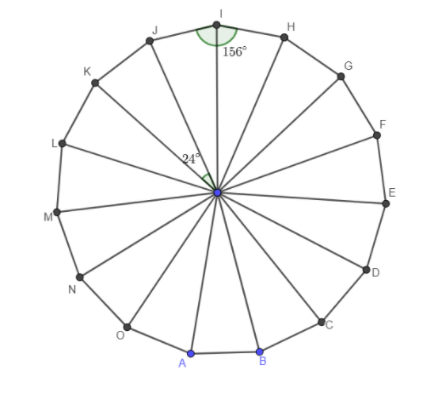
In the above figure that is 15-sided regular polygon, we have to find the interior angles of the polygon.
We know that a regular polygon with ‘n’ sides has the measure of each angle equal to \[(n-2)\times \dfrac{{{180}^{{}^\circ }}}{n}\].
Substituting \[n=15\] in the above formula, the measure of each angle \[=(15-2)\times \dfrac{{{180}^{{}^\circ }}}{15}\]
By simplifying this we get:
\[\Rightarrow 13\times \dfrac{{{180}^{{}^\circ }}}{15}\]
By further solving this we get:
\[\Rightarrow \dfrac{{{1440}^{{}^\circ }}}{15}\]
By reducing fraction, we get:
\[\Rightarrow {{156}^{{}^\circ }}\]
Hence, the value of each angle of a regular polygon with 15 sides is \[{{156}^{{}^\circ }}\].
Note:
A regular polygon is defined as a flat shape whose sides are all equal in length and whose angles are all equal. A regular polygon having 5 sides is called a pentagon. The sum of internal angles of a regular polygon is \[(n-2)\times {{180}^{{}^\circ }}\]. Thus, for a pentagon, the sum of measures is \[{{540}^{{}^\circ }}\]. The sum of all exterior angles of a regular polygon is \[{{180}^{{}^\circ }}\]. The diagonals of a convex regular polygon are in the golden ratio to its sides. One must be careful while calculating the value of interior angles. We will get different measures of angles when measured in degrees and radians.
Complete step by step solution:
We have to calculate the measure of each interior angle of a regular polygon of 15 sides.
Before solving this problem, we need to understand the property of regular polygons. That means the angles which are opposite to equal sides are also equal. As all the sides of a regular polygon are equal, all the angles have equal measure as well.
For more understanding about regular polygon figure is given below
In the above figure that is 15-sided regular polygon, we have to find the interior angles of the polygon.
We know that a regular polygon with ‘n’ sides has the measure of each angle equal to \[(n-2)\times \dfrac{{{180}^{{}^\circ }}}{n}\].
Substituting \[n=15\] in the above formula, the measure of each angle \[=(15-2)\times \dfrac{{{180}^{{}^\circ }}}{15}\]
By simplifying this we get:
\[\Rightarrow 13\times \dfrac{{{180}^{{}^\circ }}}{15}\]
By further solving this we get:
\[\Rightarrow \dfrac{{{1440}^{{}^\circ }}}{15}\]
By reducing fraction, we get:
\[\Rightarrow {{156}^{{}^\circ }}\]
Hence, the value of each angle of a regular polygon with 15 sides is \[{{156}^{{}^\circ }}\].
Note:
A regular polygon is defined as a flat shape whose sides are all equal in length and whose angles are all equal. A regular polygon having 5 sides is called a pentagon. The sum of internal angles of a regular polygon is \[(n-2)\times {{180}^{{}^\circ }}\]. Thus, for a pentagon, the sum of measures is \[{{540}^{{}^\circ }}\]. The sum of all exterior angles of a regular polygon is \[{{180}^{{}^\circ }}\]. The diagonals of a convex regular polygon are in the golden ratio to its sides. One must be careful while calculating the value of interior angles. We will get different measures of angles when measured in degrees and radians.
Recently Updated Pages
Differentiate between voluntary action and reflex class 10 biology CBSE

The uses of bleaching powder are A It is used bleaching class 10 chemistry CBSE
Fill in the blanks with abstract nouns of the words class 10 english CBSE
How many threedigit numbers are there class 10 maths CBSE
What is a reflex arc class 10 biology CBSE
Construct a square whose diagonal is 6cm Measure the class 10 maths CBSE
Trending doubts
Explain the Treaty of Vienna of 1815 class 10 social science CBSE
The slogan Jai Hind was given by A Lal Bahadur Shastri class 10 social science CBSE
10 examples of evaporation in daily life with explanations
What is the full form of POSCO class 10 social science CBSE
Identify the feminine form of noun nephew a shenephew class 10 english CBSE
CSIR full form?