




How do you work out the ratio of volume of the triangular prism to the volume of a cuboid?
Answer
 Verified
546.9k+ views
Hint: We take arbitrary dimensions of the triangular prism and the cuboid. We find their formula for general volume measurement. Then we find the ratio of volume of the triangular prism to the volume of a cuboid.
Complete step by step solution:
We need to work out the ratio of volume of the triangular prism to the volume of a cuboid.
No particular data about the sides of the cuboid or the base of the prism have been given.
We will assume the dimensions of the figures and find the ratio.
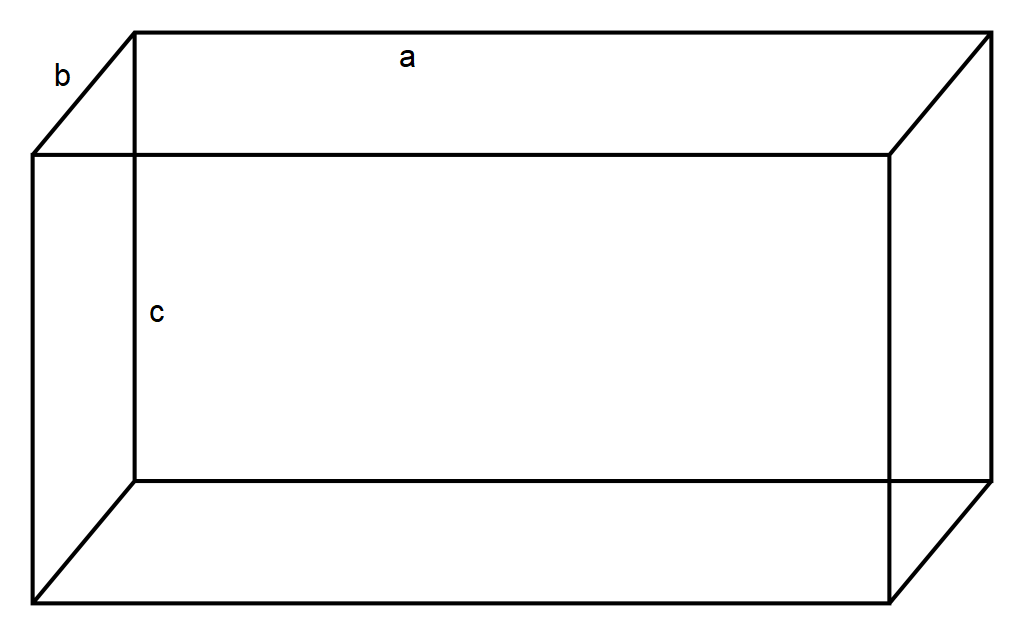
First, we take the cuboid. We assume the dimensions for the cuboid is $a,b,c$ for length, breadth and height respectively.
We know the volume for cuboids is equal to the multiplication of three dimensions.
Therefore, the volume of the cuboid will be $abc$ cubic unit.
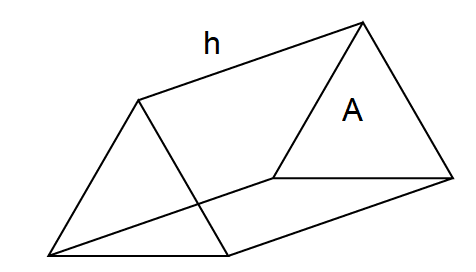
For the prism we need to know the base. We take the base area as $A$ and the height as $h$.
The volume of the prism becomes $A\times h=hA$ cubic unit.
The ratio of volume of the triangular prism to the volume of a cuboid becomes \[\dfrac{abc}{hA}\].
We now take an example.
Let the dimensions for the cuboid is $2,3,5$ units for length, breadth and height respectively.
Therefore, the volume of the cuboid will be $2\times 3\times 5=30$ cubic unit.
For the prism we need to know the base. We take the base area as $12$ unit and the height as $5$ unit.
The volume of the prism becomes $5\times 12=60$ cubic units.
The ratio is \[\dfrac{abc}{hA}=\dfrac{30}{60}=\dfrac{1}{2}\].
Note:
The base of the prism is fixed in this case as a triangle. A prism is a polyhedron in which all the faces are flat, and the bases are parallel to each other. It is a solid object with flat faces, identical ends, and the same cross-section along with its length.
Complete step by step solution:
We need to work out the ratio of volume of the triangular prism to the volume of a cuboid.
No particular data about the sides of the cuboid or the base of the prism have been given.
We will assume the dimensions of the figures and find the ratio.
First, we take the cuboid. We assume the dimensions for the cuboid is $a,b,c$ for length, breadth and height respectively.
We know the volume for cuboids is equal to the multiplication of three dimensions.
Therefore, the volume of the cuboid will be $abc$ cubic unit.
For the prism we need to know the base. We take the base area as $A$ and the height as $h$.
The volume of the prism becomes $A\times h=hA$ cubic unit.
The ratio of volume of the triangular prism to the volume of a cuboid becomes \[\dfrac{abc}{hA}\].
We now take an example.
Let the dimensions for the cuboid is $2,3,5$ units for length, breadth and height respectively.
Therefore, the volume of the cuboid will be $2\times 3\times 5=30$ cubic unit.
For the prism we need to know the base. We take the base area as $12$ unit and the height as $5$ unit.
The volume of the prism becomes $5\times 12=60$ cubic units.
The ratio is \[\dfrac{abc}{hA}=\dfrac{30}{60}=\dfrac{1}{2}\].
Note:
The base of the prism is fixed in this case as a triangle. A prism is a polyhedron in which all the faces are flat, and the bases are parallel to each other. It is a solid object with flat faces, identical ends, and the same cross-section along with its length.
Recently Updated Pages
Master Class 10 Computer Science: Engaging Questions & Answers for Success

Master Class 10 General Knowledge: Engaging Questions & Answers for Success
Master Class 10 English: Engaging Questions & Answers for Success
Master Class 10 Social Science: Engaging Questions & Answers for Success
Master Class 10 Maths: Engaging Questions & Answers for Success
Master Class 10 Science: Engaging Questions & Answers for Success
Trending doubts
What is the median of the first 10 natural numbers class 10 maths CBSE
Which women's tennis player has 24 Grand Slam singles titles?
Who is the Brand Ambassador of Incredible India?
Why is there a time difference of about 5 hours between class 10 social science CBSE
Write a letter to the principal requesting him to grant class 10 english CBSE
A moving boat is observed from the top of a 150 m high class 10 maths CBSE