



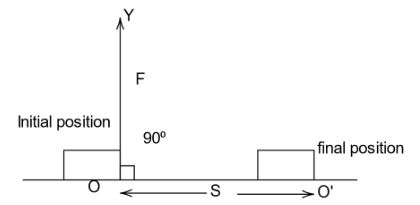
What is the work done in the situation shown below?
Answer
 Verified
517.2k+ views
Hint: We can start by writing down the formula to find the work done and defining work with it. We can define the work done mathematically; this helps us to find the solution to our question. The work done by a force is the product of the same force and the displacement caused by it. The definition can be extended a bit as it depends on one more factor, that is the angle at which the force is applied.
Formulas used:
The formula used to find the work done by a force is given by,
$W = F.S = FS\cos \theta $
Where \[F\] is the force responsible for this work done, \[S\] is the displacement caused by the force and \[\theta \] is the angle between the direction of application of force and the displacement.
Complete step by step answer:
Let us start by defining work done mathematically. Work done is defined as the dot product of the force responsible for the work done and the displacement caused by it. The equation for this will be:
$W = F.S = FS\cos \theta $
Substituting the values for theta, we get the solution for the question as,
$W = F.S \\
\Rightarrow W = FS\cos \theta \\
\Rightarrow W = FS\cos {90^ \circ }$
So, we substitute the value of cosine for 90 degrees and find the value of work done.
$W = F.S \\
\Rightarrow W = FS\cos \theta \\
\Rightarrow W = FS\left( 0 \right) \\
\therefore W = 0$
The value of \[\cos 90 = 0\] makes the whole value of work done zero.
Therefore, the work done is zero.
Note: The work done by a force can be defined as the product of the displacement of an object and the component of the applied force which is in the direction of the object's displacement. When force and displacement is perpendicular to each other, work done is zero. Hence work done also depends upon the angle between the force and displacement but not on the velocity of the moving object.
Formulas used:
The formula used to find the work done by a force is given by,
$W = F.S = FS\cos \theta $
Where \[F\] is the force responsible for this work done, \[S\] is the displacement caused by the force and \[\theta \] is the angle between the direction of application of force and the displacement.
Complete step by step answer:
Let us start by defining work done mathematically. Work done is defined as the dot product of the force responsible for the work done and the displacement caused by it. The equation for this will be:
$W = F.S = FS\cos \theta $
Substituting the values for theta, we get the solution for the question as,
$W = F.S \\
\Rightarrow W = FS\cos \theta \\
\Rightarrow W = FS\cos {90^ \circ }$
So, we substitute the value of cosine for 90 degrees and find the value of work done.
$W = F.S \\
\Rightarrow W = FS\cos \theta \\
\Rightarrow W = FS\left( 0 \right) \\
\therefore W = 0$
The value of \[\cos 90 = 0\] makes the whole value of work done zero.
Therefore, the work done is zero.
Note: The work done by a force can be defined as the product of the displacement of an object and the component of the applied force which is in the direction of the object's displacement. When force and displacement is perpendicular to each other, work done is zero. Hence work done also depends upon the angle between the force and displacement but not on the velocity of the moving object.
Recently Updated Pages
Master Class 11 Social Science: Engaging Questions & Answers for Success

Master Class 11 Chemistry: Engaging Questions & Answers for Success
Master Class 12 Business Studies: Engaging Questions & Answers for Success
Master Class 12 Chemistry: Engaging Questions & Answers for Success
Master Class 12 Biology: Engaging Questions & Answers for Success
Class 12 Question and Answer - Your Ultimate Solutions Guide
Trending doubts
One Metric ton is equal to kg A 10000 B 1000 C 100 class 11 physics CBSE
Difference Between Prokaryotic Cells and Eukaryotic Cells
How many of the following diseases can be studied with class 11 biology CBSE
Two of the body parts which do not appear in MRI are class 11 biology CBSE
Which of the following enzymes is used for carboxylation class 11 biology CBSE
Explain zero factorial class 11 maths CBSE