




Work done by restoring force in a string within an elastic limit is -10 J. Maximum amount of heat produced in the string
A. 10 J
B. 20J
C. 5J
D. 15J
Answer
 Verified
489.6k+ views
Hint: In order to solve the question, we will first draw the diagram to look the clear picture of what question says then we will compare the work done by restoring force and given in the question to the formula of work done after then we will find the maximum amount of heat produced in the string by considering minimum elastic potential energy.
Formula Used:
$W = \dfrac{1}{2}(F \times \Delta L)$
W refers to work done
F refers to force
$\Delta L$ refers to length
Complete step by step solution:
In the question we are given work done by restoring force in a string within elastic limit and we have to find the Maximum amount of heat produced in the string
Work done = - 10 J
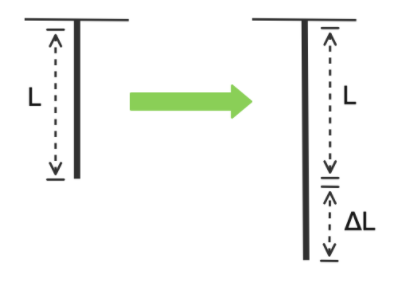
As given in the diagram we are given the string of length L that will stretch with $\Delta L$ this creates the elongated string of length $L + \Delta L$. In this process some work done has happened
So to deduce how much work happened we will use the relation between work done, force and length
$W = \dfrac{1}{2}(F \times \Delta L)$
As given the question work done is equal to -10 J we will substitute this in the above formula
-$10{\text{ J}} = \dfrac{1}{2}(F \times \Delta L)$
Work done is negative because the restoring force is applied in the upward direction while the displacement of the wire is in the downward direction
The work done is converted into heat energy as well as elastic potential energy
We are asked the maximum amount of heat energy produce which can be the whole work done so the answer is 10 J
The heat produce cannot be negative so answer is positive 10 J
Hence, the correct option a) 10 J.
Note: Many of the people will make the mistake by not taking elastic potential energy in account but both the heat energy as well as elastic potential energy should be consider here in the question we use minimum elastic potential energy that is zero as it asked about maximum heat energy produce in elongating the string .
Formula Used:
$W = \dfrac{1}{2}(F \times \Delta L)$
W refers to work done
F refers to force
$\Delta L$ refers to length
Complete step by step solution:
In the question we are given work done by restoring force in a string within elastic limit and we have to find the Maximum amount of heat produced in the string
Work done = - 10 J
As given in the diagram we are given the string of length L that will stretch with $\Delta L$ this creates the elongated string of length $L + \Delta L$. In this process some work done has happened
So to deduce how much work happened we will use the relation between work done, force and length
$W = \dfrac{1}{2}(F \times \Delta L)$
As given the question work done is equal to -10 J we will substitute this in the above formula
-$10{\text{ J}} = \dfrac{1}{2}(F \times \Delta L)$
Work done is negative because the restoring force is applied in the upward direction while the displacement of the wire is in the downward direction
The work done is converted into heat energy as well as elastic potential energy
We are asked the maximum amount of heat energy produce which can be the whole work done so the answer is 10 J
The heat produce cannot be negative so answer is positive 10 J
Hence, the correct option a) 10 J.
Note: Many of the people will make the mistake by not taking elastic potential energy in account but both the heat energy as well as elastic potential energy should be consider here in the question we use minimum elastic potential energy that is zero as it asked about maximum heat energy produce in elongating the string .
Recently Updated Pages
Master Class 11 Computer Science: Engaging Questions & Answers for Success

Master Class 11 Business Studies: Engaging Questions & Answers for Success
Master Class 11 Economics: Engaging Questions & Answers for Success
Master Class 11 English: Engaging Questions & Answers for Success
Master Class 11 Maths: Engaging Questions & Answers for Success
Master Class 11 Biology: Engaging Questions & Answers for Success
Trending doubts
One Metric ton is equal to kg A 10000 B 1000 C 100 class 11 physics CBSE
There are 720 permutations of the digits 1 2 3 4 5 class 11 maths CBSE
Discuss the various forms of bacteria class 11 biology CBSE
Draw a diagram of a plant cell and label at least eight class 11 biology CBSE
State the laws of reflection of light
Explain zero factorial class 11 maths CBSE