




How much work does it take to push an object with a mass of $ 1kg $ up a $ 6m $ ramp, if the ramp has an incline of $ \dfrac{5\pi }{12} $ and a kinetic friction coefficient of $ 4 $ ?
Answer
 Verified
545.4k+ views
Hint :In such questions we can just draw a free body diagram and balance the forces. By balancing the forces we can get the actual force required to push the object upwards. Once we get the force required to push the object we can easily find the work done by using its formula which is the dot product of force required times the displacement. In the question we have already given the displacement which is $ 6m $ and we only need to find force.
Work done: $ W=F\cdot d $
Where $ F $ is the force and $ d $ is the displacement.
Frictional force $ f=\mu N $
Where $ \mu $ is the friction coefficient and $ N $ is the normal force.
Complete Step By Step Answer:
Let us first draw the free body diagram for the given situation
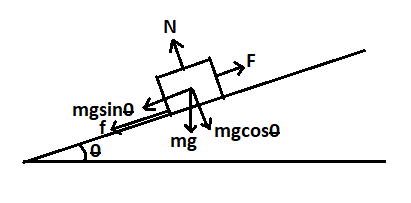
In the above diagram $ F $ is the upward force acting on the object to push upwards, $ f $ is the frictional force which will act opposite to the direction of motion, $ mg $ ( $ m $ is mass of the object and $ g $ is gravitational acceleration) is the downward gravitational pull acting on the object, $ mgcos\theta $ and $ mgsin\theta $ are the cosine and sine components respectively of the $ mg $ whereas $ N $ is the normal force on the object. Here $ \theta $ is the angle which the ramp makes with the horizontal surface and its value according to the question is $ \theta =\dfrac{5\pi }{12} $ .
We know that frictional force is given as the product of coefficient of friction and normal force, so we have
$ f=\mu N $
where, $ \mu $ is coefficient of friction and according to question, $ \mu =4 $ and from the above diagram we can see that cosine component of $ mg $ balances the normal force, so we can rewrite the above equation as
$ f=\mu mg\cos \theta $
Similarly, by balancing the forces in the above diagram we get $ F $ as
$F=f+mg\sin \theta $
$ \Rightarrow F=\mu mg\cos \theta +mg\sin \theta $
$\Rightarrow F=mg(\mu \cos \theta +\sin \theta ) $
Substituting the values we get ( $ m=1kg,g=9.8m/s $ )
$\Rightarrow F=(1)(9.8)\left[ (4)\cos \left( \dfrac{5\pi }{12} \right)+\sin \left( \dfrac{5\pi }{12} \right) \right] $
$ \Rightarrow F=9.8\left[ 1.03+0.97 \right] $
$ \Rightarrow F=9.8\times 2=19.6N $
Now, let us calculate the work done. Work done is the force $ F $ required to displace any object ‘ $ d $ ’ meters from its initial position and it is given as dot product of force and displacement, i.e.
$ W=F\cdot d $
As the force and displacement takes place in the same direction, work done can be just given as force times displacement.
$ W=Fd $
Substituting value of F calculated above and $ d=6m $ , we have
$W=19.6\times 6 $
$W=117.6J $
Note :
In case force and displacement is perpendicular to each other then, no work will be done whereas if they are in opposite directions negative work is done due to the dot product. Also while calculating note that the value of angle is in radian and not in degrees. In case the object was pulled upward with the help of string then we also have to consider the tension.
Work done: $ W=F\cdot d $
Where $ F $ is the force and $ d $ is the displacement.
Frictional force $ f=\mu N $
Where $ \mu $ is the friction coefficient and $ N $ is the normal force.
Complete Step By Step Answer:
Let us first draw the free body diagram for the given situation
In the above diagram $ F $ is the upward force acting on the object to push upwards, $ f $ is the frictional force which will act opposite to the direction of motion, $ mg $ ( $ m $ is mass of the object and $ g $ is gravitational acceleration) is the downward gravitational pull acting on the object, $ mgcos\theta $ and $ mgsin\theta $ are the cosine and sine components respectively of the $ mg $ whereas $ N $ is the normal force on the object. Here $ \theta $ is the angle which the ramp makes with the horizontal surface and its value according to the question is $ \theta =\dfrac{5\pi }{12} $ .
We know that frictional force is given as the product of coefficient of friction and normal force, so we have
$ f=\mu N $
where, $ \mu $ is coefficient of friction and according to question, $ \mu =4 $ and from the above diagram we can see that cosine component of $ mg $ balances the normal force, so we can rewrite the above equation as
$ f=\mu mg\cos \theta $
Similarly, by balancing the forces in the above diagram we get $ F $ as
$F=f+mg\sin \theta $
$ \Rightarrow F=\mu mg\cos \theta +mg\sin \theta $
$\Rightarrow F=mg(\mu \cos \theta +\sin \theta ) $
Substituting the values we get ( $ m=1kg,g=9.8m/s $ )
$\Rightarrow F=(1)(9.8)\left[ (4)\cos \left( \dfrac{5\pi }{12} \right)+\sin \left( \dfrac{5\pi }{12} \right) \right] $
$ \Rightarrow F=9.8\left[ 1.03+0.97 \right] $
$ \Rightarrow F=9.8\times 2=19.6N $
Now, let us calculate the work done. Work done is the force $ F $ required to displace any object ‘ $ d $ ’ meters from its initial position and it is given as dot product of force and displacement, i.e.
$ W=F\cdot d $
As the force and displacement takes place in the same direction, work done can be just given as force times displacement.
$ W=Fd $
Substituting value of F calculated above and $ d=6m $ , we have
$W=19.6\times 6 $
$W=117.6J $
Note :
In case force and displacement is perpendicular to each other then, no work will be done whereas if they are in opposite directions negative work is done due to the dot product. Also while calculating note that the value of angle is in radian and not in degrees. In case the object was pulled upward with the help of string then we also have to consider the tension.
Recently Updated Pages
Three beakers labelled as A B and C each containing 25 mL of water were taken A small amount of NaOH anhydrous CuSO4 and NaCl were added to the beakers A B and C respectively It was observed that there was an increase in the temperature of the solutions contained in beakers A and B whereas in case of beaker C the temperature of the solution falls Which one of the following statements isarecorrect i In beakers A and B exothermic process has occurred ii In beakers A and B endothermic process has occurred iii In beaker C exothermic process has occurred iv In beaker C endothermic process has occurred

Master Class 11 Social Science: Engaging Questions & Answers for Success
Master Class 11 Physics: Engaging Questions & Answers for Success
Master Class 11 Maths: Engaging Questions & Answers for Success
Master Class 11 Economics: Engaging Questions & Answers for Success
Master Class 11 Computer Science: Engaging Questions & Answers for Success
Three beakers labelled as A B and C each containing 25 mL of water were taken A small amount of NaOH anhydrous CuSO4 and NaCl were added to the beakers A B and C respectively It was observed that there was an increase in the temperature of the solutions contained in beakers A and B whereas in case of beaker C the temperature of the solution falls Which one of the following statements isarecorrect i In beakers A and B exothermic process has occurred ii In beakers A and B endothermic process has occurred iii In beaker C exothermic process has occurred iv In beaker C endothermic process has occurred
Master Class 11 Social Science: Engaging Questions & Answers for Success
Master Class 11 Physics: Engaging Questions & Answers for Success
Trending doubts
One Metric ton is equal to kg A 10000 B 1000 C 100 class 11 physics CBSE
There are 720 permutations of the digits 1 2 3 4 5 class 11 maths CBSE
State and prove Bernoullis theorem class 11 physics CBSE
Draw a diagram of a plant cell and label at least eight class 11 biology CBSE
Difference Between Prokaryotic Cells and Eukaryotic Cells
1 Quintal is equal to a 110 kg b 10 kg c 100kg d 1000 class 11 physics CBSE