




With the help of labelled diagrams explain the human male reproductive system.
Answer
 Verified
637.5k+ views
Hint: The male reproductive organs also have external reproductive parts like the female reproductive organs. The external part of the male reproductive system involves mostly during sexual intercourse.
Complete answer:
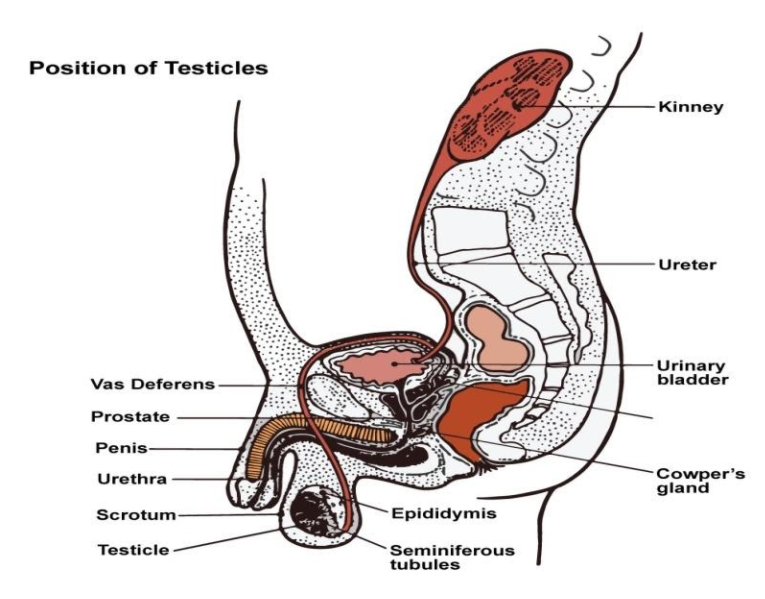
To understand the male reproductive organs, we should first know the purpose of the male reproductive organs of the system. The reproductive organs of male involve in the production, transport, and maintenance of sperm, involve in the ejaculation of sperm inside the female reproductive area, and also involve in the secretion of male sex hormones that maintain the reproductive system in males. The penis, scrotum, and testicles are the external reproductive parts of males. The vas deferens, ejaculatory ducts, urethra, seminal vesicles, prostate gland, and bulbourethral gland are the internal reproductive parts of male.
The penis is the reproductive organs that are involved in the sexual intercourse. It has a root attaché to the abdomen wall, the shaft and the glans that is cone shaped.
Scrotum is a loose pouch-like sac of skin that is found behind the penis that contains the testicles and blood vessels. It maintains the temperature for the testes for sperm development.
Epididymis is a coiled, long tube that is found in the backside of the testicles. It involves the storage of sperm cells that are produced by the testes.
Vas deferens is a muscular, long tube that connects the epididymis into the pelvic cavity. It transfers mature sperm to the urethra before ejaculation.
The urethra is the tube that collects urine from the bladder. The seminal vesicles are the sac-like pouches that attach to the vas deferens found near the bladder.
The ejaculatory ducts are formed from the fusion of the seminal vesicles and vas deferens.
Note: The male reproductive organs involve the prostate gland that is found below the urinary bladder. It involves the ejaculation of additional fluid to maintain the sperm. The bulbourethral gland is the gland that is found on the side of urethra under the prostate gland. It produces a slippery fluid.
Complete answer:
To understand the male reproductive organs, we should first know the purpose of the male reproductive organs of the system. The reproductive organs of male involve in the production, transport, and maintenance of sperm, involve in the ejaculation of sperm inside the female reproductive area, and also involve in the secretion of male sex hormones that maintain the reproductive system in males. The penis, scrotum, and testicles are the external reproductive parts of males. The vas deferens, ejaculatory ducts, urethra, seminal vesicles, prostate gland, and bulbourethral gland are the internal reproductive parts of male.
The penis is the reproductive organs that are involved in the sexual intercourse. It has a root attaché to the abdomen wall, the shaft and the glans that is cone shaped.
Scrotum is a loose pouch-like sac of skin that is found behind the penis that contains the testicles and blood vessels. It maintains the temperature for the testes for sperm development.
Epididymis is a coiled, long tube that is found in the backside of the testicles. It involves the storage of sperm cells that are produced by the testes.
Vas deferens is a muscular, long tube that connects the epididymis into the pelvic cavity. It transfers mature sperm to the urethra before ejaculation.
The urethra is the tube that collects urine from the bladder. The seminal vesicles are the sac-like pouches that attach to the vas deferens found near the bladder.
The ejaculatory ducts are formed from the fusion of the seminal vesicles and vas deferens.
Note: The male reproductive organs involve the prostate gland that is found below the urinary bladder. It involves the ejaculation of additional fluid to maintain the sperm. The bulbourethral gland is the gland that is found on the side of urethra under the prostate gland. It produces a slippery fluid.
Recently Updated Pages
Master Class 11 English: Engaging Questions & Answers for Success

Master Class 11 Social Science: Engaging Questions & Answers for Success
Master Class 11 Maths: Engaging Questions & Answers for Success
Master Class 11 Biology: Engaging Questions & Answers for Success
Master Class 11 Physics: Engaging Questions & Answers for Success
Master Class 11 Chemistry: Engaging Questions & Answers for Success
Trending doubts
Explain the Treaty of Vienna of 1815 class 10 social science CBSE
First Cotton Mill of India
In which year voting age was reduced from 21 to 18?
What planets have no moons Which one has only one moon class 10 physics CBSE
What is the full form of POSCO class 10 social science CBSE
10 examples of evaporation in daily life with explanations