




With the help of a block diagram, explain the operation of the FM superheterodyne receiver.
Answer
 Verified
605.1k+ views
Hint: A superheterodyne receiver is a radio frequency receiver that uses frequency mixing to convert a received signal into an Intermediate frequency (IF), this allows the signal to be processed more conveniently than processing the original carrier frequency.
Complete Step by step answer:
Following is the block diagram for an FM superheterodyne receiver-
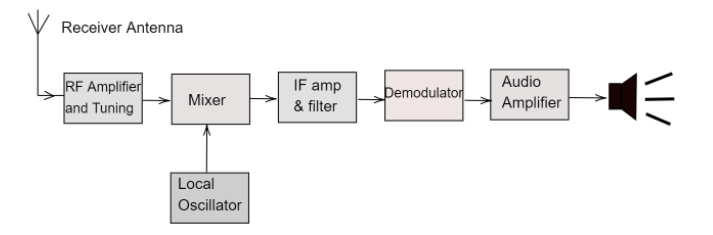
The receiver first receives the signals from the antenna and is fed to the RF Amplifier. In the RF amplifier, they are also tuned in order to remove any unwanted signals from other frequencies.
The tuned signals from the RF amplifier mixes with the incoming local frequency signals which are generated from a local oscillator. This mixing process is done in the mixer and this mixing creates an intermediate frequency (IF).
The intermediate frequency formed by the mixing is more convenient to process as compared to the original carrier frequency.
The intermediate frequency is then amplified and filtered, this amplitude is maintained by using a limiter. During filtering, the signals of a particular channel can be selected. As compared to RF filtering, the IF filter can be tuned better than the RF filter because it can be designed for a fixed frequency.
This signal is then applied to a demodulator which is an FM detector, this detector demodulates the output. It is also possible to switch between different demodulators to achieve the desired output form.
This demodulated signal is then audio amplified using a loudspeaker where it converts to sound waves of the audible frequency.
Note: The speciality of a superheterodyne FM receiver is that it mixes the original incoming frequency from a source with a locally generated frequency, this allows the receiver to filter and select only the desired RF signals.
Complete Step by step answer:
Following is the block diagram for an FM superheterodyne receiver-
The receiver first receives the signals from the antenna and is fed to the RF Amplifier. In the RF amplifier, they are also tuned in order to remove any unwanted signals from other frequencies.
The tuned signals from the RF amplifier mixes with the incoming local frequency signals which are generated from a local oscillator. This mixing process is done in the mixer and this mixing creates an intermediate frequency (IF).
The intermediate frequency formed by the mixing is more convenient to process as compared to the original carrier frequency.
The intermediate frequency is then amplified and filtered, this amplitude is maintained by using a limiter. During filtering, the signals of a particular channel can be selected. As compared to RF filtering, the IF filter can be tuned better than the RF filter because it can be designed for a fixed frequency.
This signal is then applied to a demodulator which is an FM detector, this detector demodulates the output. It is also possible to switch between different demodulators to achieve the desired output form.
This demodulated signal is then audio amplified using a loudspeaker where it converts to sound waves of the audible frequency.
Note: The speciality of a superheterodyne FM receiver is that it mixes the original incoming frequency from a source with a locally generated frequency, this allows the receiver to filter and select only the desired RF signals.
Recently Updated Pages
Master Class 12 Business Studies: Engaging Questions & Answers for Success

Master Class 12 Chemistry: Engaging Questions & Answers for Success
Master Class 12 Biology: Engaging Questions & Answers for Success
Class 12 Question and Answer - Your Ultimate Solutions Guide
Master Class 11 English: Engaging Questions & Answers for Success
Master Class 11 Social Science: Engaging Questions & Answers for Success
Trending doubts
Which are the Top 10 Largest Countries of the World?
Draw a labelled sketch of the human eye class 12 physics CBSE
Differentiate between homogeneous and heterogeneous class 12 chemistry CBSE
Differentiate between Pyramid of energy and pyramid class 12 biology CBSE
Why is the cell called the structural and functional class 12 biology CBSE
Draw the diagram of the pyramid of energy Explain In class 12 biology CBSE