




With reference to photosynthesis, what is the
A. \[{\text{C}}{{\text{F}}_{\text{0}}}{\text{ - C}}{{\text{F}}_{\text{1}}}\] complex?
B. ATP synthetase
C. Ferredoxin-NADP reductase
D. \[{\text{Cytochrome b6f complex}}\]
E. RuBP carboxylase
Answer
 Verified
510k+ views
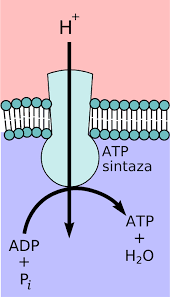
Hint: Photosynthesis is a process used by the plants to sustain their life. They do so by converting light energy into chemical energy. \[{\text{C}}{{\text{F}}_{\text{0}}}{\text{ - C}}{{\text{F}}_{\text{1}}}\] complex is an important component of the proton channel. It directly has a role in the translocation of protons across the membrane. \[{\text{C}}{{\text{F}}_1}\] is the catalytic core and \[{\text{C}}{{\text{F}}_{\text{0}}}\] is the membrane proton channel.
Complete Answer:
The \[{\text{C}}{{\text{F}}_{\text{0}}}{\text{ - C}}{{\text{F}}_{\text{1}}}\]complex is a protein. Its function is the catalysis of the formation of the energy storage molecule called ATP (adenosine triphosphate). ATP is made by using ADP (adenosine diphosphate) and PI (inorganic phosphate). It is classified under ligases.
RuBP Carboxylase is an enzyme which is part of the first main step of carbon fixation. This is the process through which the atmospheric carbon dioxide is converted by plants through photosynthesis into energy rich molecules like glucose.
\[{\text{Cytochrome b6f complex}}\] is an enzyme that is found in the thylakoid membrane of chloroplasts in plants, cyanobacteria, and green algae. It acts as a catalyst for the transfer of electrons from plastoquinol to plastocyanin.
Ferredoxin-NADP Reductase acts as a catalyst to the reaction which converts reduced ferredoxin, $NADP^+$, and $H^+$ to oxidized ferredoxin and NADPH. This enzyme is a type of oxidoreductase enzyme.
The proton – linked ATP synthetase of chloroplasts is known as \[{\text{C}}{{\text{F}}_{\text{0}}}{\text{ - C}}{{\text{F}}_{\text{1}}}\] complex. The catalytic part is known as \[{\text{C}}{{\text{F}}_1}\] and the membrane bound part is known as \[{\text{C}}{{\text{F}}_{\text{0}}}\]. It interacts with \[{\text{C}}{{\text{F}}_1}\] and contains a proton channel.
So, the correct answer is option A, ATP synthetase.
Note:
In plants, the synthesis of ATP does not take place in the mitochondria even though they are the powerhouse of the cells. It happens in membrane bound sacs known as thylakoids. They are arranged in the form of stacks and are called the grana of chloroplast. Mitochondria’s division is accelerated by the body's increased demand for energy and they divide independently by fission.
Complete Answer:
The \[{\text{C}}{{\text{F}}_{\text{0}}}{\text{ - C}}{{\text{F}}_{\text{1}}}\]complex is a protein. Its function is the catalysis of the formation of the energy storage molecule called ATP (adenosine triphosphate). ATP is made by using ADP (adenosine diphosphate) and PI (inorganic phosphate). It is classified under ligases.
RuBP Carboxylase is an enzyme which is part of the first main step of carbon fixation. This is the process through which the atmospheric carbon dioxide is converted by plants through photosynthesis into energy rich molecules like glucose.
\[{\text{Cytochrome b6f complex}}\] is an enzyme that is found in the thylakoid membrane of chloroplasts in plants, cyanobacteria, and green algae. It acts as a catalyst for the transfer of electrons from plastoquinol to plastocyanin.
Ferredoxin-NADP Reductase acts as a catalyst to the reaction which converts reduced ferredoxin, $NADP^+$, and $H^+$ to oxidized ferredoxin and NADPH. This enzyme is a type of oxidoreductase enzyme.
The proton – linked ATP synthetase of chloroplasts is known as \[{\text{C}}{{\text{F}}_{\text{0}}}{\text{ - C}}{{\text{F}}_{\text{1}}}\] complex. The catalytic part is known as \[{\text{C}}{{\text{F}}_1}\] and the membrane bound part is known as \[{\text{C}}{{\text{F}}_{\text{0}}}\]. It interacts with \[{\text{C}}{{\text{F}}_1}\] and contains a proton channel.
So, the correct answer is option A, ATP synthetase.
Note:
In plants, the synthesis of ATP does not take place in the mitochondria even though they are the powerhouse of the cells. It happens in membrane bound sacs known as thylakoids. They are arranged in the form of stacks and are called the grana of chloroplast. Mitochondria’s division is accelerated by the body's increased demand for energy and they divide independently by fission.
Recently Updated Pages
Master Class 11 Computer Science: Engaging Questions & Answers for Success

Master Class 11 Business Studies: Engaging Questions & Answers for Success
Master Class 11 Economics: Engaging Questions & Answers for Success
Master Class 11 English: Engaging Questions & Answers for Success
Master Class 11 Maths: Engaging Questions & Answers for Success
Master Class 11 Biology: Engaging Questions & Answers for Success
Trending doubts
One Metric ton is equal to kg A 10000 B 1000 C 100 class 11 physics CBSE
There are 720 permutations of the digits 1 2 3 4 5 class 11 maths CBSE
Discuss the various forms of bacteria class 11 biology CBSE
Draw a diagram of a plant cell and label at least eight class 11 biology CBSE
State the laws of reflection of light
Explain zero factorial class 11 maths CBSE