




Why is \[Pb{{O}_{2}}\] not peroxide?
Answer
 Verified
556.5k+ views
Hint: Peroxide ion has the molecular formula \[{{O}_{2}}^{2-}\]. The treatment of metallic oxides with acid i.e. hydrochloric acid produces hydrogen peroxide. The formation of peroxides is feasible with hydrogen, alkali and alkaline earth metals.
Complete answer:
Peroxides are formed by the treatment of metallic oxides with acid i.e. hydrochloric acid. The molecular formula of peroxide ion is \[{{O}_{2}}^{2-}\]. The structure of hydrogen peroxide is given in the following diagram:
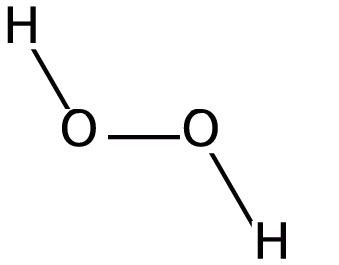
From the above diagram, we conclude that in peroxides, there is a single bond present between two oxygen atoms and charge on each oxygen atom is \[-1\]. Let us now consider the structure of \[Pb{{O}_{2}}\] which is described in the following diagram-
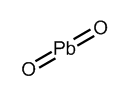
From the above structure, we conclude that \[O-O\]bond is not present in \[Pb{{O}_{2}}\] . In \[Pb{{O}_{2}}\] , lead is present in \[+4\] oxidation state while each oxygen atom carries a \[-2\] charge.
Therefore, \[Pb{{O}_{2}}\] is not a peroxide.
Additional information:
The chemical name of \[Pb{{O}_{2}}\] is lead dioxide. The electronic configuration of lead is \[[Xe]6{{s}^{2}}4{{f}^{14}}5{{d}^{10}}6{{p}^{2}}\]. Considering the electronic configuration into the account, the oxidation state of lead should be \[+2\] and \[+4\]. Due to the inert pair effect, \[+2\]oxidation state of lead is more stable in comparison to \[+4\] . As a consequence, \[PbO\] is much more stable than \[Pb{{O}_{2}}\].
Note:
It is important to note that the structure of \[Pb{{O}_{2}}\] doesn’t contain \[O-O\] bond. Hence, \[Pb{{O}_{2}}\] is not a peroxide. In \[Pb{{O}_{2}}\] , lead is present in \[+4\] oxidation state while each oxygen atom carries a \[-2\] charge.
Complete answer:
Peroxides are formed by the treatment of metallic oxides with acid i.e. hydrochloric acid. The molecular formula of peroxide ion is \[{{O}_{2}}^{2-}\]. The structure of hydrogen peroxide is given in the following diagram:
From the above diagram, we conclude that in peroxides, there is a single bond present between two oxygen atoms and charge on each oxygen atom is \[-1\]. Let us now consider the structure of \[Pb{{O}_{2}}\] which is described in the following diagram-
From the above structure, we conclude that \[O-O\]bond is not present in \[Pb{{O}_{2}}\] . In \[Pb{{O}_{2}}\] , lead is present in \[+4\] oxidation state while each oxygen atom carries a \[-2\] charge.
Therefore, \[Pb{{O}_{2}}\] is not a peroxide.
Additional information:
The chemical name of \[Pb{{O}_{2}}\] is lead dioxide. The electronic configuration of lead is \[[Xe]6{{s}^{2}}4{{f}^{14}}5{{d}^{10}}6{{p}^{2}}\]. Considering the electronic configuration into the account, the oxidation state of lead should be \[+2\] and \[+4\]. Due to the inert pair effect, \[+2\]oxidation state of lead is more stable in comparison to \[+4\] . As a consequence, \[PbO\] is much more stable than \[Pb{{O}_{2}}\].
Note:
It is important to note that the structure of \[Pb{{O}_{2}}\] doesn’t contain \[O-O\] bond. Hence, \[Pb{{O}_{2}}\] is not a peroxide. In \[Pb{{O}_{2}}\] , lead is present in \[+4\] oxidation state while each oxygen atom carries a \[-2\] charge.
Recently Updated Pages
Master Class 11 English: Engaging Questions & Answers for Success

Master Class 11 Physics: Engaging Questions & Answers for Success
Master Class 11 Computer Science: Engaging Questions & Answers for Success
Master Class 11 Chemistry: Engaging Questions & Answers for Success
Master Class 11 Social Science: Engaging Questions & Answers for Success
Master Class 11 Accountancy: Engaging Questions & Answers for Success
Trending doubts
Difference Between Prokaryotic Cells and Eukaryotic Cells
Two of the body parts which do not appear in MRI are class 11 biology CBSE
One Metric ton is equal to kg A 10000 B 1000 C 100 class 11 physics CBSE
10 examples of friction in our daily life
Draw a diagram of nephron and explain its structur class 11 biology CBSE
Draw a diagram of a plant cell and label at least eight class 11 biology CBSE