




How and why does hybridization occur $ ? $ For example, why does $ N{H_3} $ form an $ s{p^3} $ orbital $ ? $
Answer
 Verified
567.3k+ views
Hint: Hybridization is the concept of mixing atomic orbitals into new hybrid orbitals with different energies, shapes, etc., than the component atomic orbitals, suitable for the pairing of electrons to form chemical bonds in valence bond theory. Write the electronic configuration for the central atom in $ N{H_3} $ and check for the hybridization.
Complete step by step solution:
The idea of hybridization was developed because of the fact that all the $ C - H $ bonds in methane are similar. Hybridization is a theory which starts with the consideration that when atoms combine to form a molecule combination of atomic orbitals to produce new orbitals of varying energies and shapes than the initial orbitals occur. The new orbital will contain the same total electron number as the old electrons. This new hybrid molecular orbital belongs to the molecule as a whole, but its geometry is determined by the types of atomic orbitals in the central atom that were involved in the bonding of the molecule. Hybrid orbitals are useful in the explanation of molecular geometry and atomic bonding properties and are symmetrically disposed in space. For example, in a carbon atom which forms four single bonds the valence-shell $ s $ orbital combines with three valence-shell $ p $ orbitals to form four equivalent $ s{p^3} $ hybrid orbitals which are arranged in a tetrahedral arrangement around the carbon to bond to four different atoms.
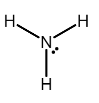
In case of $ N{H_3} $ , $ N $ is the central atom having an electronic configuration, $ \left[ {He} \right]2{s^2}2{p^3} $ which can be represented as:
$
\underline { \uparrow \downarrow } \,\,\,\,\,\underline \uparrow \,\,\,\,\,\,\underline \uparrow \,\,\,\,\,\,\underline \uparrow \\
2s\,\,\,2{p_x}\,\,2{p_y}\,\,2{p_z} \\
$ , which is the ground state as well as the excited state configuration. The one $ s $ orbital combines with three valence-shell $ p $ orbitals to form four equivalent $ s{p^3} $ hybrid orbitals where the paired electrons form a lone pair on $ N $ while the three unpaired electrons form sigma bond with $ H $ and hence has a distorted tetrahedral geometry.
Note:
You can also use Valence Shell Electron Pair Repulsion theory to know the structure or geometry of the compound by using electron count of the central atom of the molecule and then by using the structure or geometry you can determine the hybridization of the compound.
Complete step by step solution:
The idea of hybridization was developed because of the fact that all the $ C - H $ bonds in methane are similar. Hybridization is a theory which starts with the consideration that when atoms combine to form a molecule combination of atomic orbitals to produce new orbitals of varying energies and shapes than the initial orbitals occur. The new orbital will contain the same total electron number as the old electrons. This new hybrid molecular orbital belongs to the molecule as a whole, but its geometry is determined by the types of atomic orbitals in the central atom that were involved in the bonding of the molecule. Hybrid orbitals are useful in the explanation of molecular geometry and atomic bonding properties and are symmetrically disposed in space. For example, in a carbon atom which forms four single bonds the valence-shell $ s $ orbital combines with three valence-shell $ p $ orbitals to form four equivalent $ s{p^3} $ hybrid orbitals which are arranged in a tetrahedral arrangement around the carbon to bond to four different atoms.
In case of $ N{H_3} $ , $ N $ is the central atom having an electronic configuration, $ \left[ {He} \right]2{s^2}2{p^3} $ which can be represented as:
$
\underline { \uparrow \downarrow } \,\,\,\,\,\underline \uparrow \,\,\,\,\,\,\underline \uparrow \,\,\,\,\,\,\underline \uparrow \\
2s\,\,\,2{p_x}\,\,2{p_y}\,\,2{p_z} \\
$ , which is the ground state as well as the excited state configuration. The one $ s $ orbital combines with three valence-shell $ p $ orbitals to form four equivalent $ s{p^3} $ hybrid orbitals where the paired electrons form a lone pair on $ N $ while the three unpaired electrons form sigma bond with $ H $ and hence has a distorted tetrahedral geometry.
Note:
You can also use Valence Shell Electron Pair Repulsion theory to know the structure or geometry of the compound by using electron count of the central atom of the molecule and then by using the structure or geometry you can determine the hybridization of the compound.
Recently Updated Pages
Master Class 11 English: Engaging Questions & Answers for Success

Master Class 11 Maths: Engaging Questions & Answers for Success
Class 11 Question and Answer - Your Ultimate Solutions Guide
Master Class 11 Biology: Engaging Questions & Answers for Success
Master Class 11 Physics: Engaging Questions & Answers for Success
Master Class 11 Accountancy: Engaging Questions & Answers for Success
Trending doubts
Differentiate between an exothermic and an endothermic class 11 chemistry CBSE
One Metric ton is equal to kg A 10000 B 1000 C 100 class 11 physics CBSE
Difference Between Prokaryotic Cells and Eukaryotic Cells
There are 720 permutations of the digits 1 2 3 4 5 class 11 maths CBSE
Draw a diagram of a plant cell and label at least eight class 11 biology CBSE
1 Quintal is equal to a 110 kg b 10 kg c 100kg d 1000 class 11 physics CBSE