




Why are prokaryotes small?
Answer
 Verified
595.8k+ views
Hint: Prokaryotes are small, unicellular organisms that do not have membrane-bound organelles. Prokaryotes are bacteria and blue-green algae. The reproduction that occurs may be of both sexual and asexual type depending upon certain organisms.
Complete answer:
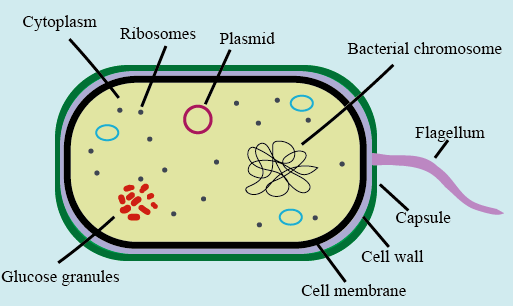
Prokaryotes are unicellular organisms in nature. Its cell ranges in size from $0.2\mu m$ – $2\mu m$ in diameter. They lack a well-organized nucleus. The permeability of the Nuclear membrane is not present. The nucleolus is absent. Various cell organelles are absent in prokaryotes that include the Golgi apparatus, endoplasmic reticulum, and mitochondria are absent. They are very minute and are submicroscopic in size. Flagella with only a single fiber are present that helps in their locomotion. Due to the smaller size of prokaryotes, the dispersion of the particles occurs rapidly.
The cell wall is found to be of peptidoglycan in most of the prokaryotes. The cell membrane helps in keeping the shape of the cell while its capsule helps it in connecting to the outer environment.
Prokaryotes include most of the single-celled organisms, which consists of 2 major classes: archaea and bacteria. Bacterial or prokaryotic cells have only one cell which carries all the functions of the organisms. These cells can also form a community in which company each other to combat the competitors. All reaction occurs in the cytosol of the prokaryotic cell. While this makes the cells slightly less efficient, prokaryotic cells still have an interesting reproductive capacity. A prokaryote imitates through twofold parting, a cycle that just parts copied DNA into independent cells. Without any organelles or complex chromosomes to breed, most prokaryotic cells can divide every 24 hours, or maybe faster with an adequate supply of food.
Note:
Reproduction in the case of prokaryotes maybe both sexual and asexual depending upon organisms and their mechanism. In the case of bacteria and archaea, sexual reproduction occurs by transferring the DNA. Sexual reproduction in bacteria occurs in three stages that include, first stage is the bacterial virus-mediated transduction, the second stage is plasmid-mediated conjugation, and the third stage is the natural transformation.
Complete answer:
Prokaryotes are unicellular organisms in nature. Its cell ranges in size from $0.2\mu m$ – $2\mu m$ in diameter. They lack a well-organized nucleus. The permeability of the Nuclear membrane is not present. The nucleolus is absent. Various cell organelles are absent in prokaryotes that include the Golgi apparatus, endoplasmic reticulum, and mitochondria are absent. They are very minute and are submicroscopic in size. Flagella with only a single fiber are present that helps in their locomotion. Due to the smaller size of prokaryotes, the dispersion of the particles occurs rapidly.
The cell wall is found to be of peptidoglycan in most of the prokaryotes. The cell membrane helps in keeping the shape of the cell while its capsule helps it in connecting to the outer environment.
Prokaryotes include most of the single-celled organisms, which consists of 2 major classes: archaea and bacteria. Bacterial or prokaryotic cells have only one cell which carries all the functions of the organisms. These cells can also form a community in which company each other to combat the competitors. All reaction occurs in the cytosol of the prokaryotic cell. While this makes the cells slightly less efficient, prokaryotic cells still have an interesting reproductive capacity. A prokaryote imitates through twofold parting, a cycle that just parts copied DNA into independent cells. Without any organelles or complex chromosomes to breed, most prokaryotic cells can divide every 24 hours, or maybe faster with an adequate supply of food.
Note:
Reproduction in the case of prokaryotes maybe both sexual and asexual depending upon organisms and their mechanism. In the case of bacteria and archaea, sexual reproduction occurs by transferring the DNA. Sexual reproduction in bacteria occurs in three stages that include, first stage is the bacterial virus-mediated transduction, the second stage is plasmid-mediated conjugation, and the third stage is the natural transformation.
Recently Updated Pages
Master Class 11 Social Science: Engaging Questions & Answers for Success

Master Class 11 English: Engaging Questions & Answers for Success
Master Class 11 Accountancy: Engaging Questions & Answers for Success
Master Class 11 Physics: Engaging Questions & Answers for Success
Master Class 11 Computer Science: Engaging Questions & Answers for Success
Master Class 11 Business Studies: Engaging Questions & Answers for Success
Trending doubts
One Metric ton is equal to kg A 10000 B 1000 C 100 class 11 physics CBSE
Find the value of the expression given below sin 30circ class 11 maths CBSE
Draw a diagram of nephron and explain its structur class 11 biology CBSE
10 examples of friction in our daily life
Proton was discovered by A Thomson B Rutherford C Chadwick class 11 chemistry CBSE
The teeth used for biting and cutting food are called class 11 biology CBSE