




Which type of plastids help in photosynthesis? Draw its diagram.
Answer
 Verified
597.6k+ views
Hint: Plastids are double membrane-bound organelles found only in plants. Their main function is procuring and storing food inside the cell which can be used up by the cell in conditions of stress. The plastids which help in the process of photosynthesis are composed of photosynthetic pigments that drive the photosystem to trap the sunlight which is essential for making food.
Complete answer: The type of plastids that help in photosynthesis is called a chloroplast. These plastids contain pigment such as chlorophyll a and b that absorb blue and red light. This light energy is then transduced to a chemical compound called glucose, which is stored as starch.
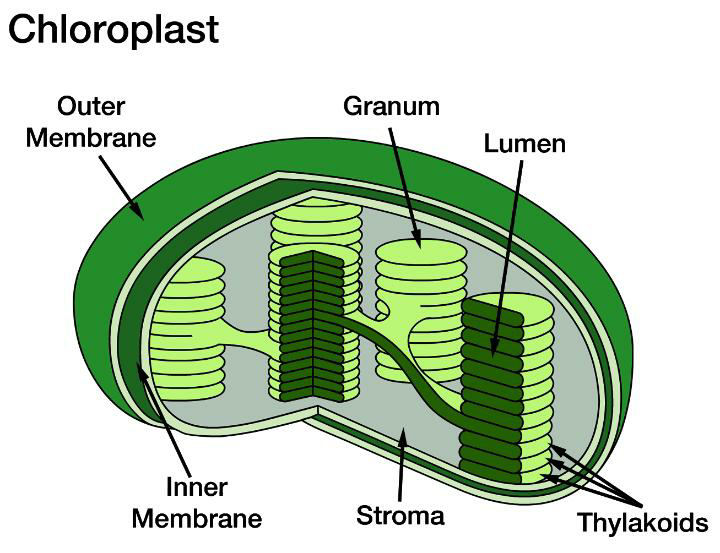
Chloroplasts are highly abundant plastids present in plants. They are responsible for carrying out the major process of food preparation via photosynthesis. These are present in the form of disc-shaped organelles within a plant cell, which allows plants to capture the solar energy. Chloroplasts are surrounded by two membranes, which means that they are bi-layered. The layers are made up of phospholipids. Photosynthesis occurs in two phases; light-dependent and light-independent. Energy molecules are synthesized in light-dependent reactions, whereas fixation of carbon dioxide takes place in light-independent reactions.
Note: Chloroplasts are composed of various organelles that are imperative to perform photosynthesis. These include stroma and lamellae which are further arranged as granum and lumen. It contains chlorophyll which acts as the reaction centre.
Complete answer: The type of plastids that help in photosynthesis is called a chloroplast. These plastids contain pigment such as chlorophyll a and b that absorb blue and red light. This light energy is then transduced to a chemical compound called glucose, which is stored as starch.
Chloroplasts are highly abundant plastids present in plants. They are responsible for carrying out the major process of food preparation via photosynthesis. These are present in the form of disc-shaped organelles within a plant cell, which allows plants to capture the solar energy. Chloroplasts are surrounded by two membranes, which means that they are bi-layered. The layers are made up of phospholipids. Photosynthesis occurs in two phases; light-dependent and light-independent. Energy molecules are synthesized in light-dependent reactions, whereas fixation of carbon dioxide takes place in light-independent reactions.
Note: Chloroplasts are composed of various organelles that are imperative to perform photosynthesis. These include stroma and lamellae which are further arranged as granum and lumen. It contains chlorophyll which acts as the reaction centre.
Recently Updated Pages
Master Class 11 English: Engaging Questions & Answers for Success

Master Class 11 Social Science: Engaging Questions & Answers for Success
Master Class 11 Maths: Engaging Questions & Answers for Success
Master Class 11 Biology: Engaging Questions & Answers for Success
Master Class 11 Physics: Engaging Questions & Answers for Success
Master Class 11 Chemistry: Engaging Questions & Answers for Success
Trending doubts
One Metric ton is equal to kg A 10000 B 1000 C 100 class 11 physics CBSE
Difference Between Prokaryotic Cells and Eukaryotic Cells
Two of the body parts which do not appear in MRI are class 11 biology CBSE
Find the value of the expression given below sin 30circ class 11 maths CBSE
Draw a diagram of a plant cell and label at least eight class 11 biology CBSE
10 examples of friction in our daily life