




Which structure in the heart is called pacemaker?
Answer
 Verified
608.1k+ views
Hint: Heart is made up of its own internal electrical system that regulates your heartbeat rate and rhythm. An electrical signal travels from the top of your heart to the bottom for each pulse. It causes the heart to contract and pumps blood as the signal travels. In a combination of cells called the sinus node sinoatrial (SA) node, each electrical signal usually starts and spreads from the top of the heart to the bottom.
Complete Answer:
- A pacemaker is a small device that's given position in the chest or abdomen to help control abnormal heart rhythms. This device usually takes help of electrical pulses to prompt the heart to beat at a normal rate.
- The sinus node (SA) continuously generated electrical impulses, thereby setting the normal rhythm and rate in a healthy heart.
- Hence, the SA node is also called as the natural pacemaker of the heart.
- The contraction of cardiac muscle (heart muscle) in all animals is started with the help of electrical impulses known as action potentials. The rate at which these. Impulses fire, controls the rate of Cardiac contraction, that is, heart rate.
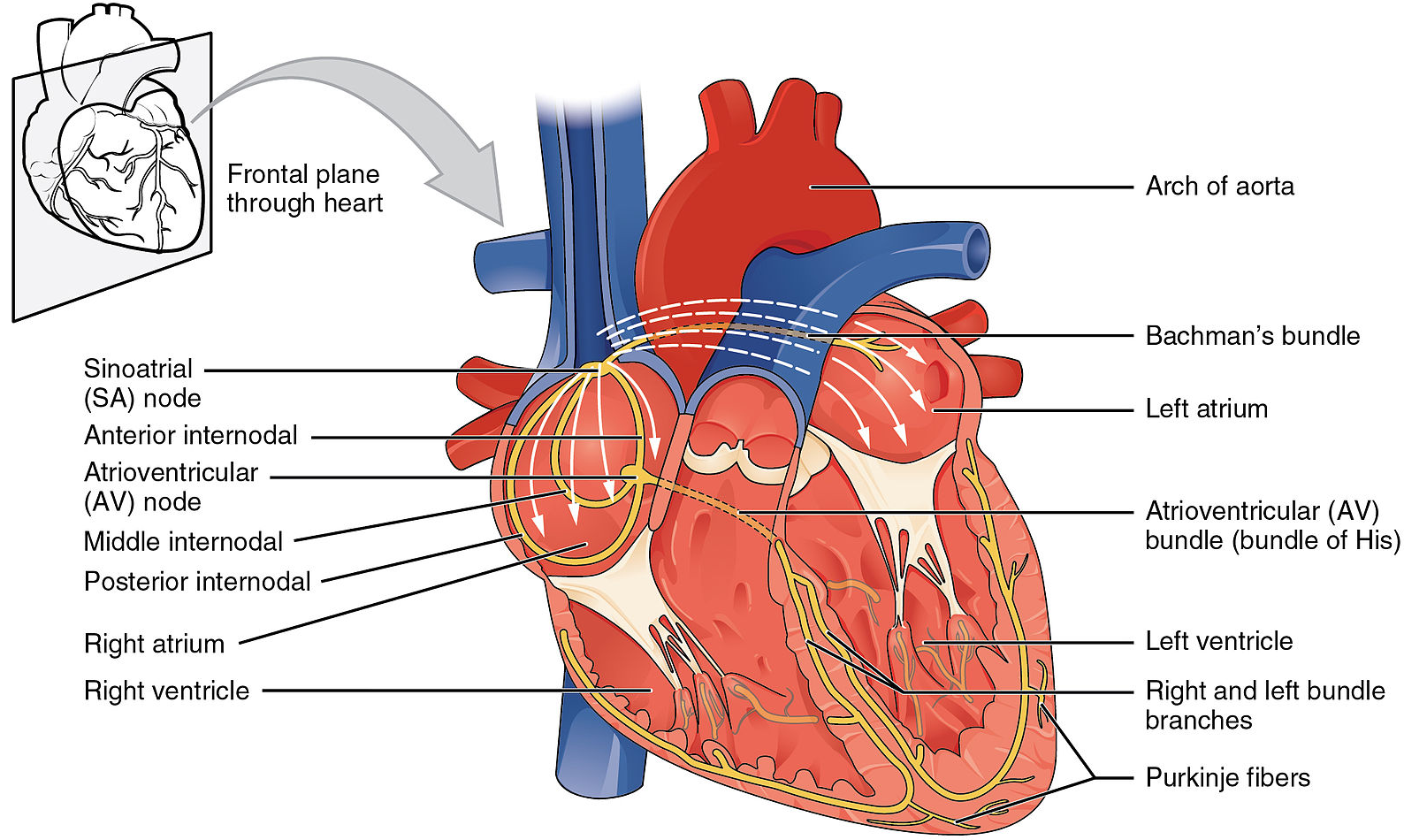
Diagram showing Sino-Atrial nodes.
- The cells that create these rhythmic impulses, setting the face for blood pumping, are called pacemaker cells, and they directly control the heart rate.
- They constitute the cardiac pacemaker, that is, the natural pacemaker of the heart. The concentration of pacemaker cells in the Sinoatrial (SA) node is the natural pacemaker, and the resultant rhythm is a sinus rhythm.
- Pacemaker is a Sinoatrial on SA node situated in the upper corner of all right atrium in the heart. Initiates and maintains the rhythmic contraction of the heart. Excitation waves begin in SA nodes due to which atria contract and the oxygenated and deoxygenated blood is forced into respective ventricles through atrioventricular valves. It acts as a stimulus for the next wave of excitation and thus maintains the frequency of heartbeat.
Note: Sometimes an ectopic pacemaker sets the face, if the SA node is damaged or if the electrical conduction system of the heart has problems. Cardiac arrhythmia can cause heart block, in which the contraction loses any useful rhythm. In humans, a mechanical device called an artificial pacemaker issued after damage to the body's intrinsic conduction system to produce these impulses synthetically.
Complete Answer:
- A pacemaker is a small device that's given position in the chest or abdomen to help control abnormal heart rhythms. This device usually takes help of electrical pulses to prompt the heart to beat at a normal rate.
- The sinus node (SA) continuously generated electrical impulses, thereby setting the normal rhythm and rate in a healthy heart.
- Hence, the SA node is also called as the natural pacemaker of the heart.
- The contraction of cardiac muscle (heart muscle) in all animals is started with the help of electrical impulses known as action potentials. The rate at which these. Impulses fire, controls the rate of Cardiac contraction, that is, heart rate.
Diagram showing Sino-Atrial nodes.
- The cells that create these rhythmic impulses, setting the face for blood pumping, are called pacemaker cells, and they directly control the heart rate.
- They constitute the cardiac pacemaker, that is, the natural pacemaker of the heart. The concentration of pacemaker cells in the Sinoatrial (SA) node is the natural pacemaker, and the resultant rhythm is a sinus rhythm.
- Pacemaker is a Sinoatrial on SA node situated in the upper corner of all right atrium in the heart. Initiates and maintains the rhythmic contraction of the heart. Excitation waves begin in SA nodes due to which atria contract and the oxygenated and deoxygenated blood is forced into respective ventricles through atrioventricular valves. It acts as a stimulus for the next wave of excitation and thus maintains the frequency of heartbeat.
Note: Sometimes an ectopic pacemaker sets the face, if the SA node is damaged or if the electrical conduction system of the heart has problems. Cardiac arrhythmia can cause heart block, in which the contraction loses any useful rhythm. In humans, a mechanical device called an artificial pacemaker issued after damage to the body's intrinsic conduction system to produce these impulses synthetically.
Recently Updated Pages
Master Class 11 English: Engaging Questions & Answers for Success

Master Class 11 Social Science: Engaging Questions & Answers for Success
Master Class 11 Maths: Engaging Questions & Answers for Success
Master Class 11 Biology: Engaging Questions & Answers for Success
Master Class 11 Physics: Engaging Questions & Answers for Success
Master Class 11 Chemistry: Engaging Questions & Answers for Success
Trending doubts
Explain the Treaty of Vienna of 1815 class 10 social science CBSE
What is the full form of POSCO class 10 social science CBSE
Define Potential, Developed, Stock and Reserved resources
The diagonals of a rhombus are 10cm and 24cm Find the class 10 maths CBSE
Fill the blanks with proper collective nouns 1 A of class 10 english CBSE
What planets have no moons Which one has only one moon class 10 physics CBSE