




Which stages of cell division do the following figures A and B represent respectively?
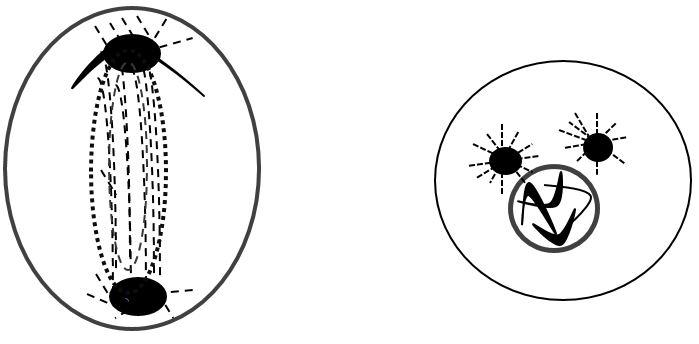
A. Prophase - Anaphase
B. Metaphase – Telophase
C. Telophase – Metaphase
D. Late anaphase - Prophase
Answer
 Verified
566.7k+ views
Hint: The process by which a parent cell undergoes division to form two or more daughter cells that resembles it in structure is called cell division. The division of the nucleus of a cell is called karyokinesis whereas the division of cytoplasm is called cytokinesis.
Complete answer:
The mitotic phase of cell division involves $4$phases of cell division namely prophase, metaphase, anaphase and telophase respectively.
Prophase- During prophase stage of cell division the duplicated DNA (deoxyribose nucleic acid) gets compactly arranged into chromosomes. The spindle formation occurs during this phase as it is shown in the second figure.
Metaphase- It is the second phase of cell division that is followed by the prophase. During the metaphase stage, the chromosomes get condensed and get aligned in right angles to spindle poles. The nuclear membrane disrupts at this phase.
Anaphase- During this stage, the chromosomes pair completely and move to opposite poles of the cell with the help of spindle fibres. It can be seen in the first image.
Telophase- During this stage of mitosis, the spindle fibres increase in lengthen and the nuclear membrane undergoes reformation to form the nuclei enclosing the separated sister chromatids.
From the above explanation it is clear that the two phases shown in the image are anaphase and the prophase.
Hence, the correct answer is option (D)
Note: Mitosis and meiosis are two kinds of cell division. The process of mitosis is also called as equational division because the cell divides into two daughter cells having equal chromosome number and the process of meiosis is called as reductional division because the chromosome number gets reduced to half.
Complete answer:
The mitotic phase of cell division involves $4$phases of cell division namely prophase, metaphase, anaphase and telophase respectively.
Prophase- During prophase stage of cell division the duplicated DNA (deoxyribose nucleic acid) gets compactly arranged into chromosomes. The spindle formation occurs during this phase as it is shown in the second figure.
Metaphase- It is the second phase of cell division that is followed by the prophase. During the metaphase stage, the chromosomes get condensed and get aligned in right angles to spindle poles. The nuclear membrane disrupts at this phase.
Anaphase- During this stage, the chromosomes pair completely and move to opposite poles of the cell with the help of spindle fibres. It can be seen in the first image.
Telophase- During this stage of mitosis, the spindle fibres increase in lengthen and the nuclear membrane undergoes reformation to form the nuclei enclosing the separated sister chromatids.
From the above explanation it is clear that the two phases shown in the image are anaphase and the prophase.
Hence, the correct answer is option (D)
Note: Mitosis and meiosis are two kinds of cell division. The process of mitosis is also called as equational division because the cell divides into two daughter cells having equal chromosome number and the process of meiosis is called as reductional division because the chromosome number gets reduced to half.
Recently Updated Pages
Master Class 11 Computer Science: Engaging Questions & Answers for Success

Master Class 11 Business Studies: Engaging Questions & Answers for Success
Master Class 11 Economics: Engaging Questions & Answers for Success
Master Class 11 English: Engaging Questions & Answers for Success
Master Class 11 Maths: Engaging Questions & Answers for Success
Master Class 11 Biology: Engaging Questions & Answers for Success
Trending doubts
One Metric ton is equal to kg A 10000 B 1000 C 100 class 11 physics CBSE
There are 720 permutations of the digits 1 2 3 4 5 class 11 maths CBSE
Discuss the various forms of bacteria class 11 biology CBSE
Draw a diagram of a plant cell and label at least eight class 11 biology CBSE
State the laws of reflection of light
Explain zero factorial class 11 maths CBSE