




Which sponge is given as a gift in Japan?
a. Hyalonema
b. Euplectella
c. Tethya
d. Leucosolenia
Answer
 Verified
626.4k+ views
Hint: It is also called a glass sponge and is a symbol of undying love in Japan.
Complete answer:
The Venus flower basket or Euplectella is the sponge that is given as a gift in Japan. It is a marine sponge found in the deep waters of the Pacific ocean. Their skeletons are presented as nuptial gifts.
Additional information:
1. Euplectella builds its skeleton from silica, which is unique as they do not require the heart to form their structure.
2. They are superior to artificially manufactured fiber optics as they do not need any artificial conditions.
3. They have a mutual relationship with the shrimps until they die, this influenced the adoption of the sponge as a symbol of undying love.
4. They are found in a small area of the sea near the Philippine Islands.
5. Similar species to glass sponge are found in Japan and other parts of the Western Pacific Ocean and the Indian Ocean.
6. Their body is composed of silica in the firm of six siliceous spicules, thus commonly called a glass sponge.
7. These sponges show bioluminescence to attract plankton.
8. They extract silicic acid from the seawater and convert them into silica.
So, the correct answer is ‘Euplectella’.
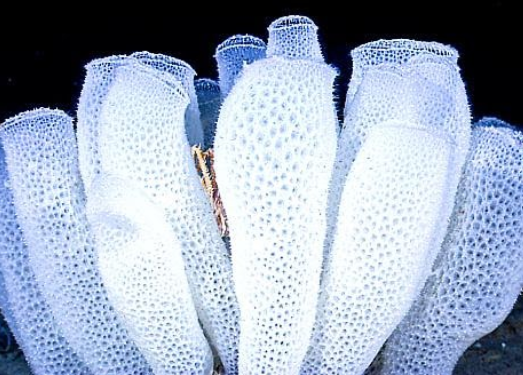
Note: Hyalonema is also called glass rope sponge, it is a very unique species of sponges that do not have any organ system or tissues. They are siliceous and have a glass-like appearance. Tethya is a sea sponge with a spherical body. They are very fast in their movement. Leucosolenia is a calcareous sponge whose shape is like a tiny branch of banana.
Complete answer:
The Venus flower basket or Euplectella is the sponge that is given as a gift in Japan. It is a marine sponge found in the deep waters of the Pacific ocean. Their skeletons are presented as nuptial gifts.
Additional information:
1. Euplectella builds its skeleton from silica, which is unique as they do not require the heart to form their structure.
2. They are superior to artificially manufactured fiber optics as they do not need any artificial conditions.
3. They have a mutual relationship with the shrimps until they die, this influenced the adoption of the sponge as a symbol of undying love.
4. They are found in a small area of the sea near the Philippine Islands.
5. Similar species to glass sponge are found in Japan and other parts of the Western Pacific Ocean and the Indian Ocean.
6. Their body is composed of silica in the firm of six siliceous spicules, thus commonly called a glass sponge.
7. These sponges show bioluminescence to attract plankton.
8. They extract silicic acid from the seawater and convert them into silica.
So, the correct answer is ‘Euplectella’.
Note: Hyalonema is also called glass rope sponge, it is a very unique species of sponges that do not have any organ system or tissues. They are siliceous and have a glass-like appearance. Tethya is a sea sponge with a spherical body. They are very fast in their movement. Leucosolenia is a calcareous sponge whose shape is like a tiny branch of banana.
Recently Updated Pages
Master Class 11 Social Science: Engaging Questions & Answers for Success

Master Class 11 English: Engaging Questions & Answers for Success
Master Class 11 Maths: Engaging Questions & Answers for Success
Master Class 11 Chemistry: Engaging Questions & Answers for Success
Master Class 11 Biology: Engaging Questions & Answers for Success
Master Class 11 Physics: Engaging Questions & Answers for Success
Trending doubts
One Metric ton is equal to kg A 10000 B 1000 C 100 class 11 physics CBSE
Difference Between Prokaryotic Cells and Eukaryotic Cells
How many of the following diseases can be studied with class 11 biology CBSE
Draw a diagram of a plant cell and label at least eight class 11 biology CBSE
Two of the body parts which do not appear in MRI are class 11 biology CBSE
10 examples of friction in our daily life