




Which species of protists are known as the 'whirling whips' because of the spin produced by two flagella beating in opposing grooves along their hard-surfaced body?
(a) Diatoms
(b) Chrysophytes
(c) Dinoflagellates
(d) None of the above
Answer
 Verified
640.2k+ views
Hint: These species bear two dissimilar flagella and have characteristics of both plants and animals. They belong to the phylum Myzozoa. All Myzozoa appears to have evolved from an ancestor that possessed plastids, required through endosymbiosis.
Complete answer:
In dinoflagellates, the spin produced by two flagella beating in opposing grooves along with their hard-surfaced bodies is known as whirling whips. These microscopically small algae have a thin outer skeleton of cellulose, that can move around with the help of flagella (whirling whips).
Dinoflagellates are single-celled Mesokaryotes. They are usually considered to be algae and are mostly marine plankton. They serve as an important link in the food chain. Most dinoflagellates are photosynthetic, but a large fraction of these are mixotrophic, which shows photosynthesis combined with the ingestion of prey.
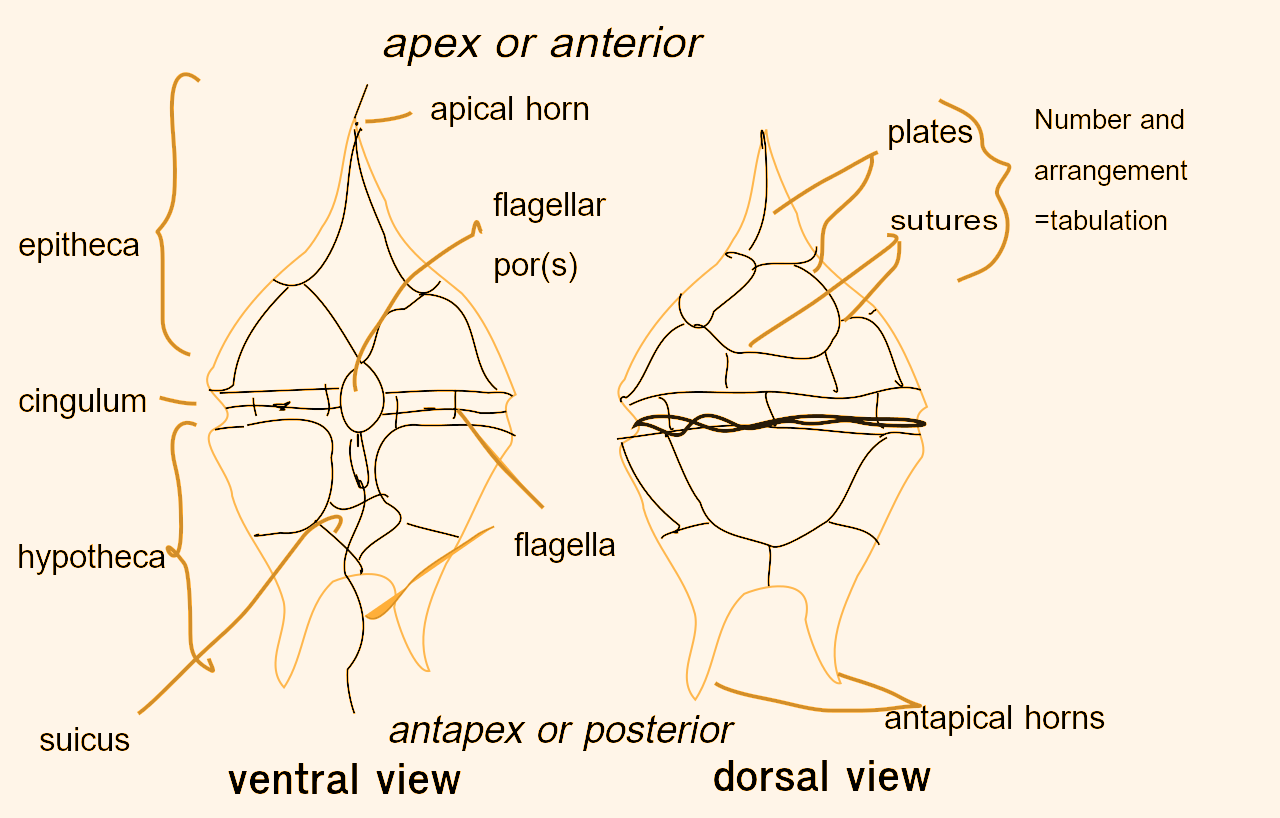
Dinoflagellate
Additional Information:
1. In terms of the number of species, dinoflagellates are one of the largest groups of marine eukaryotes, although this group is substantially smaller than diatoms. Some species which are endosymbionts play an important part in the biology of coral reefs.
2. Some dinoflagellates produce dinocyst which is the resting stage, as part of their life cycle. From 84 of the 350 described freshwater species, more than 10% are known marine species.
3. The cell walls composed of transparent, opaline silica are found only in diatoms on this planet Earth.
4. A group of algae commonly found in lakes is Chrysophytes. They are sometimes referred to as golden-brown algae due to their coloration from specific photosynthetic pigments. They are often unicellular and have a flagellum, allowing them to be mobile in the water.
So, the correct answer is, 'Dinoflagellates'.
Notes:
1. Rapid accumulation of certain dinoflagellates can result in a visible coloration of the water, colloquially known as the red tide (a harmful algal bloom), which can cause shellfish poisoning if humans eat contaminated shellfish.
2. Some dinoflagellates also exhibit bioluminescence—primarily emitting blue-green light. Thus, Some parts of the Indian Ocean light up at night giving blue-green light due to bioluminescence.
3. A well-organized nucleus is present in mesokaryotic cells similar to that of eukaryotic cells, but their nucleus divides through amitosis as in prokaryotes, so the cells are termed mesokaryotes
4. The engulfment of large food particles inside cells, as well as digestion inside the cells, is known as phagotrophy, for example, the amoebas with their pseudopodia gush around food particles until it is absorbed inside the body.
5. The feeding method of predatory ciliate, Didinium, where it is often depicted devouring a hapless Paramecium known as myzocytosis.
Complete answer:
In dinoflagellates, the spin produced by two flagella beating in opposing grooves along with their hard-surfaced bodies is known as whirling whips. These microscopically small algae have a thin outer skeleton of cellulose, that can move around with the help of flagella (whirling whips).
Dinoflagellates are single-celled Mesokaryotes. They are usually considered to be algae and are mostly marine plankton. They serve as an important link in the food chain. Most dinoflagellates are photosynthetic, but a large fraction of these are mixotrophic, which shows photosynthesis combined with the ingestion of prey.
Dinoflagellate
Additional Information:
1. In terms of the number of species, dinoflagellates are one of the largest groups of marine eukaryotes, although this group is substantially smaller than diatoms. Some species which are endosymbionts play an important part in the biology of coral reefs.
2. Some dinoflagellates produce dinocyst which is the resting stage, as part of their life cycle. From 84 of the 350 described freshwater species, more than 10% are known marine species.
3. The cell walls composed of transparent, opaline silica are found only in diatoms on this planet Earth.
4. A group of algae commonly found in lakes is Chrysophytes. They are sometimes referred to as golden-brown algae due to their coloration from specific photosynthetic pigments. They are often unicellular and have a flagellum, allowing them to be mobile in the water.
So, the correct answer is, 'Dinoflagellates'.
Notes:
1. Rapid accumulation of certain dinoflagellates can result in a visible coloration of the water, colloquially known as the red tide (a harmful algal bloom), which can cause shellfish poisoning if humans eat contaminated shellfish.
2. Some dinoflagellates also exhibit bioluminescence—primarily emitting blue-green light. Thus, Some parts of the Indian Ocean light up at night giving blue-green light due to bioluminescence.
3. A well-organized nucleus is present in mesokaryotic cells similar to that of eukaryotic cells, but their nucleus divides through amitosis as in prokaryotes, so the cells are termed mesokaryotes
4. The engulfment of large food particles inside cells, as well as digestion inside the cells, is known as phagotrophy, for example, the amoebas with their pseudopodia gush around food particles until it is absorbed inside the body.
5. The feeding method of predatory ciliate, Didinium, where it is often depicted devouring a hapless Paramecium known as myzocytosis.
Recently Updated Pages
Master Class 11 English: Engaging Questions & Answers for Success

Master Class 11 Social Science: Engaging Questions & Answers for Success
Master Class 11 Maths: Engaging Questions & Answers for Success
Master Class 11 Biology: Engaging Questions & Answers for Success
Master Class 11 Physics: Engaging Questions & Answers for Success
Master Class 11 Chemistry: Engaging Questions & Answers for Success
Trending doubts
Explain the Treaty of Vienna of 1815 class 10 social science CBSE
First Cotton Mill of India
In which year voting age was reduced from 21 to 18?
What planets have no moons Which one has only one moon class 10 physics CBSE
What is the full form of POSCO class 10 social science CBSE
10 examples of evaporation in daily life with explanations