



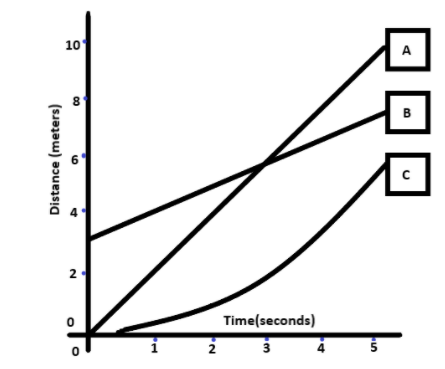
Which runner had a head start?
A. A
B. B
C. C
D. None of these
Answer
 Verified
589.5k+ views
Hint:
We will first analyze the situation for each runner, Here the y-axis is marked by distance, and the x-axis is marked by time. We know that a head start means that the runner must have an advantage over distance, Since the y-axis is associated with distance, Hence we will find the runner whose starting point is at a higher value of the y-axis to get to the final answer.
Complete step by step solution:
We will observe all the runners according to the graph given.
By observing A, we see that
A has the starting value of x-axis as \[x = 0\], Hence it has started at \[t = 0\].
A has the starting value of the y-axis as \[y = 0\], Hence it has started from the starting line itself.
By observing B, we see that
B has the starting value of the x-axis as \[x = 0\], Hence it has started at \[t = 0\].
B has the starting value of the y-axis as \[y = 3\], Hence it has started from 3 units ahead of the starting line.
By observing C, we see that
C has the starting value of x-axis as \[x = 0.5\], Hence it has started running late, that is after 0.5 units of time.
C has the starting value of the y-axis as \[y = 0\], Hence it has started from the starting line itself.
We know that in a headstart the runner is given an advantage over distance. Hence,
From the above observations, we can say that B has an advantage of distance over A and C.
Hence, B is the required answer.
Note:
In the questions related to the graph, we must know what the axes represent to observe and predict the correct results. Also, we must know that in a graph x-axis increases towards the right and the y-axis increases upwards.
We will first analyze the situation for each runner, Here the y-axis is marked by distance, and the x-axis is marked by time. We know that a head start means that the runner must have an advantage over distance, Since the y-axis is associated with distance, Hence we will find the runner whose starting point is at a higher value of the y-axis to get to the final answer.
Complete step by step solution:
We will observe all the runners according to the graph given.
By observing A, we see that
A has the starting value of x-axis as \[x = 0\], Hence it has started at \[t = 0\].
A has the starting value of the y-axis as \[y = 0\], Hence it has started from the starting line itself.
By observing B, we see that
B has the starting value of the x-axis as \[x = 0\], Hence it has started at \[t = 0\].
B has the starting value of the y-axis as \[y = 3\], Hence it has started from 3 units ahead of the starting line.
By observing C, we see that
C has the starting value of x-axis as \[x = 0.5\], Hence it has started running late, that is after 0.5 units of time.
C has the starting value of the y-axis as \[y = 0\], Hence it has started from the starting line itself.
We know that in a headstart the runner is given an advantage over distance. Hence,
From the above observations, we can say that B has an advantage of distance over A and C.
Hence, B is the required answer.
Note:
In the questions related to the graph, we must know what the axes represent to observe and predict the correct results. Also, we must know that in a graph x-axis increases towards the right and the y-axis increases upwards.

Recently Updated Pages
Basicity of sulphurous acid and sulphuric acid are

Master Class 11 Business Studies: Engaging Questions & Answers for Success
Master Class 11 Computer Science: Engaging Questions & Answers for Success
Master Class 11 Economics: Engaging Questions & Answers for Success
Master Class 12 English: Engaging Questions & Answers for Success
Master Class 12 Social Science: Engaging Questions & Answers for Success
Trending doubts
Fill the blanks with the suitable prepositions 1 The class 9 english CBSE
Difference Between Plant Cell and Animal Cell
Find the sum of series 1 + 2 + 3 + 4 + 5 + + 100 class 9 maths CBSE
Distinguish between Conventional and nonconventional class 9 social science CBSE
Find the greatest fivedigit number which is a perfect class 9 maths CBSE
Find the mode and median of the data 13 16 12 14 1-class-9-maths-CBSE