




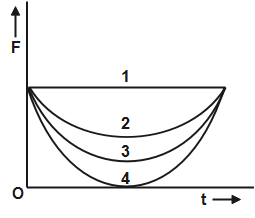
Which part of the figure best represents the force of gravity due to earth on the particle as a function of time?
Answer
 Verified
574.8k+ views
Hint: Gravity explains the mysterious force that exists among all material objects in the universe. It is also known as gravitation. Acceleration due to gravity does not vary with time and is equal to $9.8$ meters per square of second. Therefore, the curve of gravitational force must be parallel to the time axis.
Complete step by step answer:
Gravity is a natural occurrence that we observe in our daily life. We always observe that an object dropped from a height falls towards the earth and does not move upwards. We also know that all the planets revolve around the Sun. The moon revolves around the earth. In all these cases, according to the law of inertia, there must be some force acting on the objects, the planets and on the moon, which makes it possible. This force is known as the gravitational force. This phenomenon which gives an idea about the existence of a force between any two objects is known as gravity. The force due to gravity is always attractive and acts along line joining the objects.
Mathematical representation of gravitational force between two masses is given by universal law of gravity that states, “Every object in the universe attracts every other object with a force which is proportional to the product of their masses and inversely proportional to the square of the separation between them. The force acts along the line joining the centres of two objects.”
$F=\dfrac{GmM}{{{d}^{2}}}$
Here G is a constant known as universal gravitation constant, M & m are the masses of the two objects separated by a distance d.
The force of gravity due to earth is almost constant as distance $d$ is very small as compared to radius of earth.
Therefore, curve 1 best represents the force of gravity due to earth on the particle as a function of time.
Note: Gravity keeps all planets in our solar system in orbit around the sun by providing centripetal force. Acceleration due to gravity is a constant.
Sometimes students confuse mass of the object and weight as the same thing. But these are different. The mass of an object is the measure of the object's inertial property while the weight of an object is the magnitude of the force exerted on the object by gravity.
Complete step by step answer:
Gravity is a natural occurrence that we observe in our daily life. We always observe that an object dropped from a height falls towards the earth and does not move upwards. We also know that all the planets revolve around the Sun. The moon revolves around the earth. In all these cases, according to the law of inertia, there must be some force acting on the objects, the planets and on the moon, which makes it possible. This force is known as the gravitational force. This phenomenon which gives an idea about the existence of a force between any two objects is known as gravity. The force due to gravity is always attractive and acts along line joining the objects.
Mathematical representation of gravitational force between two masses is given by universal law of gravity that states, “Every object in the universe attracts every other object with a force which is proportional to the product of their masses and inversely proportional to the square of the separation between them. The force acts along the line joining the centres of two objects.”
$F=\dfrac{GmM}{{{d}^{2}}}$
Here G is a constant known as universal gravitation constant, M & m are the masses of the two objects separated by a distance d.
The force of gravity due to earth is almost constant as distance $d$ is very small as compared to radius of earth.
Therefore, curve 1 best represents the force of gravity due to earth on the particle as a function of time.
Note: Gravity keeps all planets in our solar system in orbit around the sun by providing centripetal force. Acceleration due to gravity is a constant.
Sometimes students confuse mass of the object and weight as the same thing. But these are different. The mass of an object is the measure of the object's inertial property while the weight of an object is the magnitude of the force exerted on the object by gravity.
Recently Updated Pages
Master Class 11 Computer Science: Engaging Questions & Answers for Success

Master Class 11 Business Studies: Engaging Questions & Answers for Success
Master Class 11 Economics: Engaging Questions & Answers for Success
Master Class 11 English: Engaging Questions & Answers for Success
Master Class 11 Maths: Engaging Questions & Answers for Success
Master Class 11 Biology: Engaging Questions & Answers for Success
Trending doubts
One Metric ton is equal to kg A 10000 B 1000 C 100 class 11 physics CBSE
There are 720 permutations of the digits 1 2 3 4 5 class 11 maths CBSE
Discuss the various forms of bacteria class 11 biology CBSE
Draw a diagram of a plant cell and label at least eight class 11 biology CBSE
State the laws of reflection of light
Explain zero factorial class 11 maths CBSE