




Which organ secretes the bile juice?
Answer
 Verified
614.1k+ views
Hint: Bile is perhaps a pale yellowish fluid naturally produced by the largest gland and the body's largest internal organ. Bile contributes to food absorption in the stomach. Fats are broken down via bile into fatty acids that can reach the body through the intestinal tract.
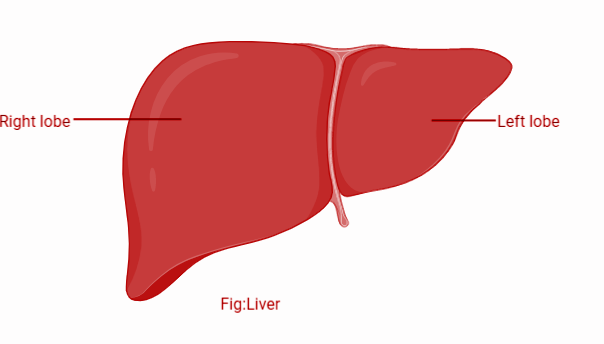
Complete answer: Bile is bitter in taste, dark green to the yellowish-brown liquid produced and secreted by the largest body gland, the Liver. It is primarily secreted by the liver's hepatic cells. It goes into the hepatic ducts later on and is collected in the gallbladder. While eating, bile retained in the gallbladder is given out in the duodenum. The Gall Bladder serves as a bile juice storage tank. Water, bile salts, bile pigments, cholesterol serve as emulsifying agents for the digestion of fats and are the key components of bile juice. Hepatic bile pH is \[7.4\], while bladder bile pH is \[6.8\]. Depending on the size of the body, one litre of bile is formed every day.
Additional information:
Few other functions of bile:
1. Emulsification of fat for digestion & absorption metabolism: For the purpose of digestion & absorption, the bile salts present in the bile are needed for the emulsification of fat.
2. The absorption of fat-soluble vitamins (A, D, E & K) also includes bile (bile salts).
3. Bile counteracts the gastric acid flowing from the stomach into the small intestine.
4. Bile salts are choleretic (a substance that enhances liver-forming bile secretion) and have a laxative effect.
5. Bile salts activate lipase mediated by bile salt.
Note: Bile secretion also differs with the secretion of bile from the pancreas. It is necessary to note that bile is not secreted or produced by the pancreas. Instead, along with aid in digestion, the pancreas that releases digestive enzymes and the bile duct that releases bile. Bile is also considered to be a digestive juice and is not part of the pancreas secreted digestive enzymes. Healthy gut health is encouraged by bile.
Complete answer: Bile is bitter in taste, dark green to the yellowish-brown liquid produced and secreted by the largest body gland, the Liver. It is primarily secreted by the liver's hepatic cells. It goes into the hepatic ducts later on and is collected in the gallbladder. While eating, bile retained in the gallbladder is given out in the duodenum. The Gall Bladder serves as a bile juice storage tank. Water, bile salts, bile pigments, cholesterol serve as emulsifying agents for the digestion of fats and are the key components of bile juice. Hepatic bile pH is \[7.4\], while bladder bile pH is \[6.8\]. Depending on the size of the body, one litre of bile is formed every day.
Additional information:
Few other functions of bile:
1. Emulsification of fat for digestion & absorption metabolism: For the purpose of digestion & absorption, the bile salts present in the bile are needed for the emulsification of fat.
2. The absorption of fat-soluble vitamins (A, D, E & K) also includes bile (bile salts).
3. Bile counteracts the gastric acid flowing from the stomach into the small intestine.
4. Bile salts are choleretic (a substance that enhances liver-forming bile secretion) and have a laxative effect.
5. Bile salts activate lipase mediated by bile salt.
Note: Bile secretion also differs with the secretion of bile from the pancreas. It is necessary to note that bile is not secreted or produced by the pancreas. Instead, along with aid in digestion, the pancreas that releases digestive enzymes and the bile duct that releases bile. Bile is also considered to be a digestive juice and is not part of the pancreas secreted digestive enzymes. Healthy gut health is encouraged by bile.
Recently Updated Pages
Master Class 11 English: Engaging Questions & Answers for Success

Master Class 11 Social Science: Engaging Questions & Answers for Success
Master Class 11 Maths: Engaging Questions & Answers for Success
Master Class 11 Biology: Engaging Questions & Answers for Success
Master Class 11 Physics: Engaging Questions & Answers for Success
Master Class 11 Chemistry: Engaging Questions & Answers for Success
Trending doubts
One Metric ton is equal to kg A 10000 B 1000 C 100 class 11 physics CBSE
Difference Between Prokaryotic Cells and Eukaryotic Cells
Two of the body parts which do not appear in MRI are class 11 biology CBSE
Find the value of the expression given below sin 30circ class 11 maths CBSE
Draw a diagram of a plant cell and label at least eight class 11 biology CBSE
10 examples of friction in our daily life