



Which option best describes the angle Q?
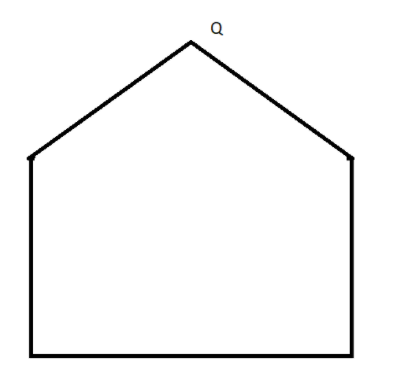
A. Obtuse
B. Acute
C. Right
D. Straight
Answer
 Verified
476.1k+ views
Hint:By definition, angle is a deviation from a straight line. When two lines meet at a shared point, they form an angle. Angles need not necessarily be formed by two straight lines but curved lines as well. There are two parts of an angle, arms and the vertex.
Arms – The two rays that come together to form the angle are called arms.
Vertex – The end point, which is common to both the arms, is called the vertex of the angle.
Angles are measured in degrees. (°)
Complete step by step answer:
Based on the measurement of the angles, we can categorize them into the following categories.
Acute angle: $0^\circ < \theta < 90^\circ $
Right angle: \[\theta = 90^\circ \]
Obtuse angle: $90^\circ < \theta < 180^\circ $
Straight angle: $\theta = 180^\circ $
Reflex angle: $180^\circ < \theta < 270^\circ $
Complete angle: $\theta = 360^\circ $
The given question can be interpreted in two ways:
Case 1:
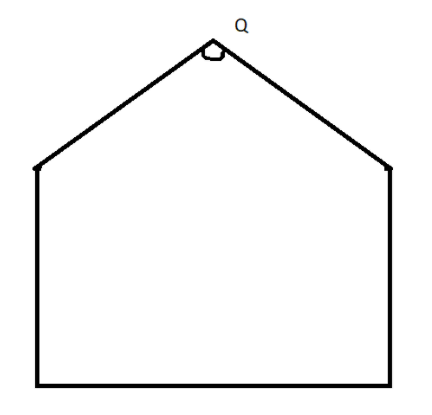
It is clearly visible from the diagram that $\left| \!{\underline {\,Q \,}} \right. < 180^\circ $.Therefore, it is either acute or right. From the diagram it is understood that the angle is greater than 90°. Hence the angle is obtuse angle.
Case 2:
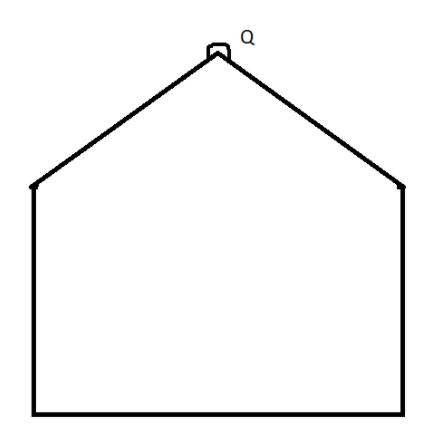
From the diagram, it is clearly visible that $\left| \!{\underline {\,Q \,}} \right. > 180^\circ $. Hence it should be a complete or reflex angle. It is understood that it is not a complete angle, therefore it should be a reflex angle. But in the options, there is no reflex angle, hence the right answer is option (A) obtuse angle.
Therefore, the correct answer is option A.
Note:The above question tests the basics and fundamental concepts of angles. Hence, one needs to remember the measurements of angles and their categories. This theory can be extended to other concepts like complementary and supplementary angles and many more. Hence, remembering such concepts and not confusing them would be very beneficial.
Arms – The two rays that come together to form the angle are called arms.
Vertex – The end point, which is common to both the arms, is called the vertex of the angle.
Angles are measured in degrees. (°)
Complete step by step answer:
Based on the measurement of the angles, we can categorize them into the following categories.
Acute angle: $0^\circ < \theta < 90^\circ $
Right angle: \[\theta = 90^\circ \]
Obtuse angle: $90^\circ < \theta < 180^\circ $
Straight angle: $\theta = 180^\circ $
Reflex angle: $180^\circ < \theta < 270^\circ $
Complete angle: $\theta = 360^\circ $
The given question can be interpreted in two ways:
Case 1:
It is clearly visible from the diagram that $\left| \!{\underline {\,Q \,}} \right. < 180^\circ $.Therefore, it is either acute or right. From the diagram it is understood that the angle is greater than 90°. Hence the angle is obtuse angle.
Case 2:
From the diagram, it is clearly visible that $\left| \!{\underline {\,Q \,}} \right. > 180^\circ $. Hence it should be a complete or reflex angle. It is understood that it is not a complete angle, therefore it should be a reflex angle. But in the options, there is no reflex angle, hence the right answer is option (A) obtuse angle.
Therefore, the correct answer is option A.
Note:The above question tests the basics and fundamental concepts of angles. Hence, one needs to remember the measurements of angles and their categories. This theory can be extended to other concepts like complementary and supplementary angles and many more. Hence, remembering such concepts and not confusing them would be very beneficial.
Recently Updated Pages
Master Class 9 General Knowledge: Engaging Questions & Answers for Success

Master Class 9 Social Science: Engaging Questions & Answers for Success
Master Class 9 English: Engaging Questions & Answers for Success
Master Class 9 Maths: Engaging Questions & Answers for Success
Master Class 9 Science: Engaging Questions & Answers for Success
Class 9 Question and Answer - Your Ultimate Solutions Guide
Trending doubts
Difference Between Plant Cell and Animal Cell
Fill the blanks with the suitable prepositions 1 The class 9 english CBSE
Who is eligible for RTE class 9 social science CBSE
Which places in India experience sunrise first and class 9 social science CBSE
What is pollution? How many types of pollution? Define it
Name 10 Living and Non living things class 9 biology CBSE