




Which one of the following statements is true?
A. Only one line can pass through a single point.
B. There are an infinite number of lines which pass through two distinct points.
C. Two distinct lines cannot have more than one point in common.
D. If two circles are equal, then their radii are not equal.
Answer
 Verified
574.8k+ views
Hint: There are four statements given. We will draw figures for each statement and then we will write arguments against the incorrect statements and in support of the right statement. Finally, we will be able to find the statement which is true.
Complete step by step solution:
We have been given four statements and we have to find the correct one. We find the right argument involving each statement and also draw their respective diagrams to find the conclusion.
We know that an infinite number of lines can pass through one single point. These lines have one common point.

For the above line we can see that the lines are intersecting themselves at a single point A.
So, the first statement is wrong.
We know that two distinct points are required to get a particular line. This means there can be only one line going through two distinct points.
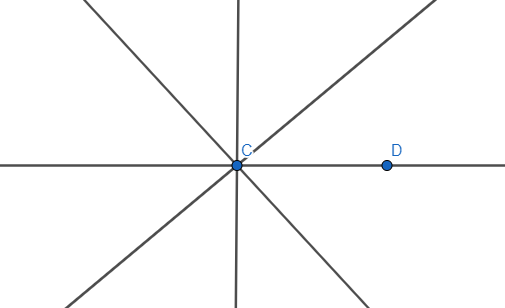
We can see that there exists only one line that goes through the points C and D. The second statement is wrong.
The fourth statement is also wrong as two circles with equal radii are called equal circles. Therefore, if two circles are equal, then their radii are equal.
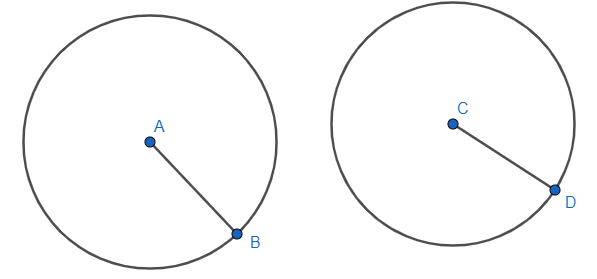
For the above diagram the radii are equal which means $AB=CD$. They are equal circles.
If two lines have more than one common point then that means they are intersecting each other at more than one point. We know that two distinct points are required to get a particular line. This means there can be only one line going through two distinct points.

The third statement is right.
So, the correct answer is “Option C”.
Note: Equal circles are those whose diameters are equal, or whose radii are equal. They also can overlap each other. Two lines are distinct if they intersect at one and only one point or if they are parallel, that is there is no point of intersection between them. ... Any two adjacent sides of a triangle are also distinct lines.
Complete step by step solution:
We have been given four statements and we have to find the correct one. We find the right argument involving each statement and also draw their respective diagrams to find the conclusion.
We know that an infinite number of lines can pass through one single point. These lines have one common point.
For the above line we can see that the lines are intersecting themselves at a single point A.
So, the first statement is wrong.
We know that two distinct points are required to get a particular line. This means there can be only one line going through two distinct points.
We can see that there exists only one line that goes through the points C and D. The second statement is wrong.
The fourth statement is also wrong as two circles with equal radii are called equal circles. Therefore, if two circles are equal, then their radii are equal.
For the above diagram the radii are equal which means $AB=CD$. They are equal circles.
If two lines have more than one common point then that means they are intersecting each other at more than one point. We know that two distinct points are required to get a particular line. This means there can be only one line going through two distinct points.
The third statement is right.
So, the correct answer is “Option C”.
Note: Equal circles are those whose diameters are equal, or whose radii are equal. They also can overlap each other. Two lines are distinct if they intersect at one and only one point or if they are parallel, that is there is no point of intersection between them. ... Any two adjacent sides of a triangle are also distinct lines.

Recently Updated Pages
Master Class 8 English: Engaging Questions & Answers for Success

Master Class 8 Science: Engaging Questions & Answers for Success
Master Class 8 Maths: Engaging Questions & Answers for Success
Class 8 Question and Answer - Your Ultimate Solutions Guide
Master Class 8 Social Science: Engaging Questions & Answers for Success
Master Class 12 Economics: Engaging Questions & Answers for Success
Trending doubts
What is BLO What is the full form of BLO class 8 social science CBSE
Citizens of India can vote at the age of A 18 years class 8 social science CBSE
Right to vote is a AFundamental Right BFundamental class 8 social science CBSE
Give me the opposite gender of Duck class 8 english CBSE
Full form of STD, ISD and PCO
Explain land use pattern in India and why has the land class 8 social science CBSE