




Which one of the following statements about mitosis is correct?
A. One nucleus gives rise to nuclei.
B. Homologous chromosome synapse during anaphase.
C. The centromeres separate at the onset of anaphase.
D. Non-sister chromatids combine.
Answer
 Verified
584.7k+ views
Hint: In equational division or mitosis, the sister chromatids separate from each other and move towards the opposite ends of the cell. This process occurs due to the action of the spindle.
Step by step answer:
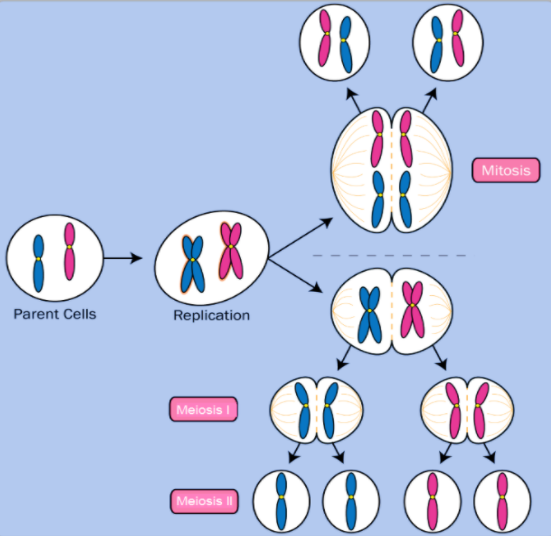
Mitosis/Equational division is a process that results in the formation of two identical daughter cells by a single cell division. The process of mitosis is also known as equational division wherein the number of chromosomes remains the same in the daughter cells to that of parent cells. It occurs in both haploid and diploid cells. It occurs in somatic cells where it helps in cell repair and recovery. It has four phases- prophase, metaphase, anaphase, and telophase.
In prophase, the nuclear membrane disintegrates, and asters move to opposite poles. In metaphase, the chromosomes align on the metaphase plate. In anaphase, the centromeres separate, and chromosomes move to the opposite poles. In telophase, the nuclear membrane reappears.
The process of meiosis is also known as a reductional division in which the number of chromosomes
is reduced. Meiosis is divided into two stages- meiosis I and meiosis II. Meiosis I is characterized by
the process of crossing over or recombination in which recombinase enzyme plays an important role. The recombination or crossing-over occurs between homologous chromosomes (non-sister chromatids). This process is observed in meiosis or reductional division. In meiosis, prophase I have five phases namely- leptotene, zygotene, pachytene, diplotene, and diakinesis. In pachytene, crossing-over of non-sister chromatids occurs. In this stage, recombination nodules are formed which help in the process of crossing-over.
Hence, the correct option is (C) The centromeres separate at the onset of anaphase.
Note: In mitosis, chromosomes start to condense in anaphase after the cell passes the spindle formation checkpoint and this allows the separation of chromosomes.
Step by step answer:
Mitosis/Equational division is a process that results in the formation of two identical daughter cells by a single cell division. The process of mitosis is also known as equational division wherein the number of chromosomes remains the same in the daughter cells to that of parent cells. It occurs in both haploid and diploid cells. It occurs in somatic cells where it helps in cell repair and recovery. It has four phases- prophase, metaphase, anaphase, and telophase.
In prophase, the nuclear membrane disintegrates, and asters move to opposite poles. In metaphase, the chromosomes align on the metaphase plate. In anaphase, the centromeres separate, and chromosomes move to the opposite poles. In telophase, the nuclear membrane reappears.
The process of meiosis is also known as a reductional division in which the number of chromosomes
is reduced. Meiosis is divided into two stages- meiosis I and meiosis II. Meiosis I is characterized by
the process of crossing over or recombination in which recombinase enzyme plays an important role. The recombination or crossing-over occurs between homologous chromosomes (non-sister chromatids). This process is observed in meiosis or reductional division. In meiosis, prophase I have five phases namely- leptotene, zygotene, pachytene, diplotene, and diakinesis. In pachytene, crossing-over of non-sister chromatids occurs. In this stage, recombination nodules are formed which help in the process of crossing-over.
Hence, the correct option is (C) The centromeres separate at the onset of anaphase.
Note: In mitosis, chromosomes start to condense in anaphase after the cell passes the spindle formation checkpoint and this allows the separation of chromosomes.
Recently Updated Pages
Master Class 11 Computer Science: Engaging Questions & Answers for Success

Master Class 11 Business Studies: Engaging Questions & Answers for Success
Master Class 11 Economics: Engaging Questions & Answers for Success
Master Class 11 English: Engaging Questions & Answers for Success
Master Class 11 Maths: Engaging Questions & Answers for Success
Master Class 11 Biology: Engaging Questions & Answers for Success
Trending doubts
One Metric ton is equal to kg A 10000 B 1000 C 100 class 11 physics CBSE
There are 720 permutations of the digits 1 2 3 4 5 class 11 maths CBSE
Discuss the various forms of bacteria class 11 biology CBSE
Draw a diagram of a plant cell and label at least eight class 11 biology CBSE
State the laws of reflection of light
10 examples of friction in our daily life