



Which one of the following reactions will not result in the formation of a carbon-carbon bond?
(A) Reimer- Tiemann reaction
(B) Friedel Crafts acylation
(C) Wurtz reaction
(D) Cannizzaro reaction
Answer
 Verified
583.5k+ views
Hint: The formation of the new C-C bond in the product, such that a new carbon atom or group is added to the reactant carbon. Thus, generating new bonds during the reaction. So, it can only be seen through the reaction mechanism of the given reactions.
Complete step by step solution:
The given reactions take place as follows:
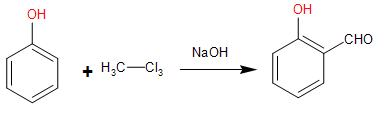
- In Reimer- Tiemann reaction, the phenol reacts with the chloroform in the presence of a strong base like sodium hydroxide to give salicylaldehyde. That is, the addition of $-CHO$ group on the benzene ring of phenol and thus, the formation of a new C-C bond.
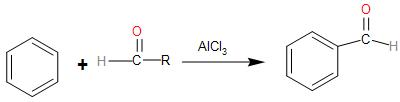
- In Friedel Crafts acylation reaction, the arene reacts with the acyl chloride or the anhydride in the presence of aluminium chloride as the catalyst, leading to the formation of aryl ketone. That is, addition of the $-COR$ group on the benzene ring and thus, formation of a new C-C bond.
- In Wurtz reaction, the alkyl halide is treated with sodium metal in the presence of dry ether to form higher alkanes. Thus, addition of two alkyl groups, forming a new C-C bond.
$R-X\xrightarrow[dry\,\,ether]{Na}R-R+2NaX$
- In Cannizzaro reaction, the non-$\alpha -H$ aldehydes undergo a self- redox reaction in the presence of a strong base like NaOH, to form an alcohol and carboxylic acid through disproportionation, thus no new C-C bond is formed. \[2RCHO\xrightarrow[{{H}_{3}}{{O}^{+}}]{NaOH}RC{{H}_{2}}OH+RCOOH\]
Therefore, in the given reactions, the option (D)- Cannizzaro reaction will not result in the formation of carbon-carbon bonds.
Note: In reaction (A) and (B), it is seen that the new C-C bond is formed by the addition of the carbonyl group to the aromatic benzene ring. Whereas, in reaction (C) it simply involves the addition of the alkyl group of the alkyl halide reactant species to another.
Complete step by step solution:
The given reactions take place as follows:
- In Reimer- Tiemann reaction, the phenol reacts with the chloroform in the presence of a strong base like sodium hydroxide to give salicylaldehyde. That is, the addition of $-CHO$ group on the benzene ring of phenol and thus, the formation of a new C-C bond.
- In Friedel Crafts acylation reaction, the arene reacts with the acyl chloride or the anhydride in the presence of aluminium chloride as the catalyst, leading to the formation of aryl ketone. That is, addition of the $-COR$ group on the benzene ring and thus, formation of a new C-C bond.
- In Wurtz reaction, the alkyl halide is treated with sodium metal in the presence of dry ether to form higher alkanes. Thus, addition of two alkyl groups, forming a new C-C bond.
$R-X\xrightarrow[dry\,\,ether]{Na}R-R+2NaX$
- In Cannizzaro reaction, the non-$\alpha -H$ aldehydes undergo a self- redox reaction in the presence of a strong base like NaOH, to form an alcohol and carboxylic acid through disproportionation, thus no new C-C bond is formed. \[2RCHO\xrightarrow[{{H}_{3}}{{O}^{+}}]{NaOH}RC{{H}_{2}}OH+RCOOH\]
Therefore, in the given reactions, the option (D)- Cannizzaro reaction will not result in the formation of carbon-carbon bonds.
Note: In reaction (A) and (B), it is seen that the new C-C bond is formed by the addition of the carbonyl group to the aromatic benzene ring. Whereas, in reaction (C) it simply involves the addition of the alkyl group of the alkyl halide reactant species to another.
Recently Updated Pages
Master Class 12 Social Science: Engaging Questions & Answers for Success

Master Class 12 Physics: Engaging Questions & Answers for Success
Master Class 12 Maths: Engaging Questions & Answers for Success
Master Class 12 Economics: Engaging Questions & Answers for Success
Master Class 12 Chemistry: Engaging Questions & Answers for Success
Master Class 12 Business Studies: Engaging Questions & Answers for Success
Trending doubts
How many chromosomes are found in human ovum a 46 b class 12 biology CBSE
The diagram of the section of a maize grain is given class 12 biology CBSE
No of 5 membered ring in left Caleft EDTA right right2 class 12 chemistry CBSE
How many 176Omega resistors in parallel are required class 12 physics CBSE
Mahavira Jain believed in the existence of gods ATrue class 12 social science CBSE
How much time does it take to bleed after eating p class 12 biology CBSE