




Which one of the following is not an insectivorous plant?
(a) Monotropa
(b) Drosera
(c) Utricularia
(d) Nepenthes
Answer
 Verified
585.6k+ views
Hint: Insectivorous plants live in a nitrogen-deficient environment and thus are provided with additional mechanisms to supplement their diet. The one which is not an insectivorous plant does not bear chlorophyll, unlike the insectivorous plants.
Complete answer:
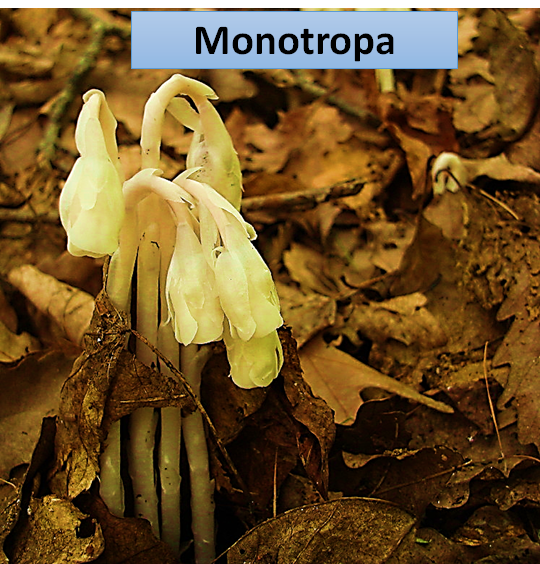
Monotropa is a herbaceous plant belonging to the family of Ericaceae. It is mostly found in the temperate regions of the Northern hemisphere. They do not possess chlorophyll and thus are unable to prepare their own food. They are myco-heterotrophs as they establish a parasitic relationship with any subterranean fungi and obtain essential nutrients from them. Insectivorous plants or carnivorous plants are the ones that are capable of trapping and ingesting insects and small animals in order to fulfil their essential nutritional requirements. Drosera, Utricularia and Nepenthes are insectivorous plants.
Additional Information: -Insectivorous plants have been evolved to develop a trapping mechanism from modified leaves and stems.
-Bladderwort plants like Utricularia use a bladder trap where they sense the movement of any insect and rapidly close its leaves and suck the organism with a partial vacuum.
-Drosera is also commonly known as sundew. It bears leaves which bear numerous mucilaginous stalks or hairs on its rim. It slowly rolls inward to catch its prey and is slow in its action as compared to other insectivorous plants.
-Nepenthes are commonly known as the tropical pitcher plant. Their leaves are modified into the characteristic pitcher or cups with a lid or operculum. The pitcher is surrounded with nectar glands which attract the insects. The hollow cup or pitcher is filled with digestive enzymes.
So, the correct answer is ‘Monotropa.’
Note: -The insect, when attracted by the sweet smell of nectar, tries to land on the edges of the mouth of the pitcher but due to its slippery texture tumbles inside the pitcher.
-The mottled appearance of the pitcher plant also gives an appearance of flesh or meat to the animals and thus fools the animal.
Complete answer:
Monotropa is a herbaceous plant belonging to the family of Ericaceae. It is mostly found in the temperate regions of the Northern hemisphere. They do not possess chlorophyll and thus are unable to prepare their own food. They are myco-heterotrophs as they establish a parasitic relationship with any subterranean fungi and obtain essential nutrients from them. Insectivorous plants or carnivorous plants are the ones that are capable of trapping and ingesting insects and small animals in order to fulfil their essential nutritional requirements. Drosera, Utricularia and Nepenthes are insectivorous plants.
Additional Information: -Insectivorous plants have been evolved to develop a trapping mechanism from modified leaves and stems.
-Bladderwort plants like Utricularia use a bladder trap where they sense the movement of any insect and rapidly close its leaves and suck the organism with a partial vacuum.
-Drosera is also commonly known as sundew. It bears leaves which bear numerous mucilaginous stalks or hairs on its rim. It slowly rolls inward to catch its prey and is slow in its action as compared to other insectivorous plants.
-Nepenthes are commonly known as the tropical pitcher plant. Their leaves are modified into the characteristic pitcher or cups with a lid or operculum. The pitcher is surrounded with nectar glands which attract the insects. The hollow cup or pitcher is filled with digestive enzymes.
So, the correct answer is ‘Monotropa.’
Note: -The insect, when attracted by the sweet smell of nectar, tries to land on the edges of the mouth of the pitcher but due to its slippery texture tumbles inside the pitcher.
-The mottled appearance of the pitcher plant also gives an appearance of flesh or meat to the animals and thus fools the animal.
Recently Updated Pages
Master Class 11 Computer Science: Engaging Questions & Answers for Success

Master Class 11 Business Studies: Engaging Questions & Answers for Success
Master Class 11 Economics: Engaging Questions & Answers for Success
Master Class 11 English: Engaging Questions & Answers for Success
Master Class 11 Maths: Engaging Questions & Answers for Success
Master Class 11 Biology: Engaging Questions & Answers for Success
Trending doubts
One Metric ton is equal to kg A 10000 B 1000 C 100 class 11 physics CBSE
There are 720 permutations of the digits 1 2 3 4 5 class 11 maths CBSE
Discuss the various forms of bacteria class 11 biology CBSE
Draw a diagram of a plant cell and label at least eight class 11 biology CBSE
State the laws of reflection of light
10 examples of friction in our daily life