




Which one of the following is an example of the taproot system?
(a) Wheat
(b) Mustard
(c) Millet
(d) Maize
Answer
 Verified
623.7k+ views
Hint: The plant which is an example of the taproot system also shows alternate phyllotaxy in its leave’s arrangement. The flower of this plant is actinomorphic i.e. it can be divided into two equal radial halves in any radial plane passing through the center.
Complete answer:
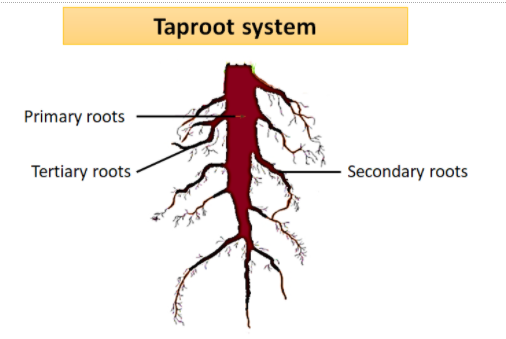
An example of the taproot system is a mustard plant. In most of the dicotyledonous plants, the radicle directly elongates to form the ‘primary root’ which grows inside the soil. The primary root along with its branches constitutes the ‘tap root system.’
Additional Information:
-The root system in monocotyledonous plants is different. Here the primary root is short-lived. It is then replaced by a large number of roots. The origin of these new roots is from the base of the stem, this constitutes the ‘fibrous root system’. A classic example of the fibrous root system is seen in wheat plants. Millets being a monocotyledon also shows the same type of roots.
- Another type of root system is seen in plants like grass, Monstera, and the banyan tree. Here there is an arrival of roots from parts of the plants other than the radicle. Such roots are called ‘adventitious roots’.
-Taproots in carrot, turnip and adventitious roots in sweet potato, get swollen, and store food.
So, the correct answer is ‘Mustard.’
Note:
- Gymnosperms like Sequoia also have taproots.
- ‘Radicle’ is the first part to emerge out of a seedling.
- ‘Alternate phyllotaxy’ is the arrangement of leaves in which a single leaf occupies each node in an alternate manner. Some examples of such an arrangement are china rose, sunflower, along with mustard.
Complete answer:
An example of the taproot system is a mustard plant. In most of the dicotyledonous plants, the radicle directly elongates to form the ‘primary root’ which grows inside the soil. The primary root along with its branches constitutes the ‘tap root system.’
Additional Information:
-The root system in monocotyledonous plants is different. Here the primary root is short-lived. It is then replaced by a large number of roots. The origin of these new roots is from the base of the stem, this constitutes the ‘fibrous root system’. A classic example of the fibrous root system is seen in wheat plants. Millets being a monocotyledon also shows the same type of roots.
- Another type of root system is seen in plants like grass, Monstera, and the banyan tree. Here there is an arrival of roots from parts of the plants other than the radicle. Such roots are called ‘adventitious roots’.
-Taproots in carrot, turnip and adventitious roots in sweet potato, get swollen, and store food.
So, the correct answer is ‘Mustard.’
Note:
- Gymnosperms like Sequoia also have taproots.
- ‘Radicle’ is the first part to emerge out of a seedling.
- ‘Alternate phyllotaxy’ is the arrangement of leaves in which a single leaf occupies each node in an alternate manner. Some examples of such an arrangement are china rose, sunflower, along with mustard.
Recently Updated Pages
Master Class 11 Social Science: Engaging Questions & Answers for Success

Master Class 11 Chemistry: Engaging Questions & Answers for Success
Master Class 9 General Knowledge: Engaging Questions & Answers for Success
Master Class 9 Maths: Engaging Questions & Answers for Success
Master Class 9 Science: Engaging Questions & Answers for Success
Master Class 9 English: Engaging Questions & Answers for Success
Trending doubts
One Metric ton is equal to kg A 10000 B 1000 C 100 class 11 physics CBSE
Difference Between Prokaryotic Cells and Eukaryotic Cells
Two of the body parts which do not appear in MRI are class 11 biology CBSE
1 ton equals to A 100 kg B 1000 kg C 10 kg D 10000 class 11 physics CBSE
10 examples of friction in our daily life
Name the Largest and the Smallest Cell in the Human Body ?