




Which one is an insectivorous plant?
(a) Vallisneria
(b) Rafflesia
(c) Santalum
(d) Nepenthes
Answer
 Verified
620.7k+ views
Hint: Insectivorous plants are those plants that feed on insects for their nutrition. They are also known as carnivorous plants. They trap and digest insects to absorb nutrients. They have special modifications for trapping organisms. There are certain plants having special modifications like a pitfall trap. They grow in humid areas with plenty of moisture and sunlight. They are found in nitrogen- deficient soil, that’s why they feed on insects for nutrients. They have special characteristics such as attractants, inescapable traps, digestive enzymes, sweet secretions, etc.
Complete answer:
Nepenthes is an insectivorous plant. It is also known as the tropical pitcher plant or monkey cups. Most species of nepenthes prefer an environment with high humidity and moderate to the high light level. They prey by means of pitcher- shaped modified leaves which serve as a pitfall trap. They are beautifully colored to attract insects. A sugary secretion makes the rim of the mouth slippery. Insects resting on the edge of the mouth get accidentally slipped into the pitcher. Soon operculum closes to prevent their escape. The insects are then digested by the enzyme secreted by the pitcher wall.
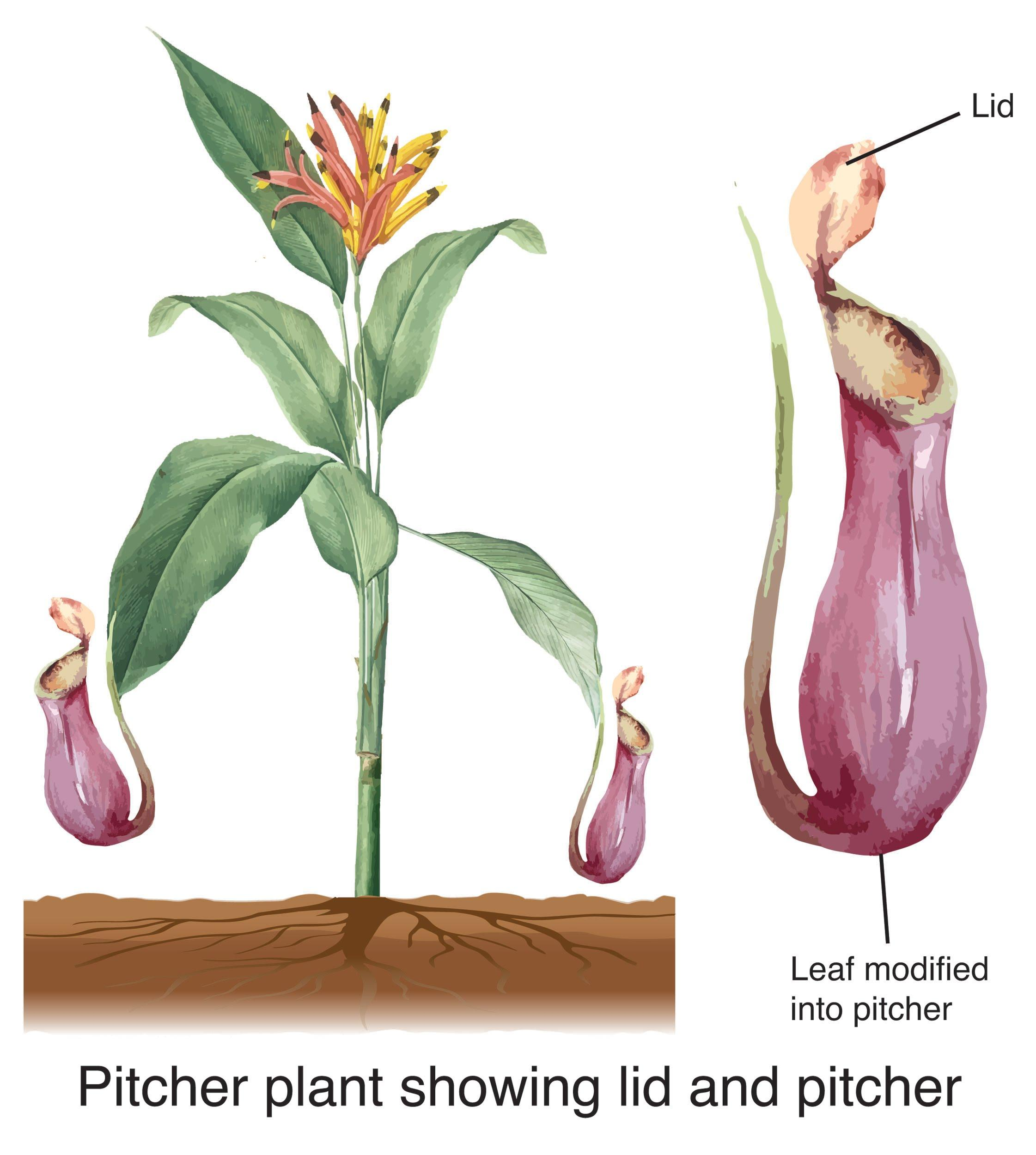
Other insectivorous plants include Venus flytrap, Drosera, Utricularia, etc. Venus flytraps are flowering plants best known for their carnivorous eating habit. They grow in moist acidic soil. They have a wide mouth lined with hair known as trichomes. Utricularia are sensitive structures, whenever an organism touches this hair the mouth snap shuts trapping the insect. They are commonly known as bladderworts. They usually inhabit fresh, nitrogen- deficient regions, they capture small organisms with the help of bladder- like traps. They feed on protozoa, water fleas, nematodes, etc. They are also cultivated for their flowers which is similar to that of orchids.
So, the answer is 'Nepenthes'
Additional Information:
- Vallisneria is a fresh-water aquatic plant. They are commonly known as the eelgrass, tape grass, or villains. Various strains of Vallisneria are kept in tropical and subtropical aquaria.
- Rafflesia is a genus of parasitic flowering plants. The plant has no stem, leaves, or roots. It is a holoparasite of vines. The only part that is seen outside the host vine is a five- petalled flower.
- Santalum is a genus of woody flowering plants, the best known and commercially important one is the Indian sandalwood tree.
Note: Insectivorous plants can be broadly divided into active and passive types based on their method of trapping their prey. The active one can close their leaf traps the moment insects land on them. The passive plants have a pitfall trap mechanism, having some kind of jar or a pitcher like structure onto which the insect's slip and fall, to eventually be digested. These Insectivorous plants have several attractions such as brilliant colors, sweet secretions, etc.
Complete answer:
Nepenthes is an insectivorous plant. It is also known as the tropical pitcher plant or monkey cups. Most species of nepenthes prefer an environment with high humidity and moderate to the high light level. They prey by means of pitcher- shaped modified leaves which serve as a pitfall trap. They are beautifully colored to attract insects. A sugary secretion makes the rim of the mouth slippery. Insects resting on the edge of the mouth get accidentally slipped into the pitcher. Soon operculum closes to prevent their escape. The insects are then digested by the enzyme secreted by the pitcher wall.
Other insectivorous plants include Venus flytrap, Drosera, Utricularia, etc. Venus flytraps are flowering plants best known for their carnivorous eating habit. They grow in moist acidic soil. They have a wide mouth lined with hair known as trichomes. Utricularia are sensitive structures, whenever an organism touches this hair the mouth snap shuts trapping the insect. They are commonly known as bladderworts. They usually inhabit fresh, nitrogen- deficient regions, they capture small organisms with the help of bladder- like traps. They feed on protozoa, water fleas, nematodes, etc. They are also cultivated for their flowers which is similar to that of orchids.
So, the answer is 'Nepenthes'
Additional Information:
- Vallisneria is a fresh-water aquatic plant. They are commonly known as the eelgrass, tape grass, or villains. Various strains of Vallisneria are kept in tropical and subtropical aquaria.
- Rafflesia is a genus of parasitic flowering plants. The plant has no stem, leaves, or roots. It is a holoparasite of vines. The only part that is seen outside the host vine is a five- petalled flower.
- Santalum is a genus of woody flowering plants, the best known and commercially important one is the Indian sandalwood tree.
Note: Insectivorous plants can be broadly divided into active and passive types based on their method of trapping their prey. The active one can close their leaf traps the moment insects land on them. The passive plants have a pitfall trap mechanism, having some kind of jar or a pitcher like structure onto which the insect's slip and fall, to eventually be digested. These Insectivorous plants have several attractions such as brilliant colors, sweet secretions, etc.
Recently Updated Pages
Master Class 11 English: Engaging Questions & Answers for Success

Master Class 11 Social Science: Engaging Questions & Answers for Success
Master Class 11 Maths: Engaging Questions & Answers for Success
Master Class 11 Biology: Engaging Questions & Answers for Success
Master Class 11 Physics: Engaging Questions & Answers for Success
Master Class 11 Chemistry: Engaging Questions & Answers for Success
Trending doubts
One Metric ton is equal to kg A 10000 B 1000 C 100 class 11 physics CBSE
Difference Between Prokaryotic Cells and Eukaryotic Cells
Two of the body parts which do not appear in MRI are class 11 biology CBSE
Find the value of the expression given below sin 30circ class 11 maths CBSE
Draw a diagram of a plant cell and label at least eight class 11 biology CBSE
10 examples of friction in our daily life