




Which one has a brood pouch for caring for eggs?
(a)Anabas
(b)Scliodon
(c)Hippocampus
(d)Cuttlefish
Answer
 Verified
640.8k+ views
Hint: Seahorse is a tiny fish named after the shape of their head that sort of looks like ahead of a tiny horse. The male seahorses are responsible for the pregnancy and giving birth.
Complete answer:
The name hippocampus comes from ancient Greek where ‘hippo’ means horse and ‘kampos’ means sea monster. The pregnancy lasts between two and four weeks, the length decreasing with increasing temperature. Males can inflate their pouch by pumping water through it to display its emptiness which indicates the courtship behaviour is to deposit her eggs in it. After eight hours of courtship, the female seahorse deposited her eggs in the male’s pouch that was located on its stomach. The male releases his sperm directly into seawater to fertilize the eggs. The egg will be embedded in the pouch wall and becomes surrounded by a spongy tissue. The pouch acts as the uterus of a female mammal completed with placental fluid that provides nutrients and oxygen.
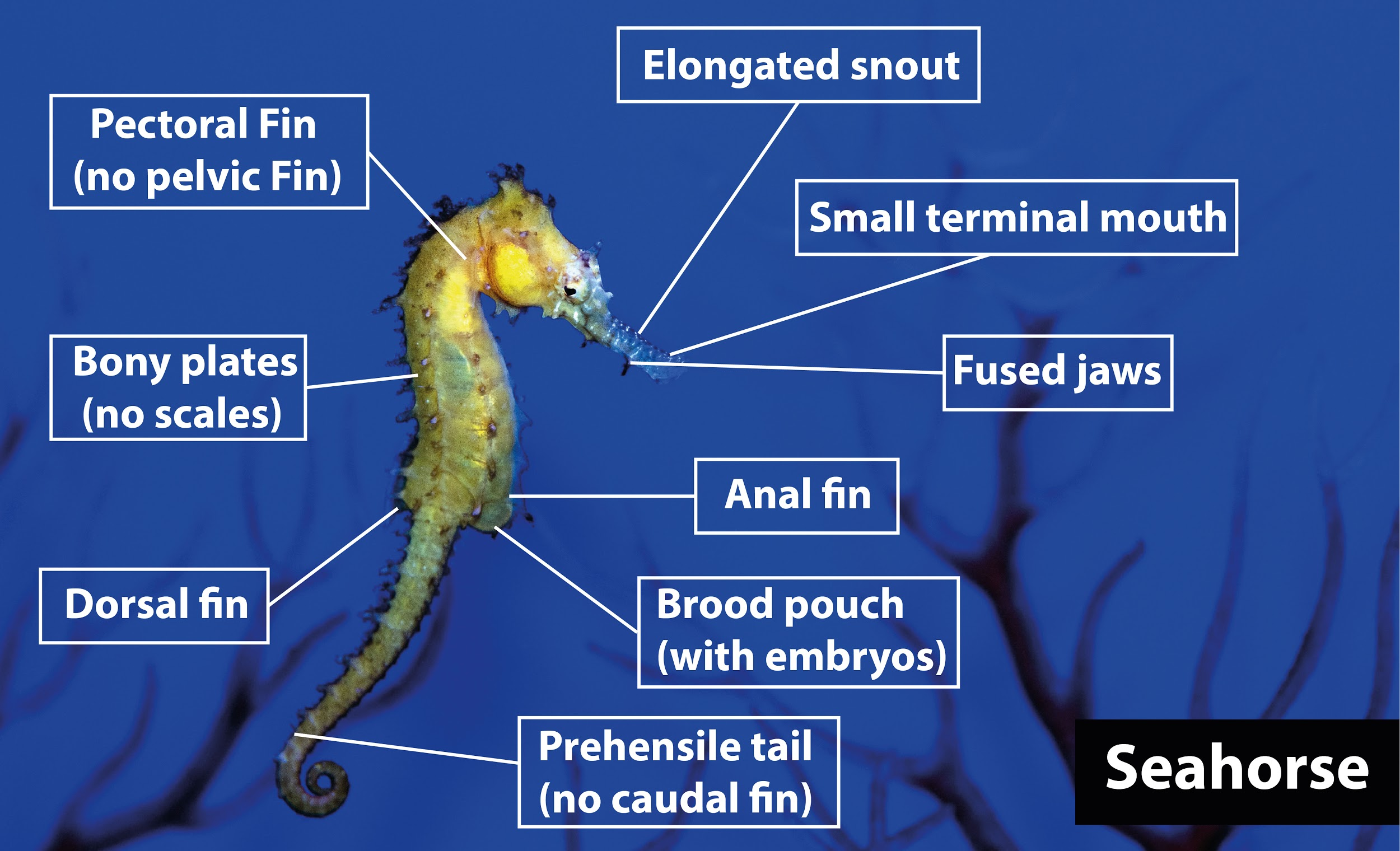
Additional Information: -In seahorse, the egg hatch in the pouch and the embryos will remain in the pouch for two to six weeks depending on species and temperature.
-The male undergoes muscular contraction pumping expel the young known as ‘fry’ from the pouch
-After giving birth, the parents do not provide their tiny offspring with any care or protection.
So, the correct answer is, ‘Hippocampus.’
Note: -Seahorses can come in all different colours as they are masters of camouflage where they can change colour to blend in with their habitat.
-Seahorse eats tiny organisms such as small shrimps as well as very small fish even small fish larvae by sucking through their tube-like snout.
Complete answer:
The name hippocampus comes from ancient Greek where ‘hippo’ means horse and ‘kampos’ means sea monster. The pregnancy lasts between two and four weeks, the length decreasing with increasing temperature. Males can inflate their pouch by pumping water through it to display its emptiness which indicates the courtship behaviour is to deposit her eggs in it. After eight hours of courtship, the female seahorse deposited her eggs in the male’s pouch that was located on its stomach. The male releases his sperm directly into seawater to fertilize the eggs. The egg will be embedded in the pouch wall and becomes surrounded by a spongy tissue. The pouch acts as the uterus of a female mammal completed with placental fluid that provides nutrients and oxygen.
Additional Information: -In seahorse, the egg hatch in the pouch and the embryos will remain in the pouch for two to six weeks depending on species and temperature.
-The male undergoes muscular contraction pumping expel the young known as ‘fry’ from the pouch
-After giving birth, the parents do not provide their tiny offspring with any care or protection.
So, the correct answer is, ‘Hippocampus.’
Note: -Seahorses can come in all different colours as they are masters of camouflage where they can change colour to blend in with their habitat.
-Seahorse eats tiny organisms such as small shrimps as well as very small fish even small fish larvae by sucking through their tube-like snout.
Recently Updated Pages
Master Class 11 English: Engaging Questions & Answers for Success

Master Class 11 Physics: Engaging Questions & Answers for Success
Master Class 11 Computer Science: Engaging Questions & Answers for Success
Master Class 11 Chemistry: Engaging Questions & Answers for Success
Master Class 11 Social Science: Engaging Questions & Answers for Success
Master Class 11 Accountancy: Engaging Questions & Answers for Success
Trending doubts
Difference Between Prokaryotic Cells and Eukaryotic Cells
Two of the body parts which do not appear in MRI are class 11 biology CBSE
One Metric ton is equal to kg A 10000 B 1000 C 100 class 11 physics CBSE
10 examples of friction in our daily life
Draw a diagram of nephron and explain its structur class 11 biology CBSE
Draw a diagram of a plant cell and label at least eight class 11 biology CBSE