




Which of the options given below would not correctly fill the blanks in the following sentence?
In order to absorb and use _______ by the body, these must be broken down by hydrolysis into ______.
A) Polysaccharides, monosaccharides
B) Amino acids, proteins
C) Fats, Glycerol and fatty acid
D) Disaccharide, monosaccharide
Answer
 Verified
516.9k+ views
Hint: The carbohydrates, proteins and fats are the major nutrients present in our food. These are broken down into simpler forms with the help of digestive enzymes in the gastrointestinal tract. These simpler substances are formed as a result of the hydrolysis by the enzymes.
Complete answer:
Hydrolysis is the process of breaking down the complex biomolecule into simpler forms that can be easily absorbed by the body. In this process, one molecule of water breaks the bond and forms simpler biomolecules. Let us discuss the hydrolysis of the nutrients in our body.
Polysaccharides- Polysaccharides are complex carbohydrates that contain repeated units of monosaccharides. The food we eat contains starch which is a polysaccharide. This polysaccharide cannot be utilized by the body until it is hydrolyzed by the amylases into monosaccharide or glucose. The hydrolysis of starch takes place in the mouth. So polysaccharide is broken down by the hydrolysis into monosaccharides.
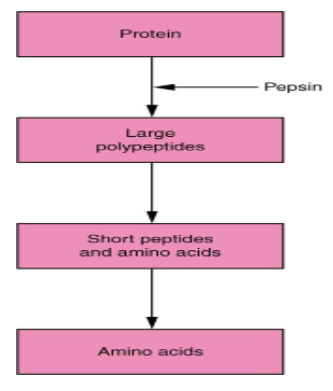
Proteins are a group of amino acids joined by peptide bonds. The proteins are hydrolyzed in the stomach by the peptic enzymes which convert them into simpler forms that are an amino acid which can be utilized by the body. The amino acids are absorbed in the intestine.
Fats- They are the energy-giving biomolecules. Fats are broken down or hydrolyzed into simple glycerol and fatty acid in the small intestine by the bile and pancreatic juice. So in order to absorb and use fat, it must be broken into fatty acid and glycerol.
Disaccharide- Disaccharide is a polymer of monosaccharide. For example, sucrose is made up of glucose joined by glycosidic bonds. The hydrolysis of glycosidic bonds takes place in the mouth as our body cannot absorb disaccharide. So it is being converted into a monosaccharide that can be absorbed.
The proteins are hydrolyzed into amino acids that can be utilized by the body.
Thus the correct answer is option ‘B’.
Note: The absorption of the simpler molecules takes place in the small intestine. The walls of the small intestine have finger-like villi which help in absorbing the nutrients into the bloodstream.
Complete answer:
Hydrolysis is the process of breaking down the complex biomolecule into simpler forms that can be easily absorbed by the body. In this process, one molecule of water breaks the bond and forms simpler biomolecules. Let us discuss the hydrolysis of the nutrients in our body.
Polysaccharides- Polysaccharides are complex carbohydrates that contain repeated units of monosaccharides. The food we eat contains starch which is a polysaccharide. This polysaccharide cannot be utilized by the body until it is hydrolyzed by the amylases into monosaccharide or glucose. The hydrolysis of starch takes place in the mouth. So polysaccharide is broken down by the hydrolysis into monosaccharides.
Proteins are a group of amino acids joined by peptide bonds. The proteins are hydrolyzed in the stomach by the peptic enzymes which convert them into simpler forms that are an amino acid which can be utilized by the body. The amino acids are absorbed in the intestine.
Fats- They are the energy-giving biomolecules. Fats are broken down or hydrolyzed into simple glycerol and fatty acid in the small intestine by the bile and pancreatic juice. So in order to absorb and use fat, it must be broken into fatty acid and glycerol.
Disaccharide- Disaccharide is a polymer of monosaccharide. For example, sucrose is made up of glucose joined by glycosidic bonds. The hydrolysis of glycosidic bonds takes place in the mouth as our body cannot absorb disaccharide. So it is being converted into a monosaccharide that can be absorbed.
The proteins are hydrolyzed into amino acids that can be utilized by the body.
Thus the correct answer is option ‘B’.
Note: The absorption of the simpler molecules takes place in the small intestine. The walls of the small intestine have finger-like villi which help in absorbing the nutrients into the bloodstream.
Recently Updated Pages
Basicity of sulphurous acid and sulphuric acid are

Master Class 11 Business Studies: Engaging Questions & Answers for Success
Master Class 11 Computer Science: Engaging Questions & Answers for Success
Master Class 11 Economics: Engaging Questions & Answers for Success
Master Class 11 Social Science: Engaging Questions & Answers for Success
Master Class 11 English: Engaging Questions & Answers for Success
Trending doubts
One Metric ton is equal to kg A 10000 B 1000 C 100 class 11 physics CBSE
The largest wind power cluster is located in the state class 11 social science CBSE
Explain zero factorial class 11 maths CBSE
State and prove Bernoullis theorem class 11 physics CBSE
Which among the following are examples of coming together class 11 social science CBSE
Can anyone list 10 advantages and disadvantages of friction