




Which of the following will show geometrical isomerism.
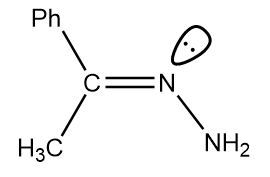
A.
B.
C.
D.
Answer
 Verified
547.5k+ views
Hint: When more than one chemical compound has the same molecular formula but differs in the structure or arrangement of atoms in space, then the compounds are known as isomers. The phenomenon of forming isomers is known as isomerism.
Complete answer:
Geometrical isomerism: It is a type of stereoisomerism in which the compounds have the same molecular formula but differ in the relative arrangement of atoms. The two types of geometrical isomers are as follows:
1) Cis isomer: When the groups with same priority lie on the same side of the alkene with respect to other functional groups, then it is termed as cis geometrical isomerism.
For example- In but-2-ene, if both the methyl groups present in the same side respectively, then it is cis isomer. Structure is shown as follows:
2) Trans isomer: When the groups with same priority lie on the opposite side of the alkene with respect to other functional groups, then it is termed as cis geometrical isomerism.
For example- In but-2-ene, if both the methyl groups are present on the opposite side respectively, then it is a trans isomer. Structure is shown as follows:
Now, among given options:
In compound (A), the structure is given as follows-
As it is clearly observed, that both the atoms connected via double bond are bonded to different groups, therefore it has a tendency to show geometrical isomerism.
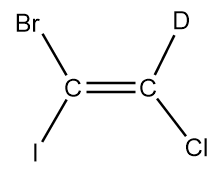
In compound (B), the structure is given as follows-
As it is clearly observed, that both the carbon atoms connected via double bond are bonded to different groups, therefore it has a tendency to show geometrical isomerism.
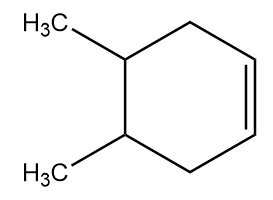
In compound (C), the structure is given as follows-
As it is clearly observed, both the carbon atoms (1) and (2) are connected to different groups and due to the presence of a ring, the rotation is restricted as well. Therefore, it has a tendency to show geometrical isomerism.
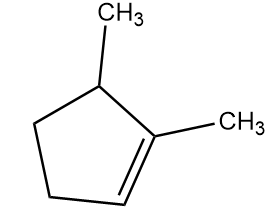
In compound (D), the structure is given as follows-
In the cyclic structures, double bonded carbon atoms are unable to show geometrical isomerism because the terminal groups do not lie in the same plane which is an important condition for a compound to show geometrical isomerism. Moreover, there must be more than one $s{{p}^{3}}$ hybridized carbon atom, which is absent for the given compound. Therefore, it does not have a tendency to show geometrical isomerism.
Hence, options (A), (B) and (C) are the correct answers.
Note:
It is important to note that the necessary conditions for a compound to show geometrical isomerism are as follows:
The rotation must be restricted i.e., the compound must contain or double bond or a ring.
The terminal groups must be present in the same group as of the carbon atoms.
Complete answer:
Geometrical isomerism: It is a type of stereoisomerism in which the compounds have the same molecular formula but differ in the relative arrangement of atoms. The two types of geometrical isomers are as follows:
1) Cis isomer: When the groups with same priority lie on the same side of the alkene with respect to other functional groups, then it is termed as cis geometrical isomerism.
For example- In but-2-ene, if both the methyl groups present in the same side respectively, then it is cis isomer. Structure is shown as follows:
2) Trans isomer: When the groups with same priority lie on the opposite side of the alkene with respect to other functional groups, then it is termed as cis geometrical isomerism.
For example- In but-2-ene, if both the methyl groups are present on the opposite side respectively, then it is a trans isomer. Structure is shown as follows:
Now, among given options:
In compound (A), the structure is given as follows-
As it is clearly observed, that both the atoms connected via double bond are bonded to different groups, therefore it has a tendency to show geometrical isomerism.
In compound (B), the structure is given as follows-
As it is clearly observed, that both the carbon atoms connected via double bond are bonded to different groups, therefore it has a tendency to show geometrical isomerism.
In compound (C), the structure is given as follows-
As it is clearly observed, both the carbon atoms (1) and (2) are connected to different groups and due to the presence of a ring, the rotation is restricted as well. Therefore, it has a tendency to show geometrical isomerism.
In compound (D), the structure is given as follows-
In the cyclic structures, double bonded carbon atoms are unable to show geometrical isomerism because the terminal groups do not lie in the same plane which is an important condition for a compound to show geometrical isomerism. Moreover, there must be more than one $s{{p}^{3}}$ hybridized carbon atom, which is absent for the given compound. Therefore, it does not have a tendency to show geometrical isomerism.
Hence, options (A), (B) and (C) are the correct answers.
Note:
It is important to note that the necessary conditions for a compound to show geometrical isomerism are as follows:
The rotation must be restricted i.e., the compound must contain or double bond or a ring.
The terminal groups must be present in the same group as of the carbon atoms.
Recently Updated Pages
Master Class 12 Economics: Engaging Questions & Answers for Success

Master Class 12 English: Engaging Questions & Answers for Success
Master Class 12 Social Science: Engaging Questions & Answers for Success
Master Class 12 Maths: Engaging Questions & Answers for Success
Master Class 12 Physics: Engaging Questions & Answers for Success
Master Class 11 Social Science: Engaging Questions & Answers for Success
Trending doubts
1 ton equals to A 100 kg B 1000 kg C 10 kg D 10000 class 11 physics CBSE
Draw a diagram of nephron and explain its structur class 11 biology CBSE
DNA is not present in A Nucleus B Mitochondria C Chloroplast class 11 biology CBSE
Proton was discovered by A Thomson B Rutherford C Chadwick class 11 chemistry CBSE
Mention the important general characters of Urocho class 11 biology CBSE
Define pneumatic bones class 11 biology CBSE