




Which of the following will not produce ethane?
A) Reduction of $C{H_3}COOH$ with HI and red P
B) Reduction of $C{H_3}COC{H_3}$ with HI and red P
C) Soda-lime decarboxylation of sodium propionate
D) Hydrogenation of ethene in the presence of Raney- Ni
Answer
 Verified
556.2k+ views
Hint: We will check each reaction to find the best suitable answer. Also, we should know the reagent behavior if it is reducing oxidation. Here HI and P are reducing agents. Raney Ni acts as a catalyst and reduces the alkene to form an alkane hydrocarbon.
Complete answer:
To solve this problem we will by each reaction-
A) Reduction of $C{H_3}COOH$ with HI and red P-
We know that red P and HI act as reducing agents. So this reagent will reduce acetic acid into ethane. This is how the reaction will proceed.
$C{H_3}COOH + 6HI\xrightarrow{{\operatorname{Re} d{\text{ P}}}}C{H_3} - C{H_3} + 2{H_2}O + 3{I_2}$
So we can say that reduction of acetic acid with rep P and HI produced ethane.
B) Reduction of $C{H_3}COC{H_3}$ with HI and red P-
The reaction of aldehyde and ketone with red P and HI is as follows-
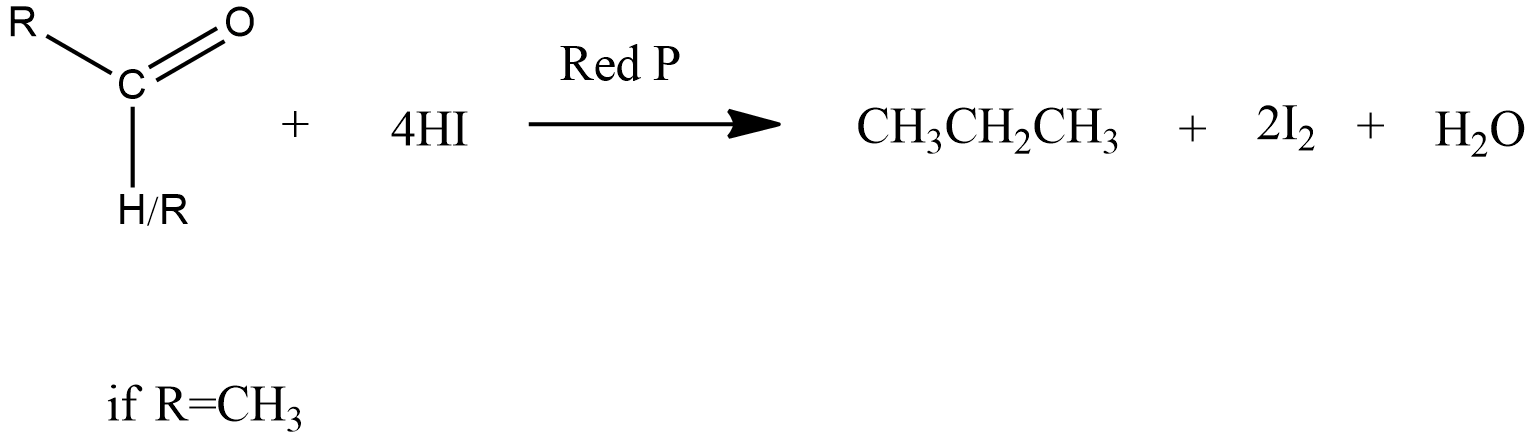
If aldehyde reacts with red P and HI then we get ethane. But in this reaction, we get propane, not ethane.
C) Soda-lime decarboxylation of sodium propionate –
This is the decarboxylation reaction and in this reaction, ethane will liberate. The reaction is as follows:
${C_2}{H_5}COONa + NaOH\xrightarrow{{CaO}}N{a_2}C{O_3} + {C_2}{H_6} \uparrow $
Here in this reaction also ethane is produced.
D) Hydrogenation of ethene in the presence of Raney- Ni –
In hydrogenation reactions ${H_2}$ will be attached to unsaturated hydrocarbons in the presence of catalytic Ni/Pd. We get alkanes.
$C{H_2}C{H_2} + {H_2}\xrightarrow{{Ni}}C{H_3}C{H_3}$
In this reaction they also get ethane.
Hence we can say that the correct answer is option (B).
Note:
Reduction of $C{H_3}COC{H_3}$ with HI and red P in this reaction is slightly different which makes confusion. If we take acetaldehyde instead of acetone then we will get ethane as a product. But here we have acetone so it will give us propane, not ethane. Do the reaction carefully.
Complete answer:
To solve this problem we will by each reaction-
A) Reduction of $C{H_3}COOH$ with HI and red P-
We know that red P and HI act as reducing agents. So this reagent will reduce acetic acid into ethane. This is how the reaction will proceed.
$C{H_3}COOH + 6HI\xrightarrow{{\operatorname{Re} d{\text{ P}}}}C{H_3} - C{H_3} + 2{H_2}O + 3{I_2}$
So we can say that reduction of acetic acid with rep P and HI produced ethane.
B) Reduction of $C{H_3}COC{H_3}$ with HI and red P-
The reaction of aldehyde and ketone with red P and HI is as follows-
If aldehyde reacts with red P and HI then we get ethane. But in this reaction, we get propane, not ethane.
C) Soda-lime decarboxylation of sodium propionate –
This is the decarboxylation reaction and in this reaction, ethane will liberate. The reaction is as follows:
${C_2}{H_5}COONa + NaOH\xrightarrow{{CaO}}N{a_2}C{O_3} + {C_2}{H_6} \uparrow $
Here in this reaction also ethane is produced.
D) Hydrogenation of ethene in the presence of Raney- Ni –
In hydrogenation reactions ${H_2}$ will be attached to unsaturated hydrocarbons in the presence of catalytic Ni/Pd. We get alkanes.
$C{H_2}C{H_2} + {H_2}\xrightarrow{{Ni}}C{H_3}C{H_3}$
In this reaction they also get ethane.
Hence we can say that the correct answer is option (B).
Note:
Reduction of $C{H_3}COC{H_3}$ with HI and red P in this reaction is slightly different which makes confusion. If we take acetaldehyde instead of acetone then we will get ethane as a product. But here we have acetone so it will give us propane, not ethane. Do the reaction carefully.
Recently Updated Pages
Master Class 12 Economics: Engaging Questions & Answers for Success

Master Class 12 Social Science: Engaging Questions & Answers for Success
Master Class 12 English: Engaging Questions & Answers for Success
Master Class 12 Maths: Engaging Questions & Answers for Success
Master Class 12 Physics: Engaging Questions & Answers for Success
Master Class 12 Biology: Engaging Questions & Answers for Success
Trending doubts
Draw a labelled sketch of the human eye class 12 physics CBSE
Which are the Top 10 Largest Countries of the World?
Draw ray diagrams each showing i myopic eye and ii class 12 physics CBSE
Which is the correct genotypic ratio of mendel dihybrid class 12 biology CBSE
Differentiate between homogeneous and heterogeneous class 12 chemistry CBSE
Give 10 examples of unisexual and bisexual flowers